
The Modern SE Tech Stack: AI Copilots, Demo Automation, and Knowledge Systems
The Modern SE Tech Stack: AI Copilots, Demo Automation, and Knowledge Systems
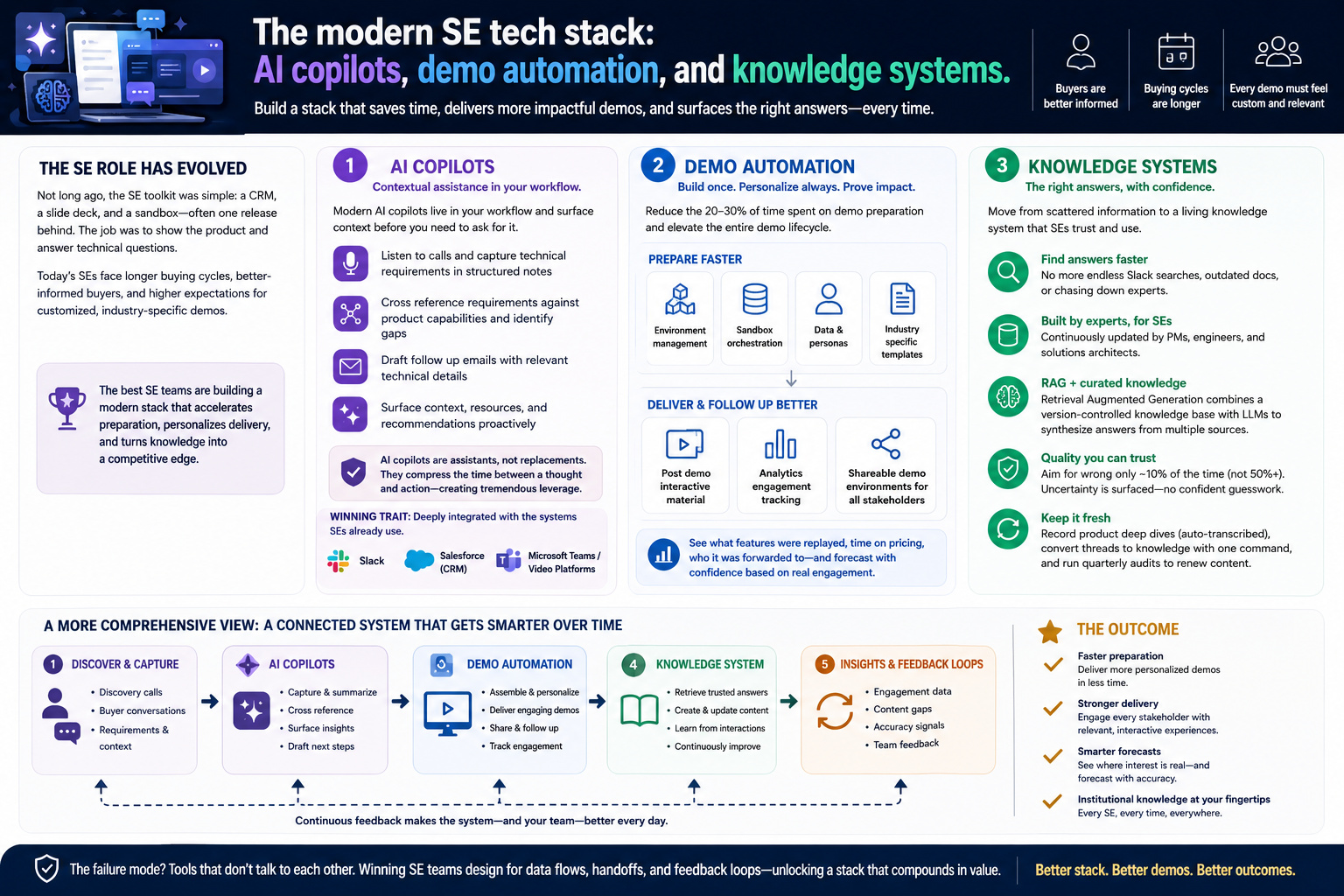
Sales engineers are living in a golden era of options that provides an impressive array of productivity routes. To not surprise, it also may create cognitive overload. Here’s how many of the best SE teams we work with are building a stack that works.
Not long ago, a sales engineer’s toolkit was relatively simple. Utilize the CRM at hand for for logging activity, a dogeared slide deck, and a sandbox environment that was seemingly always one release behind. The job was to show the product, answer pertinent technical questions, and do this in a manner that was cohesive with the AE or executive also involved in the process.
Today’s SE’s face a host of unique challenges where buying cycles are longer, purchasers are better informed, and every prospect expects a demo that feels custom built for their industry, their use case, and their particular environment. The solutions at hand have caught up to a certain degree.
AI copilots
The first wave of AI in the SE workflow primarily revolved around search. The current iteration is essentially assistance within the periphery. AI that lives inside your workflow and surfaces context before you need to ask for it.
Modern AI copilots for SEs do several things at once. They listen to discovery calls and pull technical requirements into structured notes, cross reference those requirements against known product capabilities and open feature gaps, draft follow up emails with relevant technical details, and surface context before you need to ask for it.
This certainly doesn’t imply that judgment has been replaced nor will it be any time soon. The ability to speed up the time between having a thought and acting on it, however. has produced superb leverage in an array of fields.
The assistants that are actually changing SE behavior seem to share a primary trait. Namely, they’re deeply integrated with the systems of record they already use. The offerings winning adoption live inside Slack, the CRM, and within the video conferencing platform.
Demo automation
According to an admittedly non-scientific canvassing of the group, the average sales engineer spends about 20–30% of their time on demo preparation. Not ideal…
Demo automation platforms address this problem from multiple angles including the ability to create a library of modular demo flows that can be assembled and personalized in minutes rather than hours. Beyond preparation, these tools are transforming the post demo experience via shareable, interactive demo environments for stakeholders who weren’t on the call.
Environment management
Sandbox orchestration
Data and personas
Industry specific templates
Post demo
Interactive material
Analytics
Engagement tracking
The analytics layer is often underappreciated, particularly given that when strong materials are left behind you can see which features they replayed, how long they spent on the pricing section, and who it may have been forwarded to. SE’s who are structuring their demos in this manner feel that latter stage forecasting accuracy is improved because they can see where stakeholder interest is actually concentrating.
Knowledge systems
A sales engineer will often find answers to difficult technical questions in a very similar fashion. Slack searches, a colleague’s reply, a call with a product manager, or perhaps a paper that was last updated numerous months ago.
The teams finding solutions for this issue have built a knowledge system that is continuously updated by the people who create the information itself (product managers, engineers, solutions architects) and found through interfaces SE’s actually tend to use.
The goal certainly isn’t a perfect knowledge base. Rather, a structure that’s wrong only say 10% of the time instead of 50+%. Most importantly, you’ll know if there’s uncertainty in the data rather than a confident regurgitation of stale information.
The emerging standard seems to be one of retrieval augmented generation that combines a curated, version controlled knowledge base with a large language model that can synthesize answers from multiple source documents. Clearly these systems are only as good as what goes into them thus the SE teams making this an effective method of production are recording product deep dives and auto transcribing them, converting conversation threads into knowledge articles with a single command, and running quarterly audits where outdated content is flagged and assigned for renewal.
A more comprehensive view
The failure mode for SE technical stacks revolves around tools that don’t effectively talk to each other. The SE’s and SE leaders who are ahead of the curve are thinking about their solutions structure in a manner that maintains explicit attention to data flows, handoffs between tools, and feedback loops that make the whole system more capable over time. Preparation is faster, delivery is more personalized, and the institutional knowledge of your entire team is available to every SE at the moment they need it.