What’s Changed With the Executive Job Search Over the Past 5 Years?
What’s Changed With the Executive Job Search Over the Past 5 Years?
The general approach previously utilized has undergone a number of changes for senior leaders seeking a new role
There used to be a fair amount of predictability with a leadership position if you properly cultivated relationships. Your reputation was known, and when it was time to ponder a move a few well placed calls peers would set things in motion.
That has changed so dramatically that executives who rely on the old approach risk being left behind.
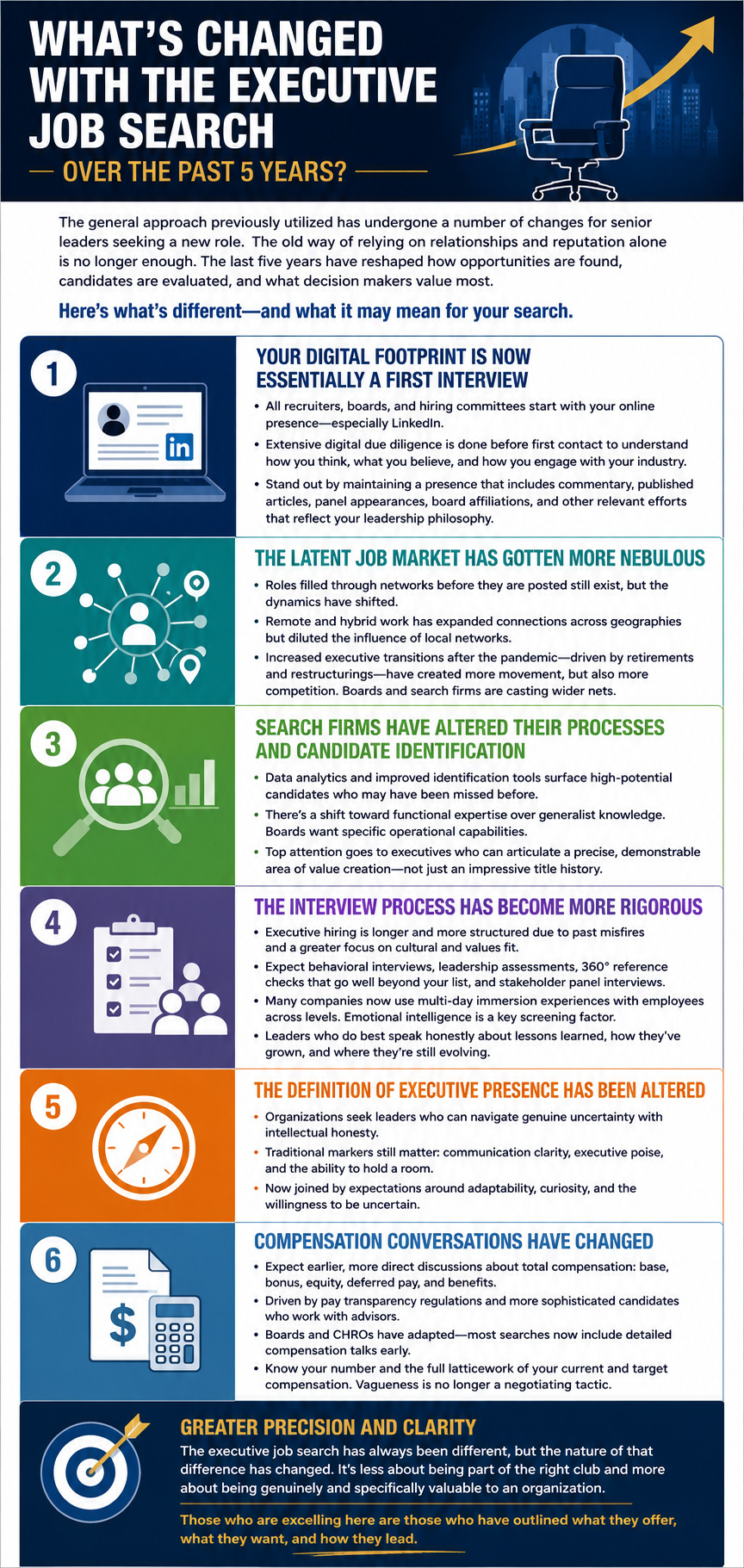
The last five years have reshaped how senior leaders find opportunities, how companies vet candidates, and what decision makers actually value at the top of the structure. Here’s what’s different and what it may mean for a search.
1. Your digital footprint is now essentially a first interview
All recruiters, board members, and hiring committees are certain to start with an examination of your profiles – particularly Linkedin. Extensive digital due diligence is conducted prior to making first contact to understand how you think, what you believe, and whether your stated expertise matches how you engage with your industry.
The executives who stand out today are those who maintain a presence that includes commentary, published articles, panel appearances, board affiliations, and other pertinent efforts that allows someone to have a basic understanding of your leadership philosophy.
2. The latent job market has gotten more nebulous
Roles filled through networks before they are ever posted has always existed at the senior level, but the dynamics of this activity have shifted considerably.
Remote and hybrid work has diffused professional associations in ways that simultaneously expand and dilute them. You may now have meaningful relationships with peers in an array of locations, but some of the inherent influence is lost due to the dilution of geographic density that made local networks relatively powerful.
At the same time, the volume of executive transitions has increased after the pandemic. An array of movement including early retirements and corporate restructurings have created more instability at the senior level, but also more competition for the best roles. Boards and search firms are casting wider nets.
3. Search firms have altered their processes and candidate identification
Improved means of candidate identification along with data analytics to surface candidates that may have been missed have provided individuals with the opportunity to reach shortlists that may not have been viable via traditional routes.
There’s also been a tangible shift toward functional expertise over generalist knowledge at the senior level. More focus has been placed on specific operational capabilities. The executives getting the most attention are those who can articulate a precise, demonstrable area of value creation, not just an impressive title history.
4. The interview process has become more rigorous
Executive hiring processes have grown longer and more structured over the past five years, driven partly by high profile misfires, but also by a genuine shift in how boards think about cultural and values fit.
Behavioral interviewing techniques have migrated to the C-suite. Structured leadership assessments, 360 style reference checks that go well beyond your provided list, and stakeholder panel interviews are now standard at many organizations. Some companies have introduced multi day immersion experiences where finalists meet broad groups of employees across levels. This would have been unusual to say the least only a few years ago. The obligatory emotional intelligence factor has also gained greater screening value.
The executives who tend to do best in this environment are those who can speak honestly about what they’ve learned from missteps, how they’ve changed as leaders, and where they are still seeking growth.
5. The definition of executive presence has been altered
Organizations have made it clear that they are seeking leaders who can effectively navigate genuine uncertainty. Intellectual honesty is an asset rather than a liability.
This doesn’t imply that the traditional markers of executive presence no longer matter. Communication clarity, executive poise, and the ability to hold a room still count. But they’ve been joined by a set of expectations around adaptability, curiosity, and the willingness to be uncertain.
6. Compensation conversations have changed
Both sides of the table now expect earlier, more direct talks about total compensation architecture including base, bonus, equity structure, deferred payment, and benefits in order to ensure alignment before significant time is invested in the process.
This has been driven somewhat by pay transparency regulations in several major markets and partly by an increased sophistication among executive candidates, many of whom now work with advisors who help them evaluate complex compensation structures. Boards and CHROs have generally adapted, and most search processes now include detailed discussions early in the process.
The best approach here is to know your number and the full latticework of your current and target compensation before you’re in conversations. Vagueness is no longer a primary negotiating tactic.
Greater precision and clarity
The executive job search has always been different from the rest of the market, but the nature of that difference has changed. It’s less about being part of the right club and more about being genuinely and specifically valuable to an organization.
Those who are excelling here are those who have outlined what they offer, what they want, and how they lead.