
The Evolving Role of the Chief Product Officer
The Evolving Role of the Chief Product Officer
The CPO position has become one of the most consequential roles in the modern enterprise.
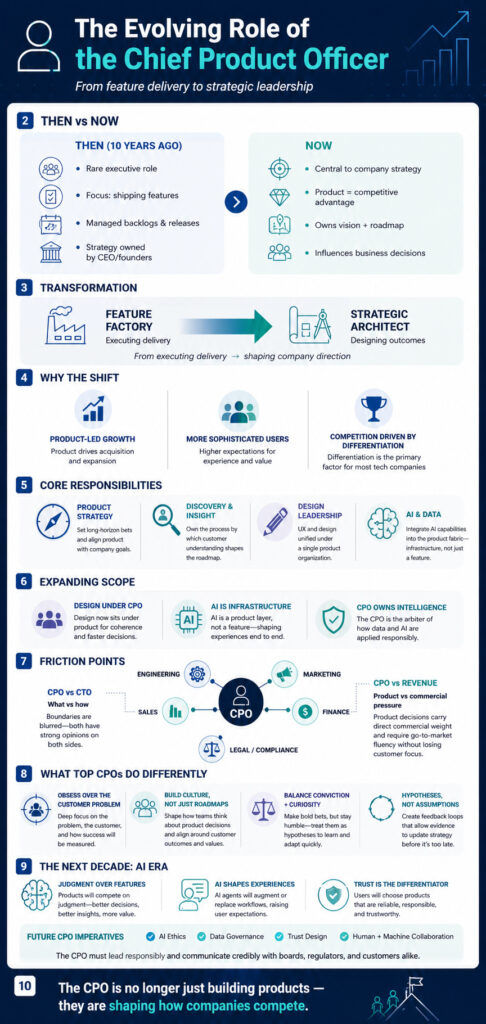
10 years ago, the Chief Product Officer was a somewhat rare individual to find in a corporate structure. Product decisions were largely brokered between engineering leads and the CEO while product management acted as a middle layer between business requirements and sprint cycles. Today, the CPO often sits at the center of company strategy, or at least that’s often the primary goal. What’s actually happening in practice is considerably more nuanced.
The job has expanded dramatically in scope, influence, and expectation over the years, and it has also become more contested, more ambiguous, and, when it doesn’t work properly, more visibly prone to failure than almost any other CXO slot.
From feature factory to strategic architect
The earliest CPOs were, in many ways, product managers with a loftier title. Their primary mandate was getting things shipped thus managing backlogs, coordinating releases, and aligning stakeholders around delivery timelines. The work was important, but it was primarily operational in nature. The strategy happened in board rooms and founder conversations.
That model has fundamentally changed. The modern CPO is expected to hold a vision for where the product is going numerous years ahead while simultaneously making highly informed decisions about what goes out in the short term. They must translate business outcomes into product bets, and product learning into business strategy. The flow of influence now runs in both directions.
This shift was driven by a convergence of the rise of product led growth as a go to market model, the increasing sophistication of software consumers, and the competitive reality that differentiation is now the primary distinguishing factor for most technology companies. When your product is your competitive advantage, the person stewarding that output tends to garner a seat at the strategy table.
The new responsibilities landscape
What does a contemporary CPO actually own at this point? This depends on the company and the organizational approach they have chosen. Certain themes have emerged, however, that are consistent across the landscape.
• Product strategy Setting long-horizon bets and translating company goals into a precise direction.
• Discovery and insight Owning the process by which customer understanding shapes the product roadmap.
• Design leadership CPOs are increasingly absorbing UX and design under a unified product organization.
• AI and data Integrating AI capabilities into the product fabric not only as a feature, but as part of the infrastructure itself.
The absorption of design into the product function is particularly notable. Many organizations have collapsed the Chief Design Officer role (or never created one) and simply choose instead to put design under the CPO’s purview. The argument is one of coherence as when product and design report to the same leader, decisions about what to build and how it should be perceived can be made in unison rather than drawn out negotiations.
The relationship with data and AI has similarly transformed the role. CPOs who once delegated analytics to data science teams are now expected to be literate (and often fluent) in how data informs product decisions, how machine learning models get embedded into user experiences, and how AI driven personalization gets governed responsibly. As AI becomes a product layer rather than a product feature, the CPO becomes the primary arbiter of how it’s utilized.
Difficulties at the top
With expanded scope comes additional friction. The CPO role, more than perhaps any other in the C-suite, sits at the intersection of nearly every other function within the company including engineering, marketing, sales, finance, and increasingly legal/compliance.
The most persistent source of friction is the CPO/CTO relationship. In the healthiest organizations, these two roles are genuinely complementary as the CPO defines what is worth building and for whom while the CTO determines how it gets constructed and at what quality and scale. However, the boundary between the two is frequently nebulous, and both leaders often have strong opinions on both sides.
There’s also the question of the CPO’s relationship with the revenue side. In product led growth companies where the wares drive acquisition and expansion, the CPO is often the effective revenue leader working with the Chief Revenue Officer. This creates a dynamic where product decisions carry direct commercial weight, and the CPO must become fluent in go to market thinking without losing the customer focused instincts that define great product work.
What the best CPOs are doing differently
Certain patterns have emerged. These individuals are almost universally are highly focused on the problem being solved, who the customer is, and how success will be measured.
They also invest heavily in building culture. The insight here is that roadmaps and rituals are insufficient if the underlying values of the organization aren’t aligned around customer outcomes. The most effective CPOs spend as much time shaping how people think about product decisions as they do making those decisions themselves.
Perhaps most importantly, the best CPOs have learned to hold conviction and curiosity simultaneously. They are decisive enough to cut through ambiguity and make bets, but humble enough to treat those tempered risks as hypotheses that create feedback loops allowing evidence update strategy before it’s too late to change course.
AI and the next reinvention
If the past decade was about the CPO stepping up from operational manager to strategic leader, the next 10 years may see the CPO emerge as the primary steward of how AI changes the relationship between companies and their customers.
This is essentially about navigating a transition in which AI agents begin to substitute for, or augment, human workflows in ways that fundamentally alter user expectations. Products that once competed on features will compete on judgment where the winners will provide AI that makes better decisions, surfaces better insights, and earns more trust. The CPO will be at the center of those choices.
That means the CPO of the future will need to be as comfortable with questions of AI ethics, data governance, and trust design as they are with traditional product craft. They’ll need to hold a point of view on what responsible AI deployment looks like in their domain, and communicate that view credibly to boards, regulators, and customers alike.