
Rethinking Quotas: How AI Changes the Math on Territory Planning and Representative Productivity
Rethinking Quotas: How AI Changes the Math on Territory Planning and Representative Productivity
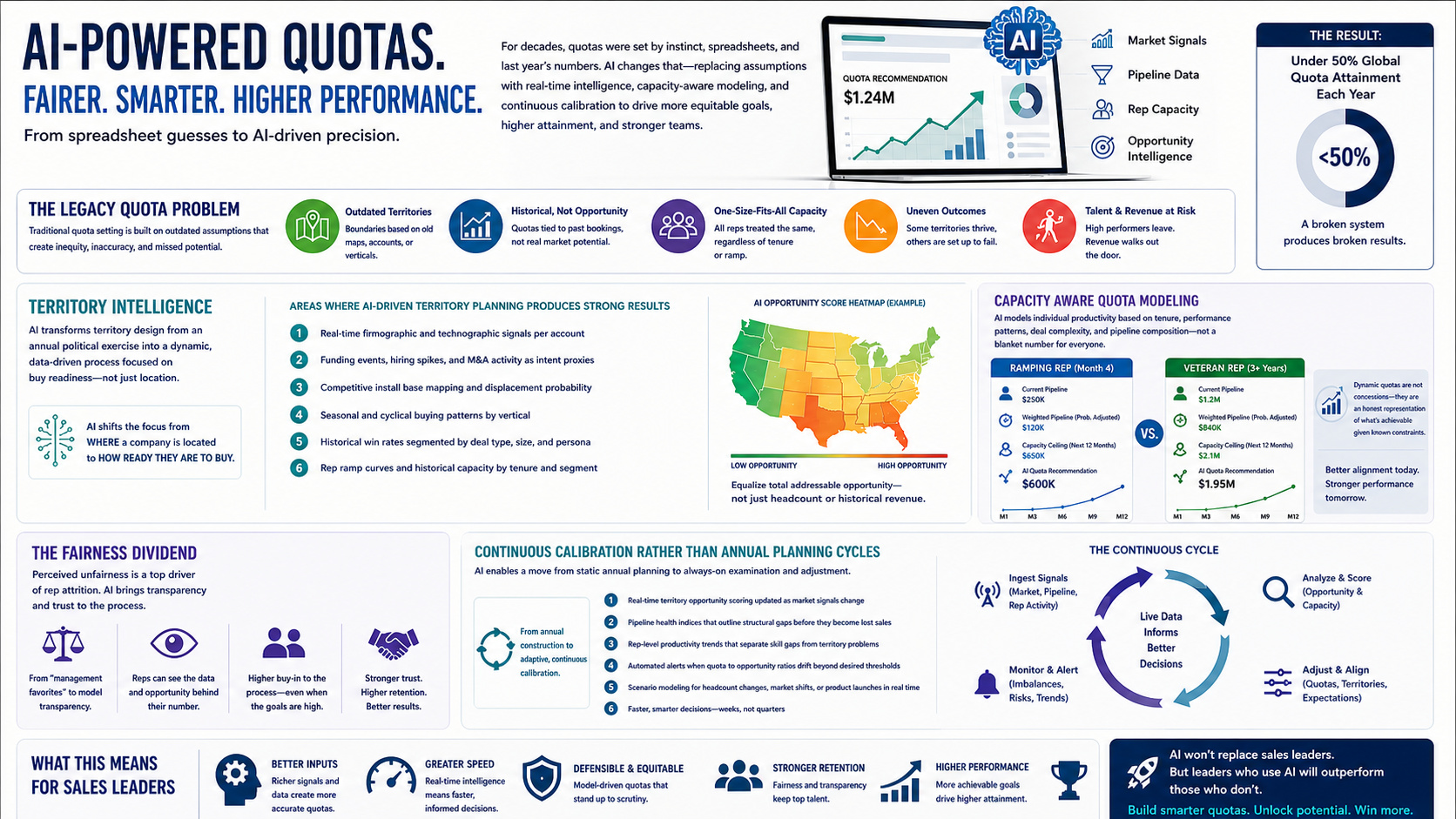
For decades, sales quotas have been set by instinct, spreadsheets, and last year’s numbers. AI is rapidly changing this approach.
Every year, in conference rooms and video calls across the country, sales leaders perform a very familiar ritual. Last year’s numbers are gathered and a growth percentage is tacked on that will presumably satisfy the board. This is then divide it by the number of reps in the organization and a quota number is reached. Then they often spend the next twelve months explaining why gut feeling and intuition aren’t leading to expected production.
The inherent limitations of working with incomplete data, flawed territory maps, and a fundamental misunderstanding of what individual reps are actually capable of lead to an array of that contribute greatly to a global quota attainment mark of less than 50% in any given year. AI is beginning to restructure each of those limitations a model driven approach that is already producing results.
The Legacy Quota Problem
Traditional quota setting suffers from a handful of structural flaws that inevitably compound each other. Territories are drawn by geography, named account lists, or industry verticals that were defined years ago, often before a company’s ideal customer profile shifted.
Quotas are calibrated to historical bookings in those territories rather than to actual market opportunity. Sales executive capacity is often treated as a constant often with the misguided thought that veteran enterprise sellers and a newly ramped mid-market reps are interchangeable units of output.
The result is a system that is simultaneously inequitable and inaccurate. High potential territories are provided with a lack of proper resources. Reps in saturated or declining regions are essentially set up to fail. Top performers hit their number easily while underperformers churn before leadership has a full understanding of why this occurred. As a result, the organization unnecessarily sheds both talent and revenue, and the resulting examination of performance almost always misses the primary causes.
Territory Intelligence
The first place where AI is making a tangible difference is in territory design. Modern artificial intelligence driven revenue platforms can ingest firmographic data, technographic signals, hiring velocity, funding rounds, contract renewal windows, site visits, executive hires, social sentiment, and competitive displacement indicators to produce a real-time opportunity score for every account in a given market. This transforms territory design from an annual exercise in political negotiation into a dynamic, data grounded process. Instead of drawing boundaries on a map, AI systems can recommend territory compositions that equalize total addressable opportunity, not just headcount or historical revenue. The result is a set of boundaries that are far more comparable in upside which means quotas set against them are more equitable and achievable across the board.
AI has shifted the focus from where a company is located to how ready they are to buy. By analyzing millions of these intent signals the models identify an effective density that can be very effectively employed.
Areas where AI driven territory planning produce strong results
Real-time firmographic and technographic signals per account
Funding events, hiring spikes, and M&A activity as intent proxies
Competitive install base mapping and displacement probability
Seasonal and cyclical buying patterns by vertical
Historical win rates segmented by deal type, size, and persona
Rep ramp curves and historical capacity by tenure and segment
Capacity Aware Quota Modeling
This is where AI departs most sharply from the spreadsheet approach. Rather than applying a blanket number to every representative in a given segment, AI models can generate individual productivity projections based on tenure, historical performance patterns, deal complexity, and even the composition of their current pipeline. A person in month four of their ramp up period has a fundamentally different capacity ceiling than a three-year veteran. Taking another approach sets both of them up for a distorted performance review.
Some AI powered platforms now go further by modeling the expected contribution of the pipeline as it’s in motion. If a rep is carrying a $400K deal that has a 70% close probability in the next 45 days, their forward quota attainment curve looks very different from an AE with an empty top of the funnel and six months of potential runway. Dynamic quota models can adjust expectations in a manner that are not concessions to underperformers, but as a more honest representation of what’s achievable given known constraints.
The Fairness Dividend
There certainly is a retention argument residing inside all of this math. One of the leading drivers of voluntary attrition among high performing reps is the perception of unfair quota assignment. When top performers are rewarded for hitting a perceptibly high goal by receiving an even more aggressive number the following year, the signal they receive is that excellence is essentially penalized, particularly if others seem to be coasting in greener territories.
AI driven quota equity doesn’t solve this entirely of course, but it does shift the conversation from a view that may be perceived as management playing favorites to one that provides a model’s output and shows the data behind it. That type of transparency can in and of itself be a viable retention tool. AE’s who understand how their number was set (and who can see the opportunity surface underneath it) are more apt to buy into the process, even when the number is seemingly high.
Continuous Calibration Rather Than Annual Planning Cycles
Perhaps the most profound shift AI enables is the move from annual quota setting to continuous examination. Traditional planning cycles operate on a fiscal year cadence where quotas are locked, territories are frozen, and any misalignment discovered during the year has to wait until the final month to be corrected. By then, the damage may already be beyond repair.
AI systems that continuously ingest market signals, pipeline data, and rep activity can flag territory imbalances and quota misalignment nearly in real time. A market disruption such as competitor’s product launch or a funding drought in a key vertical can now be factored into productivity expectations within weeks rather than quarters. This doesn’t imply that quotas become a moving target that demoralizes reps. It simply means the inputs to the model are live so leaders can make informed decisions about when intervention is warranted.
From annual construction to adaptive that employs continuous calibration
Real-time territory opportunity scoring updated as market signals change
Pipeline health indices that outline structural gaps before they become lost sales
Rep-level productivity trends that separate skill gaps from territory problems
Automated alerts when quota to opportunity ratios drift beyond desired thresholds
Scenario modeling for headcount changes, market shifts, or product launches in real time
What This Means for Sales Leaders
None of this makes quota setting easy. The model still requires human judgment at every stage of the process and effective determination regarding which signals matter, how to weight historical data against forward looking intent, and the best way to balance organizational goals against individual rep benefit AI changes the inputs and the speed of the process, but it does not eliminate the need for leaders who understand both the computations involved and the people themselves.
What this approach ideally does eliminate is the excuse that the data wasn’t there nor utilized. For the first time in enterprise sales history, the signal density exists to build quotas that are empirically grounded, continuously updated, and defensible at the individual level. Organizations that build that capability now will have a structural advantage in both performance and retention over those still running a spreadsheet driven environment.