
How Usage Based Pricing Is Rewriting Sales Engineering Strategy
How Usage Based Pricing Is Rewriting Sales Engineering Strategy
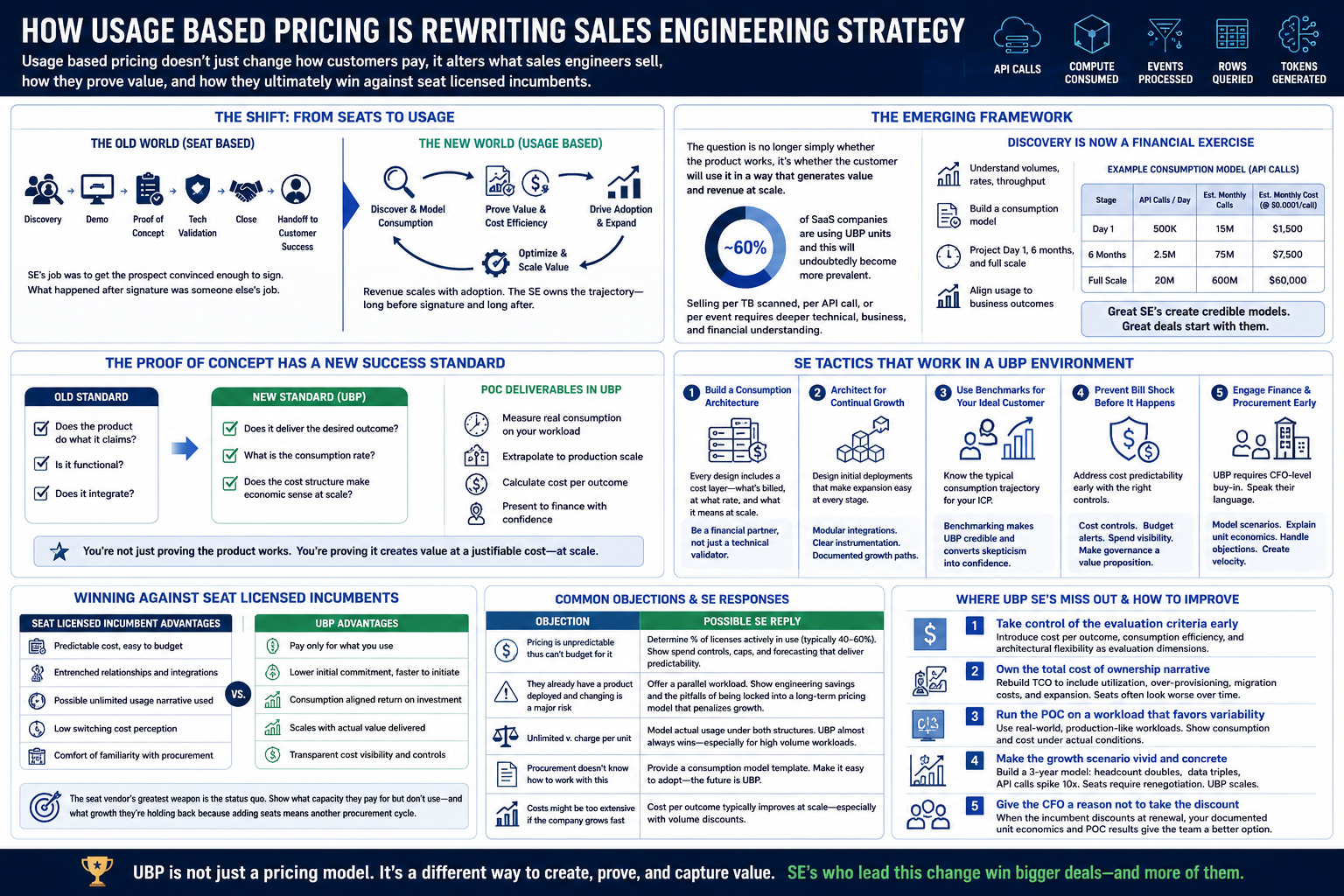
Usage based pricing doesn’t just change how customers pay, it alters what sales engineers sell, how they prove value, and how they ultimately win against seat licensed incumbents.
For most of the last two decades, high technology sales ran on a fairly simple construct: quote a seat count, negotiate a discount, close what will hopefully be a multi-year deal, and relay the account to customer success. The SE’s job was to get the prospect convinced enough to sign, and what occurred after signature was largely the responsibility of other departments in the organization.
UBP (customers pay for API calls, compute consumed, events processed, rows queried, or tokens generated) has made that model often untenable at best. When revenue scales with actual consumption rather than contracted seats, the trajectory of an account is no longer at signature, but at adoption. This stage of the process is often shaped by decisions the SE makes long before the agreement is finalized. For sales engineers operating in cloud infrastructure, data platforms, AI/ML production, developer tools, and observability, this is a fundamental reorientation of the role.
The framework of the emerging model
Traditional SaaS pricing created a predictable structure for SE engagement that utilized a general pattern of discovery, demo, proof of concept, technical validation, and close. Each stage had clear inputs and outputs where the product worked or did not, and once that bar was cleared the SE’s primary contribution was essentially complete.
Usage based pricing radically changes this approach. The question is no longer simply whether the product works, it’s also whether or not the customer will use it in a way that generates value and revenue at scale. This requires a fundamentally different kind of SE engagement as about 60% of SaaS companies are using UBP units and this will undoubtedly become more prevalent.
An SE selling a per seat BI tool needs to prove the product is functional, intuitive, and integrates with the customer’s current data stack, while another talking with a cloud data warehouse billed per TB scanned needs to anticipate query patterns, help design cost efficient schemas, understand the customer’s growth trajectory, and frame the entire commercial story around cost per action. The technical depth required is simply greater.
Discovery is now often a financial exercise
In a seat based realm, the initial process is often about use case and stakeholder mapping. UBP, on the other hand, requires that discovery generates a credible consumption model. Given this, an effective SE needs to understand data volumes, event rates, transaction throughput, or inference request patterns (whatever the billing metric is) and build a sketch of what the usage structure looks like at Day 1, 6 months, and full production scale.
This obviously changes the approach to producing a discovery template considerably. We’re working with a host of companies who have made this shift seemingly with only months of strategizing, and it’s now essential to know what a current pipeline throughput may look like, how many active users generate transactions versus passive consumers, and what their projected growth rate is for workloads they may be migrating? The SE who can produce a finely constructed model template of this type is well ahead of their peers.
The proof of concept has a new success standard
The traditional POC benchmark simply asks does the product do what is claimed by the company? In a UBP context, that bar is certainly necessary but not sufficient. The proof now needs to answer at what cost structure success will be defined and does that structure make economic sense at scale.
Given this, SE helmed POC’s in UBP environments need to be prepared differently. It’s no longer enough to show that the product processes customer data correctly. You need to demonstrate consumption rate during that processing, extrapolate this to production volumes, and present a credible cost per outcome figure that the customer’s finance team can readily utilize.
SE Tactics That Work in a UBP Environment
Build a consumption architecture rather than simply a solution construct
Every technical design that’s presented should include an explicit cost layer that outlines which operations are billed, at what rate, and what does the customer’s design pattern mean for their bill at scale. This reframes you as a financial partner as opposed to simply a technical validator.
Initiate an approach that promotes continual growth at each stage
UBP deals often start small by design which implies that the SE’s job is to architect the initial deployment in a way that makes expansion a readily achievable goal at each stage. This may include modular integrations, clear instrumentation, and documented growth paths.
Develop usage benchmarks for your ideal customer profile
If you’re selling to fintech companies, for example, you should have a good idea of what a typical consumption trajectory looks like on your platform. Benchmarking data from comparable customers transforms an abstract pricing model into a credible reference point.
Proactively address bill shock before it becomes an objection
One of the most common late stage issues in UBP deals is cost unpredictability. Get ahead of it by outlining cost controls, budget alerts, and spend visibility features. Make governance part of the value proposition from the inception of the process.
Engage finance and procurement earlier than usual
UBP deals generally require CFO level buy in in a manner that seat licenses rarely do. The SE who can speak credibly to a financial audience while modeling consumption scenarios, explaining cost per outcome economics, and handling operations objections will create deal velocity that a purely technical SE may have difficulty achieving.
The Post-Sale SE revamped
Perhaps the most structurally significant shift UBP creates for SE organizations is the erosion of the often distinct line between pre-sale and post-sale. When revenue grows with consumption, the activities that drive this type of collection (onboarding quality, integration depth, and architectural guidance during initial deployment) are directly activities of the commercial type, not just customer success refinements.
Leading SE organizations are experimenting with models where the engineers involved retain ownership through the first production deployment rather than just through signature. The companies navigating approach with success have made explicit decisions about where SE involvement post close creates enough commercial leverage to justify the investment and where strong documentation and CSM enablement can be implemented as a substitute.
Winning as a UBP vendor against seat based incumbents
Where to begin when the renewal is typically automatic unless something breaks, particularly when you are asking a buyer to introduce cost variability, re-train their team, and absorb a good deal of migration risk for a model they may not fully understand. Seat licensed competitors will certainly exploit every one of those possible roadblocks thus an SE who goes attempts displacement without a deliberate counter strategy will invariably lose deals that more than likely should have been completed.
|
Seat Licensed Incumbent Advantages |
UBP Advantages |
|---|---|
|
Predictable cost, easy to budget |
Pay only for what you use |
|
Entrenched relationships and integrations |
Lower initial commitment, faster to initiate |
|
Possible unlimited usage narrative used |
Consumption aligned return on investment |
|
Low switching cost perception |
Scales with actual value delivered |
|
Comfort of familiarity with procurement |
Transparent cost visibility and controls |
The seat licensed competitor’s greatest weapon is the status quo. The SE’s job is to effectively outline what capacity the customer is paying for that they never use and what growth they may be curtailing because adding seats requires a new procurement cycle.
The unlimited narrative that seat vendors use is particularly worth addressing from a technical standpoint. When a competitor claims no ceiling on usage, the SE needs to introduce questions of precision as seat based “unlimited” is almost always bounded by certain factors. Compute contention, rate limits, support tier, or contract fine print all can be reworked by a strong SE to outline to inherent boundaries of the older approach.
Objections and responses we are seeing in various organizations
These are the objections that we hear are coming up in nearly every competitive displacement opportunity against a seat licensing vendor.
|
Objection |
Possible SE Reply |
|---|---|
|
Pricing is unpredictable thus can’t budget for it |
Determine what percentage of their current licenses are actively in use. You’ll find that this number is about 40-60% in most organizations. Outline spend controls and cap features that emphasize the predictability you can offer. |
|
They already have a product deployed and changing is a major risk |
Offer to deploy a parallel workload to show the difference in engineering hours and outline the pitfalls of being locked into a long-term pricing model that penalizes growth at what might be the worst possible time. |
|
Unlimited v. charge per unit |
Model actual usage against each pricing structure. UBP will almost always come out ahead, particularly for those in high volume structures. |
|
The procurement team doesn’t know how to work with other offerings |
Frame a consumption model template as one that is readily assimilated and will be necessary to be fluent in as many products seek the UBP path. |
|
Costs might be too extensive if the company experiences rapid growth |
Cost per outcome will typically contract at scale thus ultimately resulting in greater efficiency – particularly when volume discounts come into play. |
Where UBP SE’s miss out on deals and how to improve.
The most common reason a UBP product misses the mark isn’t due to price nor features. The following approaches have proven to be effective:
Take control of the evaluation criteria early in the process
Get to the evaluation framework prior to the incumbent whenever possible. Introduce cost per outcome, consumption efficiency, and architectural flexibility as evaluation dimensions alongside features as a scorecard the customer builds with your help will naturally reflect what UBP does well.
Own the cost of ownership narrative
Rebuild TCO to include utilization rate, over provisioning costs, migration and integration overhead, and expansion possibilities. A seat licensed product that looks cheaper on unit cost frequently looks worse after a detailed TCO has been constructed.
Run the POC on a workload that favors variability
If you’re selling to fintech companies, for example, you should have a good idea of what a typical consumption trajectory looks like on your platform. Benchmarking data from comparable customers transforms an abstract pricing model into a credible reference point.
Make the growth scenario vivid and concrete
Build a three year model that shows what happens to cost under the incumbent’s structure when headcount doubles, data volumes triple, or API call rates spike 10 by multiple factors. Most seat based contracts require renegotiation at each growth stage. UBP scales automatically.
The seat licensed vendor’s renewal team will more than likely show up with a discount. When they do, the customer needs a reason not to simply take it out of habit. The SE who built the consumption model, ran the POC on production fashioned workloads, and documented the unit economics gave the team something very viable to put in front of their CFO.