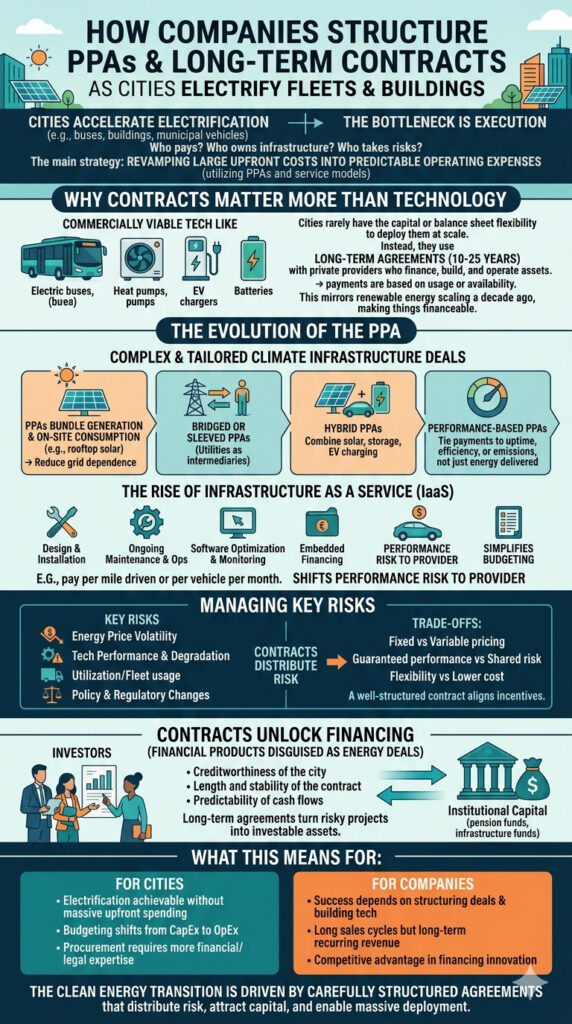
How companies are structuring PPAs and long‑term contracts as cities electrify fleets and buildings
How companies are structuring PPAs and long‑term contracts as cities electrify fleets and buildings
As cities accelerate electrification by transitioning bus fleets, municipal vehicles, and buildings away from fossil fuels, the bottleneck is now one of execution
As this large paradigm shift takes place, the primary questions revolve around who pays for the services, who owns the infrastructure, and who ultimately takes the risks involved. Relevant entities are increasingly utilizing long-term contracts (especially power purchase agreements) and service type models that revamp large upfront infrastructure costs into relatively predictable operating expenses.
Why contracts matter more than technology
Electric buses, heat pumps, EV chargers, and battery storage are all commercially viable today, but cities rarely have the capital or balance sheet flexibility to deploy them at scale. Instead of buying infrastructure outright, municipalities are entering into long-term agreements with private providers who finance, build, and operate the assets. The city agrees to pay over a period of time (often 10 to 25 years) based on usage or availability. This shift mirrors what happened in renewable energy a decade ago when solar and wind scaled not just because costs fell, but because PPAs made them far more financeable.
The evolution of the PPA
Traditional PPAs were relatively simple. A buyer agrees to purchase electricity at a fixed price over a long period, giving developers the revenue certainty needed to secure financing. Today’s climate infrastructure deals are more complex and tailored to specific requirements. These include:
• PPAs that bundle generation (like rooftop solar) with on-site consumption thus reducing grid dependence.
• Bridged or sleeved PPAs that involve utilities acting as intermediaries between developers and cities.
• Hybrid PPAs that combine solar, storage, and EV charging into a single contract.
• Performance-based PPAs tie payments to uptime, efficiency, or emissions reductions rather than just energy delivered.
The rise of infrastructure as a service
Beyond PPAs, many companies now offer full-service contracts that go further than energy supply. These agreements typically include:
• Design and installation of infrastructure.
• Ongoing maintenance and operations.
• Software for optimization and monitoring.
• Financing embedded into the contract.
Instead of buying electric buses and chargers separately, a city might pay per mile driven or per vehicle per month. This shifts performance risk to the provider and simplifies budgeting thus essentially making this the tangible product.
Key risks include:
• Energy price volatility.
• Technology performance and degradation.
• Utilization regarding how much a fleet actually runs.
• Policy and regulatory changes.
Private providers take on these risks in exchange for long-term, stable revenue. Cities gain predictability but may pay a premium compared to owning assets outright.
The negotiation of these type of contracts often comes down to trade-offs that include:
• Fixed vs. variable pricing.
• Guaranteed performance vs. shared risk.
• Flexibility vs. lower cost.
A well-structured contract aligns incentives so both sides benefit from efficiency and reliability as these documents are designed to unlock financing and ideally ensure optimum efficiency.
Lenders and investors care less about the technology and more about:
• Creditworthiness of the city.
• Length and stability of the contract.
• Predictability of cash flows.
A 20-year agreement with a municipality can turn a risky infrastructure project into an investable asset class. This is why institutional capital (pension funds, infrastructure funds) is increasingly flowing into the climate realm. Indeed, in many ways, these contracts are financial products disguised as energy deals.
What this means for cities and companies
For cities:
• Electrification becomes achievable without massive upfront spending.
• Budgeting shifts from capital expenditures to operating expenses.
• Procurement becomes more complex, requiring financial and legal expertise.
For companies:
• Success depends as much on structuring deals as on building technology.
• Long sales cycles are offset by long-term, recurring revenue.
• Competitive advantage comes from financing innovation as much as engineering and design.
The transition to clean energy in cities certainly won’t be driven by hardware alone. Rather, contracts that are carefully structured agreements that distribute risk, attract capital, and make massive deployment possible will come to the forefront. The companies that succeed won’t just build infrastructure, they’ll know how to effectively sell it.