
Restructuring the Organizational Chart: How AI Functions Are Shrinking Middle Management and Expanding Fractional Leadership
Restructuring the Organizational Chart: How AI Functions Are Shrinking Middle Management and Expanding Fractional Leadership
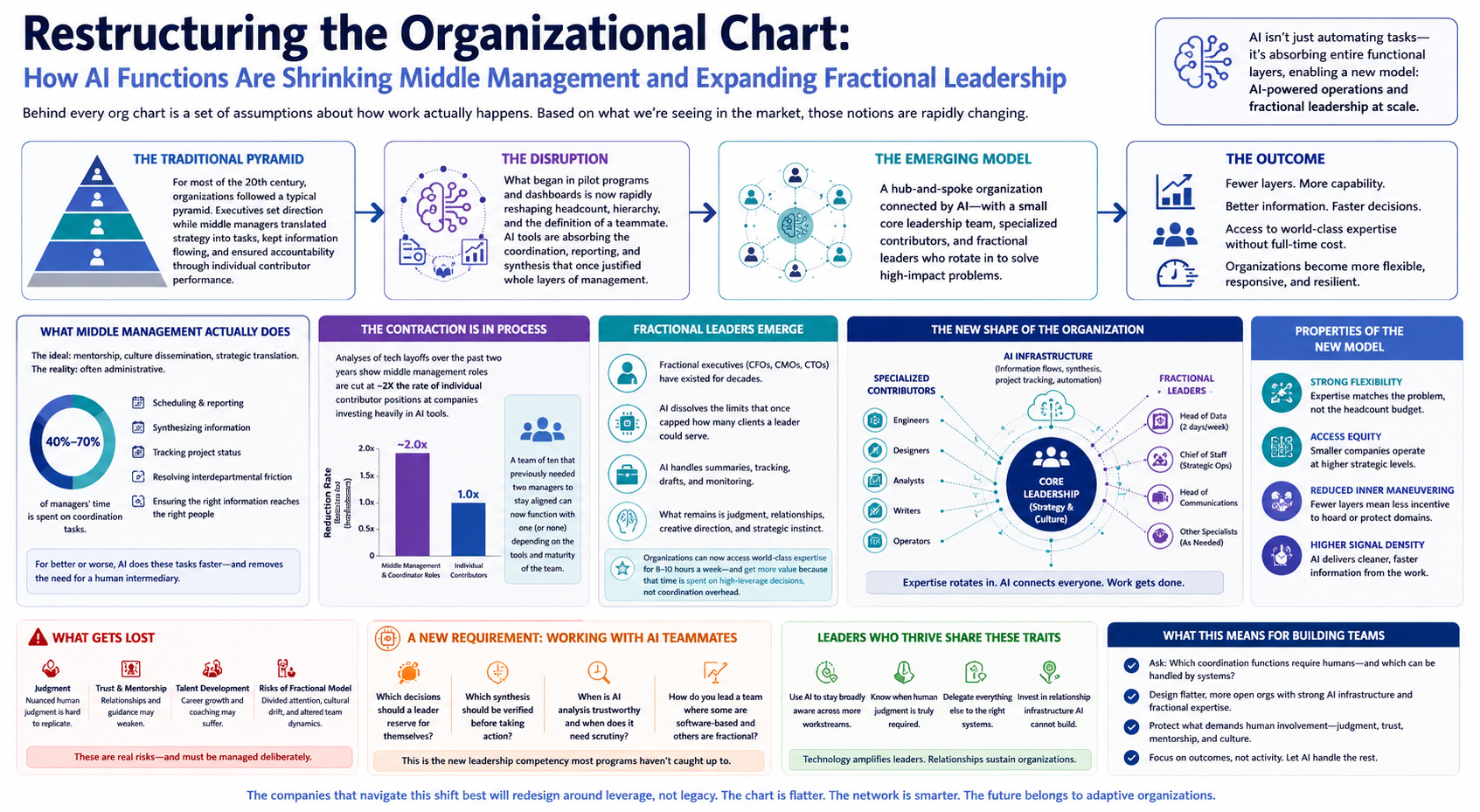
Behind every org chart is a set of assumptions about how work actually happens. Based on what we’re seeing in the market, those notions are rapidly changing.
For most of the 20th century, the organizational pyramid followed a fairly typical structure. Executives set the general direction while middle managers translated strategy into tasks, kept information flowing up and down, and ensured accountability via individual contributor performance.
We are now living through a structural disruption that subtly began in pilot programs and productivity dashboards and is rapidly reshaping how companies think about headcount, hierarchy, and the definition of a teammate. AI tools are not simply automating tasks, they are absorbing entire functional layers of the organization that justified whole tiers of management. This is leading to a new model that entails utilizing AI offerings as fractional leaders – an option that is no longer too expensive nor too scarce for organizations that couldn’t previously afford them.
What middle management actually does
Before we can understand what’s changing, it’s instructive to examine what middle management is primarily designed to handle. The idealized notion encompasses mentorship, culture dissemination, and strategic translation. A more realistic version is often geared around administrative function.
Studies have consistently shown that managers spend from 40% to 70% of their time on coordination tasks including scheduling, reporting, synthesizing information from direct reports into summaries for leadership, tracking project status, resolving interdepartmental friction, and ensuring that the right information reaches the proper individuals in a timely fashion. For better or worse, AI does some of these tasks faster and eliminates the need for a human intermediary.
The contraction is in process
We’re seeing a consistent pattern of layoffs at major tech companies over the past two years disproportionately targeting middle management. Analyses of workforce reductions at these organizations shows that those who had invested heavily in AI tools found were eliminating managerial and coordinator roles at approximately twice the rate of individual contributor positions. They’re discovering that far fewer humans are required to achieve a set of operations. A team of ten that previously needed two managers to stay aligned can now function with one (or none) depending on the sophistication of the tools and the maturity of the team.
Fractional leaders emerge
This is certainly not a new phenomenon as fractional CFOs, CMOs, and CTOs have existed for decades, often hired by smaller companies that couldn’t justify a full time C-suite salary but needed viable strategic expertise. The model worked, but it certainly had limits as a fractional executive could only serve so many clients before the cognitive load became unmanageable. The administrative overhead of getting up to speed, managing communication threads, and tracking deliverables across multiple organizations was itself a constraint on how many engagements a talented leader could sustain. AI is dissolving that limitation.
A fractional CMO equipped with AI tools can maintain deep situational awareness across four or five client organizations simultaneously. Their revamped stack handles meeting summaries, status tracking, draft reports, and competitive monitoring. What remains is judgment, relationships, creative direction, and strategic instinct.
The result is a new model of expertise where organizations that couldn’t afford a world class VP for 40 hours a week can now access that caliber of operation for 8 to 10 hours and get disproportionately more value from it because that time is spent on advanced strategic decisions rather than coordination overhead.
The new shape of the organization
The emerging structure no longer has a typical pyramid outline. Rather, it looks more like a hub and spoke model with AI as connective lattice. At the center is generally a small, senior leadership team that sets strategy and culture. Radiating outward are specialized contributors including engineers, designers, analysts, writers, and operators. Connecting them are AI systems that handle the information flows, project tracking, and synthesis that middle management previously provided.
Interspersed throughout are fractional leaders that include specialists who rotate through key problems while providing depth and perspective that a small full time team may not have been able to sustain internally. A company might retain a fractional Head of Data for two days a week, a Chief of Staff for strategic ops work, and a Head of Communications for brand critical decisions, all of whom coordinate through shared AI infrastructure.
This structure has properties that differ from traditional constructs:
• Strong flexibility: Expertise can be amended based on the problem at hand, not the headcount budget.
• Access equity: Smaller companies can operate at higher levels strategically and operationally.
• Reduced inner maneuvering: Fewer hierarchical layers generally means less incentive to hoard information or protect domains.
• Higher signal density: With AI handling information aggregation, leadership gets cleaner, faster information from the work itself.
What gets lost
Middle managers, while operating at their best, are able to things that AI still cannot. Judgment, trust, mentorship, and talent development all may suffer. The fractional model also has its own risks given divided attention inherent to the approach, cultural drift, and team dynamics that may be altered in ways yet to be fully realized.
A new requirement
There is a competency that is seemingly becoming the most important in the modern organization, and most leadership development programs have yet to catch up with it: knowing how to work with AI teammates.
This requires sound judgment applied to a new kind of collaboration. Which decisions should a leader reserve for themselves? Which synthesis should they verify before taking direct action? When is AI generated analysis trustworthy and when does it require large amounts scrutiny? How do you lead a team where some are software based and others are fractional employees?
The leaders who are thriving in this environment seem to share a few traits. They are comfortable using AI to stay broadly aware across more workstreams than was previously possible. They understand when human judgment is genuinely required and know how to properly delegate everything else. Most importantly, they have invested in the relationship infrastructure that AI cannot build for them.
What this means for building a team in the current environment
Questions will more often revolve around what coordination functions actually require humans to perform and which can be handled by systems. The chart will be flatter, more open, and place greater reliance on AI infrastructure along with fractional expertise. The companies that will navigate this best will clearly understand what demands human involvement and protect that determinedly.