
What Top Candidates Look for Beyond Salary
What Top Candidates Look for Beyond Salary
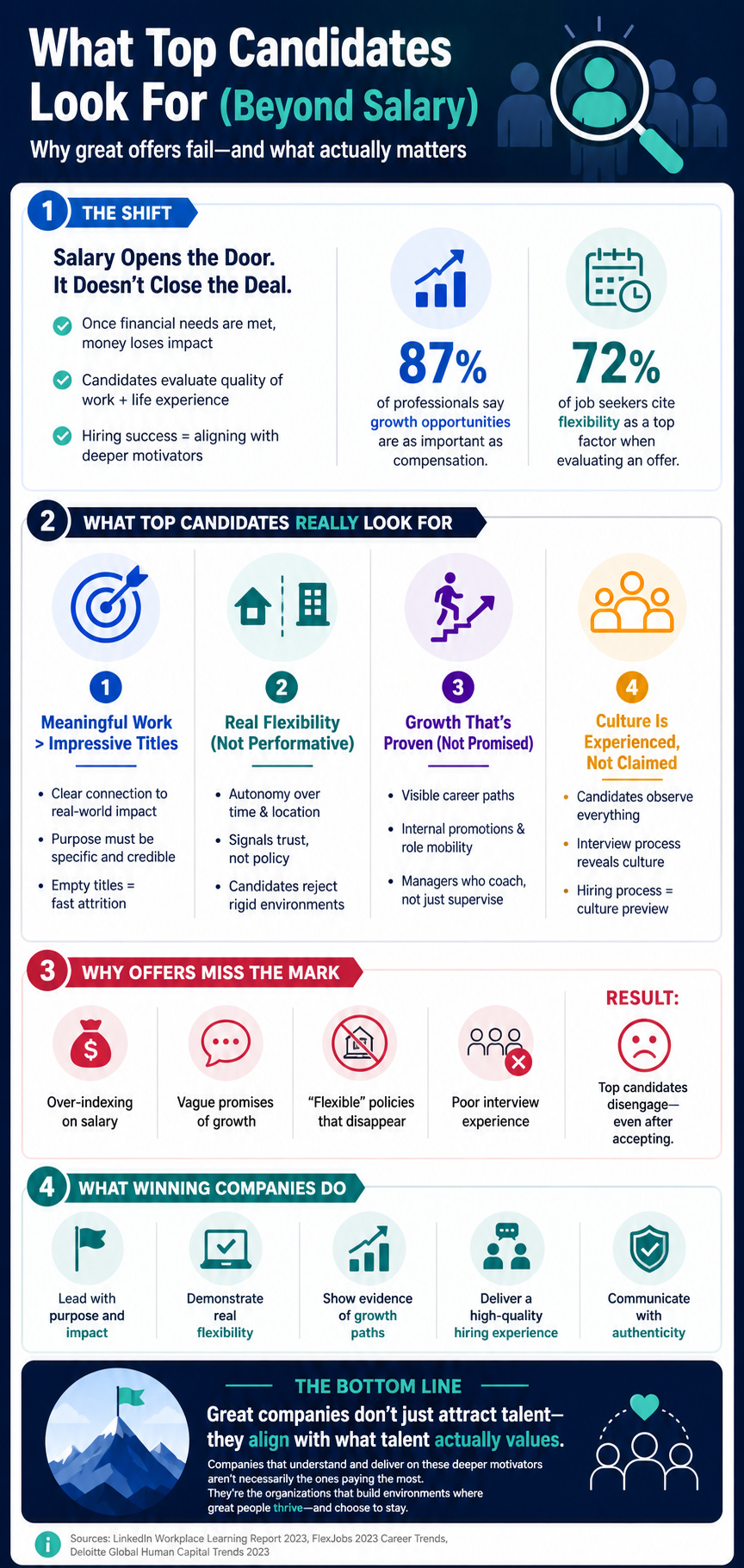
What top candidates really look for and why many job offers miss the essential items
The quest for top talent has never been based on salary alone. Today’s most sought after candidates enter conversations with a checklist that goes far deeper than compensation, and companies that fail to take it into consideration risk losing individuals who may be superb contributors.
Salary certainly matters a great deal and it’s irrational at best to think otherwise. But once candidates reach their personal financial threshold, money tends to rapidly loses its power as a differentiator. What takes over is a more nuanced calculation that incorporates meaning, autonomy, and growth.
Understanding this set of requirements as weighted by each individual is the difference between a company that attracts great people and one that merely leases them. Indeed, 87% of professionals say growth opportunities are as important as compensation while 72% of job seekers cite flexibility as a top factor when evaluating an offer.
Meaningful work over impressive titles
High performers are purpose driven and want to see a clear, credible line between their daily tasks and something that genuinely matters to customers, society, or an overall goal that incorporates more than than quarterly targets. Specifics are essential here.
Companies that communicate purpose convincingly and back it up with how they actually operate have a significant recruiting edge. Those that rely on inflated monikers as a substitute for meaningful work tend to find that their new hires start looking for an exit within a brief period.
Tangible flexibility rather than performative
The pandemic reset expectations permanently in a number of ways. Candidates who have experienced genuine autonomy regarding when and where they work are highly averse to going back to rigid five day, on-site schedules without a very compelling reason.
However, this isn’t only about remote work. It’s about trust. Top candidates evaluate whether a company’s flexibility policies signal genuine respect or whether they’re a recruitment tactic that disappears once someone is hired.
Growth that’s real rather than theoretical
Top candidates put in the requisite amount of study regarding career paths, how long people stay in similar roles, and available reviews with the specific goal of finding out whether career development is likely in the environment. They want to have a clear picture of the trajectory of people who joined before them.
The most attractive companies can point to concrete examples such as internal promotions, lateral moves that broadened someone’s expertise, and managers who actively coached their teams rather than simply supervised them.
Culture is a product rather than a simple perk
Candidates have become remarkably sophisticated at discerning which companies are employing various facades. They speak to current employees through their own networks, watch how interviewers treat staff, and notice whether the people in the room seem energized or depleted. Culture is actively transmitted through every interaction in the hiring process.
This means the recruiting experience is an overall demonstration of what working at the company actually feels like. Delayed feedback, disorganized interviews, or interviewers who seem surprised the role is open send signals that are impossible to miss.
What this means for hiring managers
The practical implication is straightforward. Start building offer conversations around these deeper motivators. Ask candidates what matters most to them and then respond honestly. Authenticity is itself a large differentiator and a company that is open in this area will earn far more trust from a senior candidate than one that claims to have solved every problem.
The companies performing well here aren’t necessarily the ones paying the most. They’re the organizations that have figured out what great people actually want and then built environments that deliver it.
Pillars beyond salary
Culture and Belonging
Psychological safety, inclusivity, and teams where people genuinely respect each other and collaborate effectively.
Manager quality
People join companies but leave managers. A strong, direct manager is a superb asset.
Health and wellbeing
Benefits that reflect genuine care include mental health support, sustainable workloads, and real boundaries.
Mission clarity
A clear, believable set of motivations that connect daily work to a larger goal.
Autonomy and ownership
The latitude to make decisions and own outcomes, not just execute instructions.
Learning infrastructure
Budget, time, and cultural permission to keep growing skills that matter.