
The Skills That Matter in the Current Age of AI Hiring
The Skills That Matter in the Current Age of AI Hiring
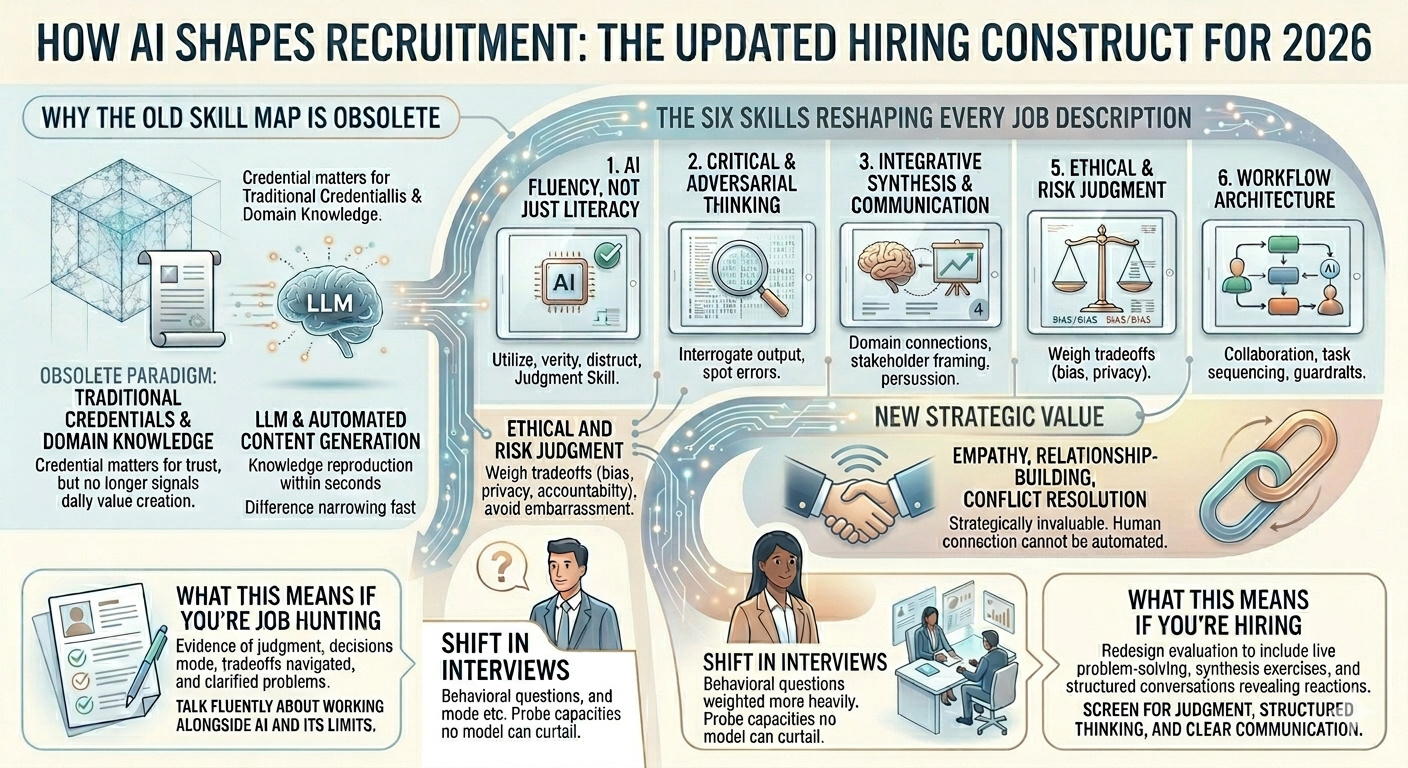
AI has changed the approach recruiters use to evaluate who will be a strong match for a given position. Here’s what the updated construct looks like.
Only a couple of years ago AI skills on a resume typically meant knowing how to write a ChatGPT prompt. Today it means something far more nuanced and often much more demanding. Across industries, hiring managers are redesigning interview questions, job descriptions, and their definitions of competence. The candidates winning roles in 2026 aren’t just technically fluent, they possess a hybrid profile that would have seemed somewhat contradictory not that long ago.
Why the old skill map is obsolete
For decades credentials and domain knowledge were reliable proxies for job performance. These credentials signaled that you had absorbed a body of knowledge through structured effort. Large language models can now reproduce the output of that absorbed knowledge in second. Certainly not with absolute perfection, but well enough that the difference between a trained professional and a capable AI is narrowing fast. The credential still matters for licensure, trust, and legal accountability, but it no longer signals what it once did about day-to-day value creation.
What does remain irreplaceable (and what employers are scrambling to assess) generally falls into six broad categories:
The six skills reshaping every job description
AI fluency, not just literacy
Knowing that AI tools exist is a minimum stake. Employers want people who know when to utilize them, when to employ distrust, and how to verify outputs. This is a essentially a judgment skill rather than a software skill.
Critical and adversarial thinking
AI systems are confident and wrong with uncomfortable regularity. The ability to interrogate output, spot plausible sounding errors, and demand evidence is now a core professional competency.
Synthesis across domains
When AI can go deep in any single area, the human edge lies in combining them to make strong connections across and array of infrastructure realms.
Communication and framing
AI generates while humans decide what to do with the output and how to present it to stakeholders who need to trust and act on it. Writing, clarity, and persuasion are invaluable.
Ethical and risk judgment
Deploying AI in any consequential context requires someone who can weigh tradeoffs including bias, privacy, accountability, and make calls that won’t embarrass the organization.
Workflow architecture
Designing the process by which humans and AI tools collaborate (sequencing tasks, setting guardrails, defining handoffs) is a new skill that high-performing teams are valuing enormously.
As AI has become more prevalent, competencies once deemed as nice to have (empathy, adaptability, relationship-building, conflict resolution) have become the most strategically valuable. AI can’t hold a difficult conversation with an unhappy client, read the room in a board meeting, and build trust with an array of individuals throughout the organization.
Hiring managers at a range of companies report a notable shift in interview emphasis. Behavioral questions are being weighted more heavily because they probe capacities that no model can curtail.
What this means if you’re job hunting
The practical implications are actionable. If your resume leads with software proficiencies and domain credentials alone it will seem somewhat outdated, even if those items are still genuinely required for the role. The modern resume needs to provide evidence of judgment, decisions made, tradeoffs navigated, and ambiguous problems properly clarified.
In interviews the candidates landing offers tend to be those who can talk fluently about how they work alongside AI and know the limits and the leverage points. They have specific stories about when an AI output misled them, what they caught, and what they did instead.
What this means if you’re hiring
The traditional interview is not fully designed to surface these skills. Companies getting this right are redesigning their evaluation processes to include live problem-solving with real ambiguity, exercises that require synthesis rather than recall, and structured conversations about past issues that reveal how someone reacts.
The instinct to screen for AI tool experience is understandable but often misguided as the landscape changes so rapidly. Judgment, structured thinking, and clear communication are what need to be at the forefront.
Renascent Solutions AI CXO/Sales/Sales Engineering Recruitment