
Do You Need a COO Yet?
Do You Need a COO Yet?
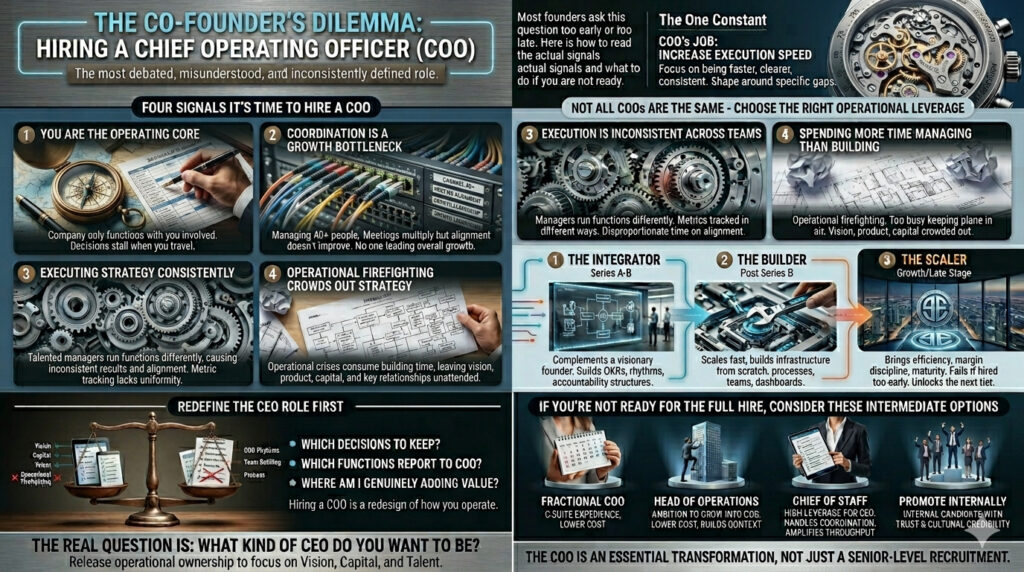
Most founders ask this question either too early or too late. Here’s how to read the actual signals and what to do if you’re not ready for the full hire.
There is no role in a growing company more debated, more misunderstood, or more inconsistently defined than the Chief Operating Officer. Ask ten founders when they hired one and you’ll get an array of answers at best. Ask them what the COO actually does at their company and you’ll probably get an equally diverse set of replies.
It comes down to a question about how you want to spend your time, where your company is at in its growth arc, and whether the gap you’re observing is structural or personal. Getting the answer wrong in either direction is costly. Hire too early, and you’ve introduced expensive overhead and a reporting line that confuses your existing team. Hire too late and you may burn out, your best managers may leave, and execution quality collapses quietly under the weight of coordination debt.
The role that often cannot be precisely defined
Unlike a CFO or CTO, whose mandates are relatively stable across companies, the COO is defined almost entirely by its relationship to the CEO. In some companies, the COO owns all revenue-generating functions. In others, they’re a pure integrator — the person who makes sure the machine runs. Some function as a chief-of-staff with a grander title. Some are effectively co-CEOs in all but name.
The one constant
The COO’s job is to increase execution speed, not add hierarchy or take more decisions. They need to focus on making the company faster, clearer, and more consistent between strategy and output. This ambiguity is a feature and the role should be shaped around your specific gaps. However, it means you need to be clear about what those spaces actually are before you start the search. A COO hired into a vague construct rarely succeeds.
Four signals it’s time to employ a Chief Operating Officer
You are the operating core
The company only functions smoothly when you’re personally involved. Decisions stall when you travel. Teams default to waiting for you rather than resolving things themselves. This is a scalability issue dressed up as a management style.
Coordination has become your growth bottleneck
You’re managing 40+ people, meetings multiply but alignment doesn’t improve, and you can no longer see clearly inside each function. The problem isn’t that your team lacks talent, it’s that no one is leading the overall growth
Execution is inconsistent across teams
Your managers are talented, but each runs their function differently. Metrics are tracked in different ways, accountability is muddled, and you spend a disproportionate amount of time on alignment that should be automatic.
You’re spending more time managing than building
The CEO job you signed up for covering vision, product, capital, and key relationships has been crowded out by operational firefighting. You’re too busy keeping the plane in the air and haven’t considered where it should land.
Not all COOs are the same
Before you write a job description, decide which type of operational leverage you actually need. Hiring the wrong archetype is as costly as hiring too early. Knowing which stage you’re in prevents an errant hire. A builder type brought in during a scaling phase feels like unnecessary bureaucracy. A scaler hired while you’re still finding product/market fit will slow you down tremendously.
The Integrator
• Series A–B
• Complements a visionary founder.
• Builds the operating system of the business including OKRs, rhythms, and accountability structures so that creative energy converts into consistent output.
The Builder
• Post Series B Ideal for companies scaling fast and building infrastructure from scratch including processes, teams, and dashboards.
• Comes in when the foundation genuinely doesn’t exist yet.
The Scaler
• Growth / Late Stage
• Brings efficiency, margin discipline, and organizational maturity.
• Usually comes from larger organizations.
• Hired too early they add friction. Timed right they unlock the next tier.
Redefine the CEO role first
The single most common mistake in COO hiring is bringing someone in without first deciding what the CEO will stop doing. If you haven’t drawn that line, the COO will struggle to own anything because you’ll keep pulling it back. The result is an expensive, frustrated executive in a structurally impossible job. Before the search begins, answer these questions honestly: Which decisions do I want to keep making myself? Which functions will report to the COO vs. directly to me? Where am I genuinely adding value versus just maintaining items? The COO hire is not just an addition to the organizational chart, it’s a redesign of how you and the business operate. The companies that get this right treat it as an essential transformation. The ones that get it wrong view it simply as a senior level recruitment.
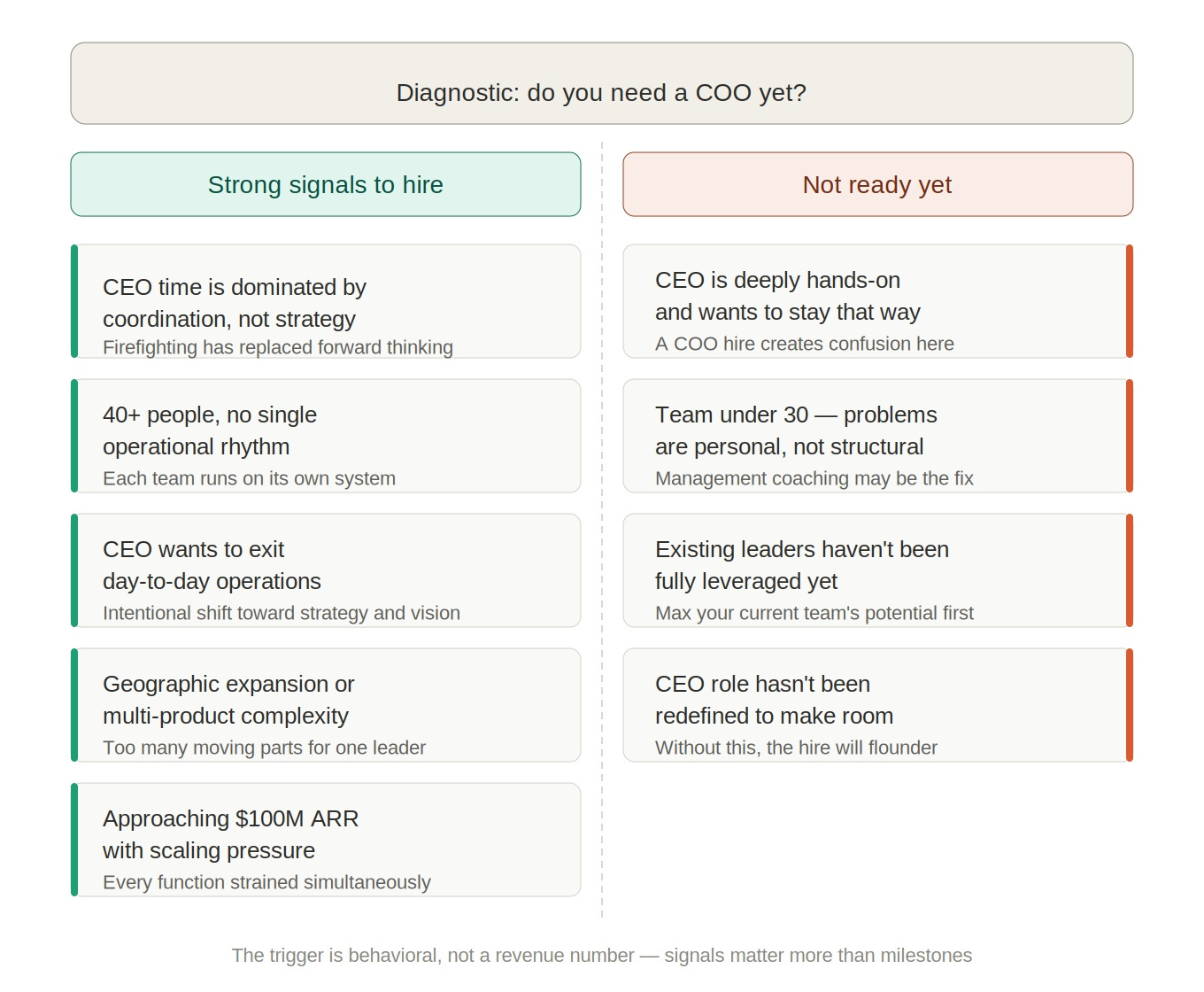
Cash position doesn’t support the full compensation package
If you’re not ready, what to do instead? Most founders who ask this question are actually describing a problem that doesn’t require a full COO hire to solve. Here are the intermediate options worth considering:
• Fractional COO
• A senior operator on a part-time contract. This provides access to C-suite experience without the full salary commitment. Ideal for building systems before you’re ready for the permanent hire.
• Head of Operations. Someone with the ambition and potential to grow into the COO role. Lower cost, high upside if you find the right person and builds institutional knowledge.
• Chief of Staff. A high-leverage role for a founder still doing the CEO job themselves. Handles coordination, tracks priorities, and amplifies your throughput without restructuring reporting lines.
• Promote internally. If someone on your leadership team is already acting as the operational anchor you may want to consider formalizing it. Internal COOs carry trust, context, and cultural credibility that outside hires spend months building.
Most founders don’t actually need help answering the question of whether or not they need to hire a COO. Rather, they need help answering what kind of CEO do they want to be? If you desire to remain deeply embedded in every function a COO hire creates confusion and perhaps resentment. If you’re ready to release operational ownership and focus on vision, capital, and the talent agenda, a great COO becomes one of the highest-leverage decisions you’ll make.