
A Leadership Playbook for Distributed and Remote Teams
A Leadership Playbook for Distributed and Remote Teams
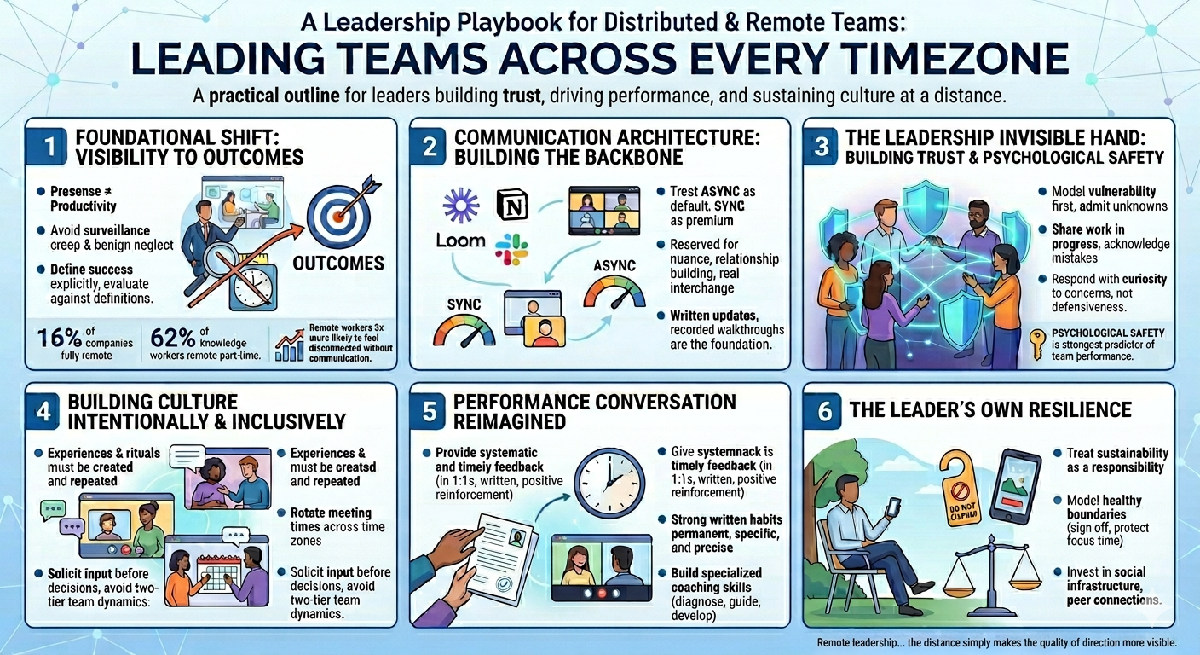
Leading Teams Across Every Timezone
A practical playbook for leaders who must build trust, drive performance, and sustain culture when their team is rarely if not ever in the same room.
The shift to distributed work didn’t just change where people sit, it changed the fundamental physics of leadership. Every instinct built for the office, from the hallway meeting to reading the room in a team gathering, becomes unreliable or irrelevant. Leaders who were excellent in person may often fail when operating at a distance. Conversely, leaders who struggled in traditional environments sometimes thrive in an alternative structure, freed from the dynamics that held them back.
What separates effective distributed leaders from ineffective ones isn’t charisma, seniority, or even technical skill. It’s a specific set of practices, habits, and mental models that most organizations have never explicitly taught because, until recently, they never had to.
16% of companies globally are now fully remote.
62% of knowledge workers work remotely at least part of the time.
3× more likely to feel disconnected without structured, regular communication.
The Foundational Shift: From Visibility to Outcomes
The most important mental reframe for any distributed leader is coming to terms with the fact that presence does not guarantee nor equate to productivity. In an office physical visibility creates a proxy for engagement. Seeing someone at their desk, overhearing their calls, watching them stay late are all signals that are imperfect even in person. Remotely, they are simply unavailable.
Leaders who try to replicate the visibility model at a distance end up in one of two failure modes. The first is surveillance creep which often entails the use of monitoring software, excessive check-ins, camera-on mandates and other similar requirements. These engender distrust and systematically drive away the highest performers who always have the most options. The second is benign neglect which leads to assuming that no news is good news until a project quietly falls apart or a team member silently departs the company.
The alternative is outcome-based leadership which requires defining what success looks like for each role, making those definitions explicit and shared, and then evaluating people against them rather than against their calendar availability. This requires more upfront investment in goal-setting than most on premises environments demand, but it pays compounding dividends in team autonomy, accountability, and trust.
Communication Architecture: Building the Backbone
In a co-located office, communication infrastructure is largely invisible. It exists in the environment that includes shared spaces, overheard conversations, and the ambient sense of what’s happening. Distributed teams have none of that infrastructure in place thus every communication channel must be deliberately designed, and every norm around it must be explicitly established.
The first and most important design decision is the synchronous/asynchronous balance. Most distributed teams default too heavily toward synchronous communication which lean heavily on video calls, instant messages, and real-time pings because it feels more like the office. But synchronous communication can be unnecessarily taxing. It requires coordination across time zones, interrupts deep work, and creates information silos for anyone who missed the call.
A healthier architecture treats asynchronous communication as the default and synchronous as the premium. Written updates, recorded walkthroughs, and documented decisions are the foundation. Real-time meetings are reserved for things that genuinely require them such as nuanced discussion, relationship-building, and decisions where live interchange adds irreplaceable value.
The Leadership Invisible Hand
Trust in a distributed team is both more fragile and more important than in a co-located one. More fragile because the signals that build trust in person such as body language, consistent presence, and the texture of daily interaction are attenuated or absent. More important because a distributed team without trust defaults to dysfunction where people work in silos, withhold problems, duplicate effort, and stop asking essential questions.
The research on psychological safety (the belief that one can speak up, take risks, and admit mistakes without punishment) consistently identifies it as the strongest predictor of team performance, and its effects are amplified in remote environments where ambiguity is higher and visibility is lower. Leaders who build psychologically secure remote teams consistently outperform those who don’t.
Building that safety requires deliberate, repeated behaviors. Leaders must model vulnerability first which may require admitting when they don’t know something, sharing work in progress rather than only finished products, and acknowledging mistakes openly. They must respond to raised concerns with curiosity rather than defensiveness. It’s also essential to create consistent, low-pressure touchpoints where team members can surface problems before they become crises.
The 1:1 as infrastructure
The single most powerful trust-building tool a distributed leader has is the regular one-on-one meeting, and it is also the most commonly sacrificed when calendars get full. This is a mistake. The type of meeting is not a status update. Its purpose is to develop and strengthen the relationship. Done well, it’s where leaders learn what is actually going on, what people are proud of, what they’re struggling with, what they’re not saying in team calls. An effective distributed leader deems these meetings as essential.
Building Culture Intentionally
Culture in a distributed team environment can’t be left to emerge organically. In an office, culture accumulates through shared lunch tables, spontaneous conversations, and the ambient experience of being together. None of that happens automatically when people are spread across cities and time zones.
This doesn’t imply that culture must be manufactured or forced. It means that the experiences and rituals that build a cohesive environment must be intentionally created and repeated. They can be as simple as a standing Friday thread or as involved as a quarterly all-hands that is designed primarily for human connection rather than information transfer. The format matters less than the consistency.
Distributed leaders also need to pay particular attention to inclusion across time zones. When a team spans multiple regions, it is easy for the time zone where most people reside (or where leadership sits) to become the de facto cultural center. Decisions get made in morning standups that the Asia-Pacific team hears about the next day. Informal banter happens in a window that excludes anyone on the other side of the planet. Over time, these patterns create a two-tier team which breaks out into those at the center and those at the edge.
Counteracting this requires rotating meeting times so no single region always bears the cost of an inconvenient hour, creating asynchronous spaces for the informal conversation that builds connection, and being deliberate about soliciting input from distributed team members before decisions are finalized.
The Performance Conversation Reimagined
Giving feedback is harder at a distance. The absence of in-person cues means that tone is harder to convey, context is harder to establish, and the impact of a critical comment is more difficult to gauge and soften in real time. Leaders who rely on casual, spontaneous feedback loops in the office often find that they are giving far less input than they realize when those loops disappear.
The solution is to systematize what was previously spontaneous. Rather than waiting for a natural moment to give an assessment, remote leaders need to build this into the cadence of their management. This includes dedicated time in 1:1s, written reinforcement of positive contributions, and specific and timely written thoughts when something needs to change.
The written medium also has underappreciated advantages. This type of observation is permanent, readable at any time, and specific in a way that a passing verbal comment often isn’t. Leaders who develop strong written communication habits often find that their suggestions land with more precision and are better retained than what they delivered in person.
The Leader’s Own Resilience
Leadership of a distributed team is cognitively and emotionally demanding in ways that differ from in-person management. The lack of ambient awareness means leaders must work harder to understand what’s happening across their team. The absence of in-person social interaction means that the informal interactions that happen naturally in an office must be consciously created. And the always on quality of digital communication creates real risks of boundary erosion and burnout.
Effective remote leaders treat their own sustainability as a responsibility, not a personal indulgence. They model healthy boundaries explicitly including signing off at reasonable hours, taking vacations without constant check-ins, and protecting focus time from notification overload. A leader who answers messages at midnight implicitly signals that this is expected, even if they never say so.
They also invest in their own social infrastructure including regular peer connections with other leaders facing similar challenges, deliberate in-person time with the team when geography and resources allow, and intentional rituals that mark the end of the workday and maintain the separation that remote work so easily dissolves.
Remote leadership is not a watered down version of in-person leadership. Done well, it can produce teams that are more focused, more autonomous, more inclusive, and more productive than their office-bound counterparts because the practices that make it work entail fundamentally good leadership that most in-house environments were too busy or too comfortable to develop. The distance simply makes the quality of direction more visible. There is nowhere for ambiguity to hide, and little room for trust deficits to stay secret for long.