
The Modern CFO: Finance Leader to Strategic Operator
The Modern CFO: Finance Leader to Strategic Operator
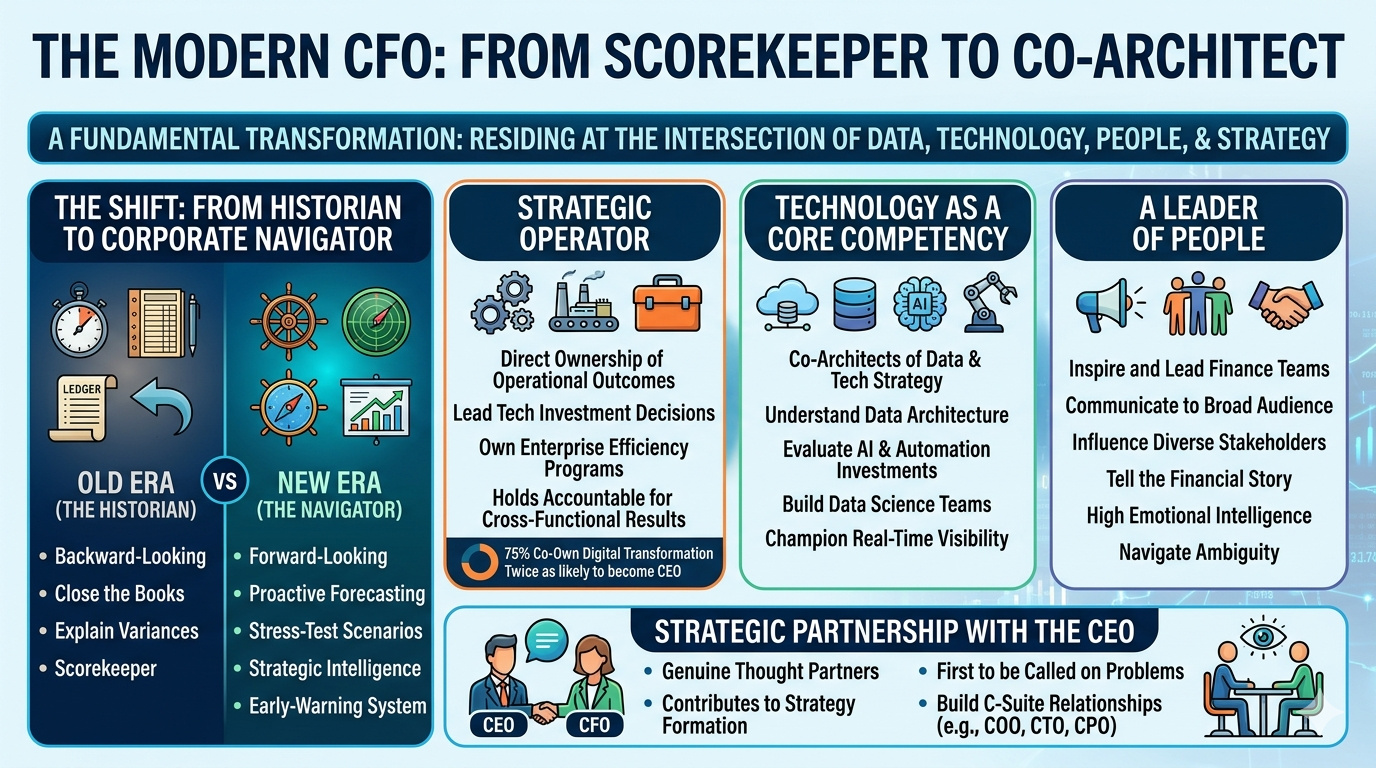
The spreadsheet never disappears, but today’s CFO is expected to be the co-architect of the company’s future, not merely its scorekeeper.
There was a time when the Chief Financial Officer’s world was defined by columns and closings, month-end reconciliations, audit readiness, and covenant compliance. The CFO’s primary area of focus was the numbers. That era is over. Across industries and company growth stages, the CFO role has undergone a fundamental transformation. Today’s finance chief is expected to reside at the intersection of data, technology, people, and strategy while translating financial reality into decisions that shape the trajectory of the business.
From Historian to Corporate Navigator
Traditional finance was, at its core, a somewhat backward-looking discipline. Close the books, report the results, explain the variances that arose. The CFO’s value was, for the most part, largely retrospective. which served organizations reasonably well in stable, predictable environments. But the modern business sphere is neither stable nor predictable due to increased competitive cycle compression, capital market fluctuations, and geopolitical waves that now decimate supply chains overnight. In this context, the organization needs its finance leader to be a more direct and involved leader who can read the current conditions and project a viable course forward.
This shift requires a fundamentally different posture. The modern CFO proactively builds forecasting capabilities, stress-tests scenarios before crises hit, and translates financial signals into strategic intelligence that the CEO and board can act on. The finance function often becomes an early-warning system.
Now More of a Technician
Perhaps the most significant evolution is the CFO’s growing ownership of operational outcomes. Finance is no longer a function that simply observes and reports on the business. It is now directly embedded in it. Modern CFOs own enterprise-wide efficiency programs, lead technology investment decisions, and increasingly hold accountability for cross-functional results. Almost 75% of these executives now maintain co-ownership of digital transformation initiatives along with direct technology and data functions. They’re also twice as likely to be considered for an open CEO position than they were a decade ago.
This operator orientation demands a willingness to get close to the work as current CFO’s need to understand the operational logic behind capital expenditure requests. They also must proactively engage with talent strategy and workforce design while gaining a full understanding of how the business actually runs. This can be somewhat disorienting for many finance professionals trained in the discipline of objectivity and distance. but effective modern CFOs have found a way to maintain analytical rigor while developing genuine operational intuition.
Strategic Partnership with the CEO
The relationship between the CEO and CFO has always been inherently consequential from a number of perspectives, but the nature of that partnership has shifted. Where the CFO once functioned primarily as a check on the CEO’s ambitions and actions, today’s most effective CFO/CEO pairs operate as genuine thought partners.
This means the CFO contributes to strategy formation, not just evaluation. It also entails being present and vocal in conversations about markets, customers, and competitive positioning in addition to primary duties of weighing in when a budget is needed.
The best CFOs today are one of the first individuals the CEO calls when a problem may arise. This requires the modern financial executives to fully invest in relationships across the C-suite to build productive partnerships with the Chief Operating Officer, Chief Technology Officer, and Chief People Officer at a minimum.
Technology as a Core Competency
No transformation of the CFO role is complete without addressing technology. The finance function has historically been a major consumer of enterprise software and, given current advances in the field, modern CFO’s must actively assist in the architecture of the organization’s data and technology strategy.
They don’t have to be a pure technologist, but these individuals now must maintain enough literacy to ask the right questions, evaluate the proper investments, and hold appropriate partners accountable for outcomes. CFOs who treat technology as an IT problem are abdicating one of the most consequential levers in the modern enterprise.
Today’s finance leaders need to:
• Understand the data architecture that underpins financial and operational reporting
• Evaluate AI and automation investments with both financial and operational rigor
• Build finance teams with meaningful data science and analytics capability
• Champion real-time visibility rather than accepting periodic reporting cycles
• Own the financial modeling infrastructure that powers strategic decisions
Leading Across the Organization
The modern CFO is, above all, a leader of people. This may sound obvious, but it represents a meaningful departure from the archetype of the detail-oriented, technically excellent finance executive who keeps their head down and focuses solely on the numbers. Current CFO’s must be able to inspire a finance team, communicate effectively to a broad organizational audience, and influence stakeholders who don’t share their functional background. They must be able to tell the financial story of the business in a way that motivates action, not just compliance. Doing this effectively requires communication skills that the traditional finance curriculum rarely develops. It also demands emotional intelligence, political awareness, and the ability to navigate ambiguity with confidence. These certainly are learnable capabilities, but they require intentional development.
The Opportunity Ahead
The expansion of the CFO role will certainly come with an array of challenges. The expectations are broader, stakeholders have expanded in number, and subsequent scrutiny of all activities is more intense. However, for those who embrace these changes, the opportunity is extraordinary. Finance leaders now have more influence over the strategic direction of the enterprise than at any previous period, and their ability to navigate uncertainty, allocate resources intelligently, and build durable competitive advantage is essential.