
What Makes a Great CTO in 2026?
What Makes a Great CTO in 2026?
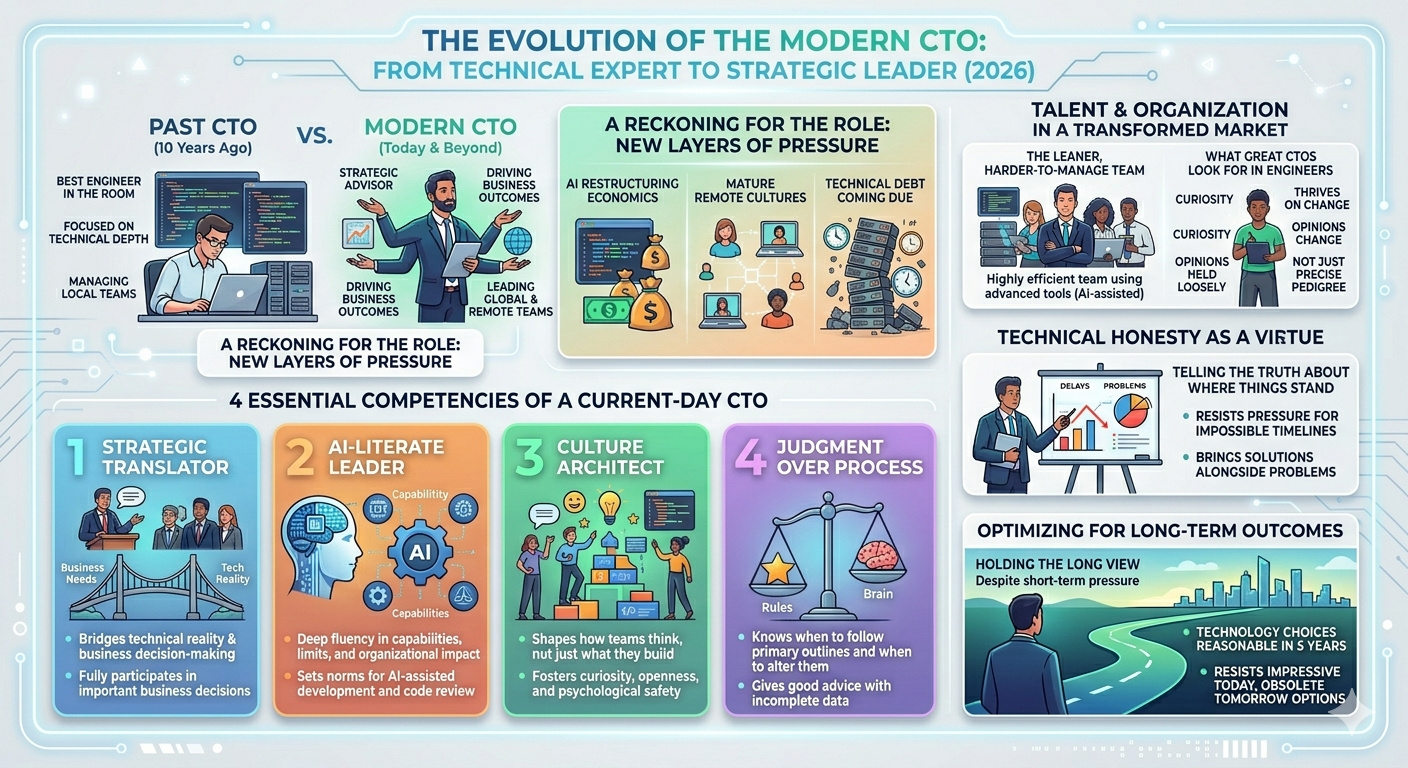
The CTO role has been substantially altered in recent years, and the best technical leaders today look nothing like their predecessors from a decade ago
Ask a room of founders what they want in a modern CTO and you’ll hear the usual litany that includes a strong engineering background, the ability to scale systems, good with hiring. Ask the same room which CTOs they actually admire and the conversation goes somewhere entirely different.
The job has always been relatively hard to define from a number of perspectives. Executive, engineer, occasionally therapist, sometimes the person who has to tell the board why the rewrite took so long. But the current time period has added new layers of pressure that are forcing a reckoning with what the role actually demands.
AI has restructured the economics and mechanics of software development. Remote first engineering cultures have matured and grown complicated while the technical debt accumulated during the hypergrowth years is coming due. Most interesting of all, the companies that are winning aren’t necessarily the ones with the best engineers, they’re often the organizations with the best technical judgment at the top.
Strategic clarity over technical depth
It used to be enough for a CTO to be the best engineer in the room. That era has dissolved with the explosion of AI assisted development, the commoditization of cloud infrastructure, and the maturation of the software industry as a whole. What matters now isn’t who can write the most elegant code, it’s now about who can make the right calls about where technology is taking the business.
Great CTOs in 2026 are architects of strategy in addition to overall systems. They fully participate in important business decisions and translate technical reality into language that changes the outcome. They know when a competitor’s AI advantage is real and when it’s not quite where it should be. This requires a comfort with ambiguity that often doesn’t come naturally to many engineers who are accustomed to operating in more direct environs. The people who thrive in the role have learned to give good advice when the data is incomplete, and to hold their technical convictions loosely enough to update them when they’re wrong.
AI fluency as a mandatory component of knowledge
A CTO who doesn’t deeply understand AI is already at a structural disadvantage. This doesn’t mean every individual in this role needs to train models. It does, however, require that they understand when AI is the right tool, when it isn’t, and how to build organizations that use it well.
The practical implications mean that great CTOs today are actively shaping how their engineering teams work with AI-assisted development while also setting norms around code review, properly assessing the role of human involvement, and watching the productivity numbers closely enough to know when the buildup doesn’t match the reality.
Four essential competencies of a current day CTO
Strategic Translator
Bridges technical reality and business decision-making
AI-literate leader
Deep fluency in capabilities, limits, and organizational impact
Culture architect
Shapes how teams think, not just what they build
Judgment over process
Knows when to follow the primary outline and when to alter it
Talent in a transformed market
The engineering asset market has been reshaped by Artificial Intelligence tools in ways that, understandably, weren’t fully anticipated. A smaller team with the right capabilities and the correct tooling can do what once required multiples of the headcount. A bad hire at the senior level, particularly someone who resists the new instruments or sets the wrong tone around them, can cost far more than it would have only five years ago.
Great CTOs today are obsessive about what kind of engineers they hire and the reasons for doing so. They’re less focused on precise pedigree and value curiosity. Most importantly, they seek people who thrive in environments that are rapidly changing and who can hold strong opinions about technical approaches while remaining genuinely open to being incorrect at times.
These individuals are also thinking carefully about the shape of their organizations and how to effectively direct something leaner and harder to manage. The best CTOs have figured out how to make that work without losing the institutional knowledge and psychological safety that makes good teams possible.
Honesty as a technical virtue
There’s a quality that shows up in the CTOs people consistently describe as great, and it’s harder to develop than any technical skill. Namely, the willingness to tell the truth about where things stand. This sounds like it should be obvious but, in practice, it’s fairly rare. Engineering organizations are often rewarded for promising timelines that slip, scoping projects that grow, describing technical health in terms that make the business appear better than it may be. The CTOs who build lasting credibility are the ones who resist that pressure and are willing to tell the board that a particular migration is going to take longer than expected.
This kind of honesty has to be paired with the ability to bring solutions alongside the problems. Delivering bad news is only useful if you’re also helping to think through what happens next. The CTOs who do both are the ones that organizations genuinely rely on.
The extended view of the role
Great CTO’s have a willingness to optimize for outcomes that matter over timelines that are very often longer than most organizations are comfortable with. AI adoption may fail because of short-term skepticism, wavering enthusiasm, and questionable metrics. The best of these professionals hold the long view without losing the ability to act in the present while making technology choices that will still look reasonable in five years, even when that means resisting the options that would look impressive today.