
When to Replace a Founder CEO and How to Do It Properly
When to Replace a Founder CEO and How to Do It Properly
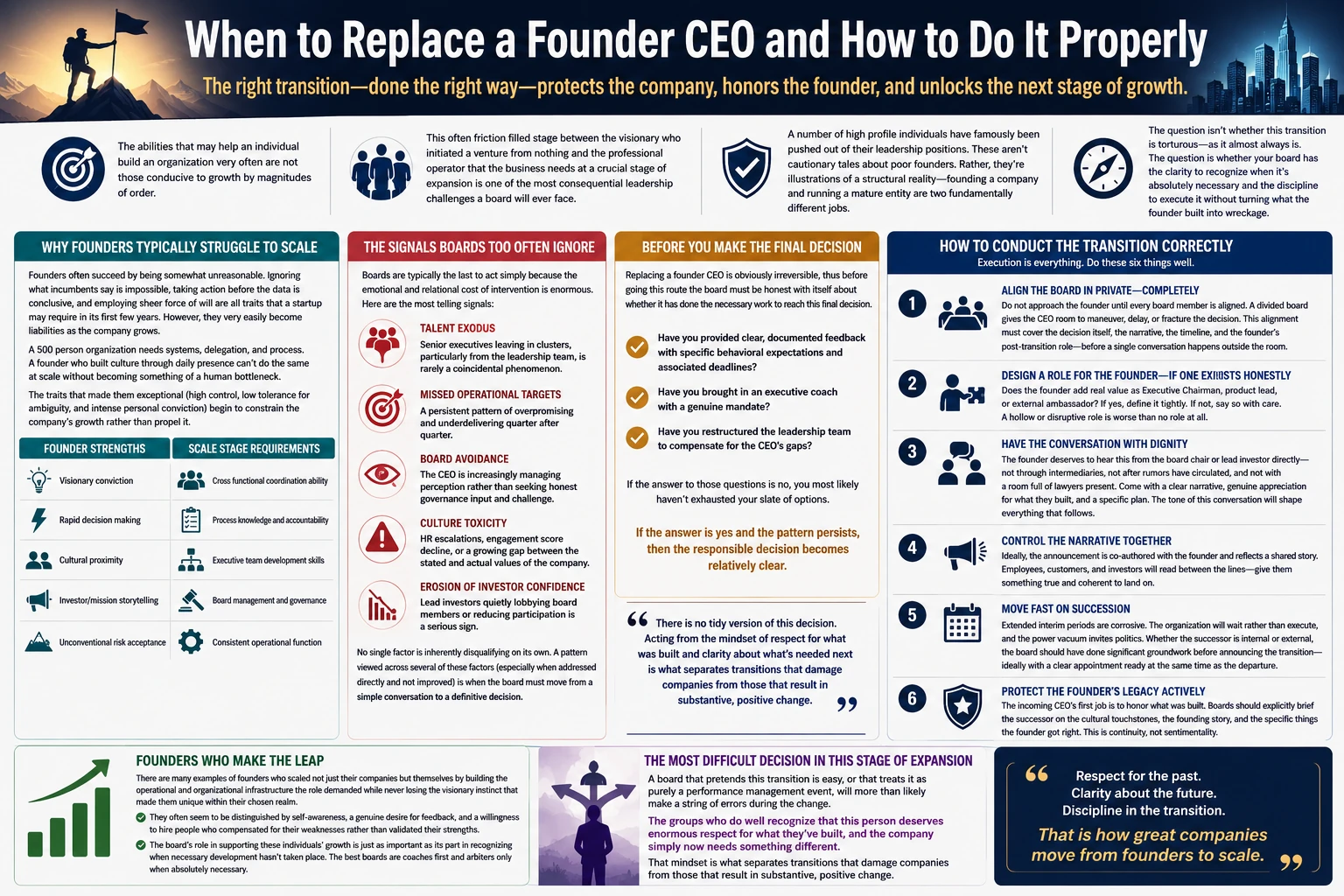
The abilities that may help an individual build an organization very often are not those conducive to growth by magnitudes of order
This often friction filled stage between the visionary who initiated a venture from nothing and the professional operator that the business needs at a crucial stage of expansion is one of the most consequential leadership challenges a board will ever face.
A number of high profile individuals have famously been pushed out of their leadership positions. These certainly aren’t cautionary tales about poor founders. Rather, they’re illustrations of a structural reality whereby founding a company and running a mature entity are two fundamentally different jobs.
The question isn’t whether this transition is torturous as it almost always is for a host of reasons. The important consideration here is whether your board has the clarity to recognize when it’s absolutely necessary and the discipline to execute it without turning what the founder built into wreckage.
Why founders typically struggle to scale
Founders often succeed by being somewhat unreasonable. Ignoring what incumbents say is impossible, taking action before the data is conclusive, and employing sheer force of will are all traits that a startup may require in its first few years. However, they very easily become liabilities as the company grows.
A 500 person organization needs systems, delegation, and process. A founder who built culture through daily presence can’t do the same at scale without becoming something of a human bottleneck. The traits that made them exceptional (high control, low tolerance for ambiguity, and intense personal conviction) begin to constrain the company’s growth rather than propel it.
|
Founder strengths |
Scale stage requirements |
|---|---|
|
Visionary conviction |
Cross functional coordination ability |
|
Rapid decision making |
Process knowledge and accountability |
|
Cultural proximity |
Executive team development skills |
|
Investor/mission storytelling |
Board management and governance |
|
Unconventional risk acceptance |
Consistent operational function |
The signals boards too often ignore
Boards are typically the last to act simply because the emotional and relational cost of intervention is enormous. Here are the most telling signals:
Talent exodus
Senior executives leaving in clusters, particularly from the leadership team, is rarely a coincidental phenomenon.
Missed operational targets
A persistent pattern of overpromising and underdelivering quarter after quarter.
Board avoidance
The CEO is increasingly managing perception rather than seeking honest governance input and challenge.
Culture toxicity
HR escalations, engagement score decline, or a growing gap between the stated and actual values of the company.
Erosion of investor confidence
Lead investors quietly lobbying board members or reducing participation is a serious sign.
No single factor is inherently disqualifying on its own. A pattern viewed across several of these factors (especially when addressed directly and not improved) is when the board must move from a simple conversation to a definitive decision.
Before you make the final decision
Replacing a founder CEO is obviously irreversible, thus before going this route the board must be honest with itself about whether it has done the necessary work to reach this final decision. Have you provided clear, documented feedback with specific behavioral expectations and associated deadlines? Have you brought in an executive coach with a genuine mandate? Have you restructured the leadership team to compensate for the CEO’s gaps? If the answer to those questions is no, you most likely haven’t exhausted your slate of options. If the answer is yes and the pattern persists, then the responsible decision becomes relatively clear.
How to conduct the transition correctly
When done poorly, CEO transitions destroy culture, trigger talent flight, and undermine the company at its most vulnerable moment. Done well, they can be genuinely galvanizing for the workforce. The difference lies almost entirely in execution.
Align the board in private and ensure all are in unison
Do not approach the founder until all members are in agreement. A divided board gives the CEO room to maneuver, delay, or fracture the decision. This coordination must cover the decision itself, the narrative, the timeline, and the founder’s post-transition role before a single conversation happens outside the room.
Design a role for the founder if one exists that is legitimate
Many transitions fail because the board offers the founder a face saving position that is either hollow or genuinely disruptive to the new leader and team as a whole. Does the founder add real value as Executive Chairman, product lead, or external ambassador? If yes, define it tightly. If not, say so with all due esteem.
Have the conversation with respectability
The founder deserves to hear this from the board chair or lead investor directly rather than through intermediaries. Present your thoughts with a clear narrative, genuine appreciation for what they built, and a specific plan going forward. The tone of this conversation will shape everything that follows.
Control the narrative together
Ideally, the announcement is co-authored with the founder and reflects a shared story. Employees, customers, and investors will always read between the lines thus give them something true and coherent to absorb.
Move as rapidly as possible on succession
Extended interim periods are often corrosive if seen to poorly. The organization will wait rather than execute, and the power vacuum invites unnecessary political maneuvering. Whether the successor is internal or external, the board should have done significant groundwork before announcing the transition, ideally with a clear appointment ready at the same time as the departure.
Protect the founder’s legacy
The incoming CEO’s first job is to honor what was built by the entrepreneur. Boards should explicitly brief the successor on the primary cultural foundations, the primary organizational story, and the specific things the founder did indeed get right. Companies that dismiss their founding era in often lose the animating spirit that made them a growth entity in the first place.
Founders who make the leap
There are many examples of founders who scaled not just their companies but themselves by building the operational and organizational infrastructure the role demanded while never losing the visionary instinct that made them unique within their chosen realm. They often seem to be distinguished by a good amount of self-awareness, a genuine desire for feedback, and a willingness to hire people who compensated for their weaknesses rather than validated their strengths. The board’s role in supporting these individuals growth is just as important as its part in recognizing when necessary development hasn’t taken place. The best boards are coaches first and arbiters only when absolutely necessary.
The most difficult decision in this stage of expansion
There is no tidy version of this decision, and a board that pretends the transition is easy, or that treats it as purely a performance management event, will more than likely make a string of errors during the change. The groups who do well recognize that this person deserves enormous respect for what they’ve built, and the company simply now needs something different. Acting from that mindset is what separates transitions that damage companies from those that result in substantive, positive change.