
Equity vs. Cash in 2026: What Candidates Actually Care About Now
Equity vs. Cash in 2026:
What Candidates Actually Care About Now
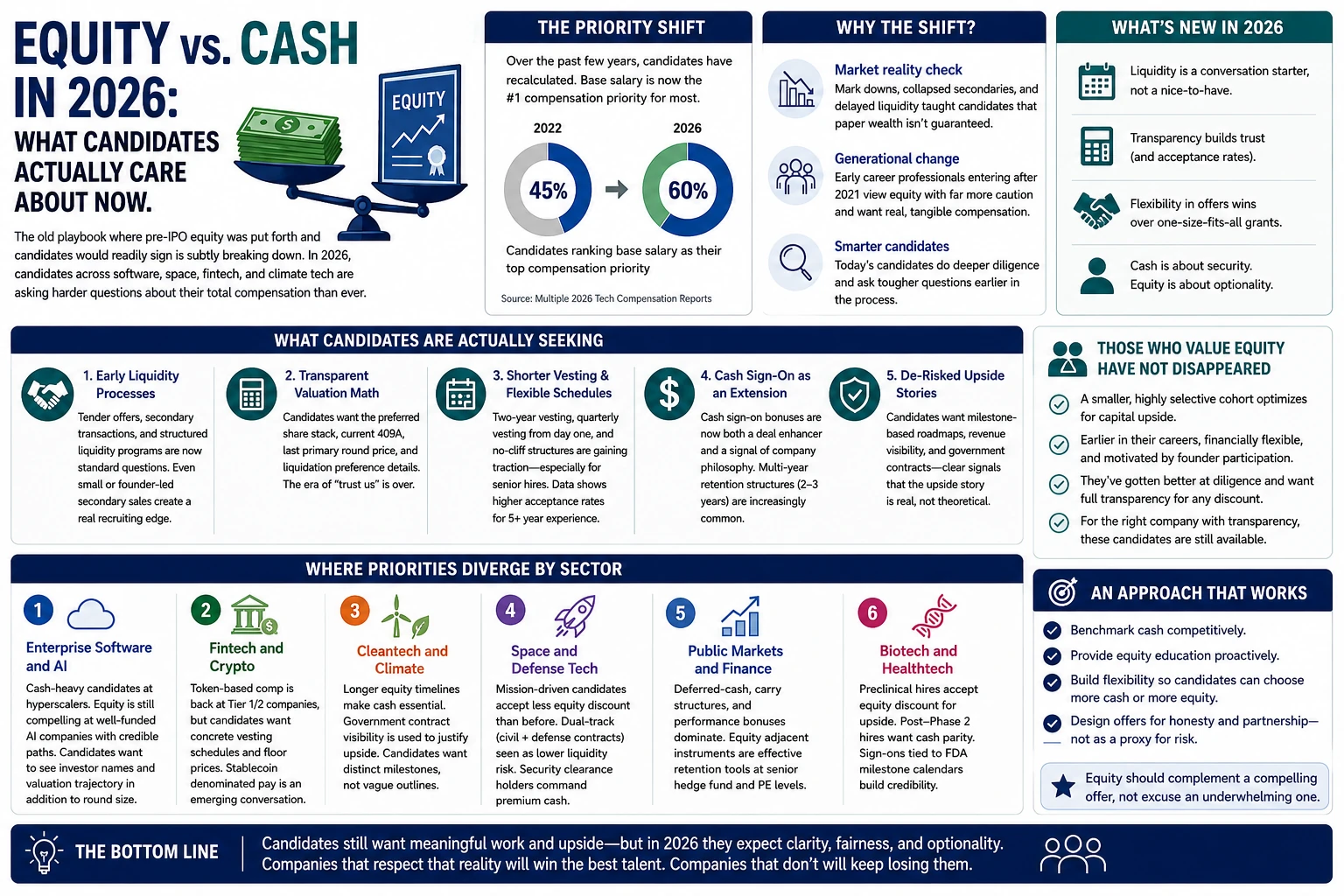
The old playbook where pre-IPO equity was put forth and candidates would readily sign is subtly breaking down. In 2026, candidates across software, space, fintech, and climate tech are asking harder questions about their total compensation than ever before.
For most of the last decade, a large equity grant was the universal recruiting leverage. The form varied depending on the company and growth stage, but the proposal was generally the same. Bet on us and it’ll be well worth it.
The 2022–2023 correction prompted changes on all sides along with a wave of IPO windows that opened briefly but not always lucratively. By 2026, individuals have done the personal math and many of them have altered their approach significantly. Indeed, over 60% of tech candidates now rank base salary as their top compensation priority, a figure that is well up from about 45% in 2022.
Significant shifts
What changed? Many individuals observed colleagues at companies like Stripe, Klarna, and a host of other similar organizations sit on paper fortunes for years only to see valuations marked down, secondary markets collapse, and tax events arrive before liquidity was reached. There’s also a very tangible generational dimension that we’ve observed. Early career professionals who entered the workforce after the 2021 peak tend to have a much different cultural approach where equity is viewed with far greater apprehension. That shift in sentiment is prompting a reckoning within compensation teams, particularly at growth stage companies that can’t simply outbid behemoths on cash and have historically relied on the equity approach to close candidates.
What candidates are actually seeking
• Early liquidity processes
Tender offers, secondary transactions, and structured liquidity programs that were once rare perks at elite companies are now mentioned in early conversations by a meaningful cross section of senior candidates. Startups that can point to a regular measure of secondary sales (even if small or led by the founder) have a distinct recruitment edge.
• Transparent valuation math
The days of offering a candidate a significant piece of the venture are diminishing. Sophisticated candidates are now seeking the preferred share stack, the current 409A, the last primary round price, and the liquidation preference event.
• Shorter vesting periods and flexible schedules
The standard four year vest with a one year wait window does still remain as a viable option. However, candidates are pushing back on it more aggressively than before. In competitive fintech and infrastructure software markets, we’re seeing some companies move to two year vesting schedules for key hires, or offering quarterly vesting from day one with no cliff at all. The data suggests these approaches improve acceptance rates for candidates with 5+ years of experience.
• Cash sign on as an extension
As restricted stock values at public tech companies fluctuated heavily in recent years, cash sign on bonuses emerged as a more practical tool not just for enhancing deals, but as a philosophical statement regarding the company itself. In cleantech and climate infrastructure, where the equity story is often particularly protracted, signings are increasingly being framed as multi year retention instruments that spread across two or three years of employment.
Where priorities tend to diverge in various sectors:
Enterprise Software and AI
Cash heavy candidates at seen at hyperscalers. Equity is still compelling at well funded AI companies with credible paths. Candidates want to see investor names and valuation trajectory in addition to round size.
Fintech and Crypto
Token based compensation is back on the table at Tier 1/2 companies, but candidates want concrete vesting schedules and floor prices. Stablecoin denominated pay is an emerging conversation at some firms operating in this realm.
Cleantech and Climate
Longer equity timelines make cash compensation essential. Government contract visibility is increasingly used to justify upside stories. Candidates want distinct milestones, not just a stated, imprecise outline.
Space and Defense Tech
Mission driven candidates will still accept an equity discount, but less of one than previously. Dual track companies (civil plus defense contracts) are seen as lower liquidity risk. Security clearance holding individuals command premium cash.
Public Markets and Finance
Deferred cash, carry structures, and performance bonuses dominate here. Equity adjacent instruments are increasingly offered at senior hedge fund and PE levels as retention tools that are seeing greater effectiveness.
Biotech and Healthtech
Preclinical candidates will accept an equity discount for upside. Post Phase 2 hires want tend to desire cash parity. Sign on bonuses tied to FDA milestone calendars are becoming more common as a credibility marker
Those who value equity certainly have not disappeared
It would be errant to view all of this as a wholesale rejection of equity as a compensation tool. There remains a distinct and highly sought after cohort of candidates who explicitly optimize for capital upside and will accept a relatively significant cash discount to get it. They do tend to be earlier in their careers, financially flexible, and motivated by founder participation in outcomes.
This group is smaller and more selective than it was only five years ago. They’ve also gotten better at diligence as if they’re accepting a discount, they want to understand exactly what they’re getting. For the right company with the proper amount of transparency, these candidates are still available. The mistake is assuming that any growth stage opportunity can attract them on narrative alone.
An approach that works
The answer definitely is not to abandon equity as a tool. Rather, it is more fruitful to allay its use as a substitute for honest compensation design. Companies that are succeeding in this area in 2026 tend to share a few basic traits. They benchmark cash competitively, provide equity education proactively rather than waiting for candidates to inquire, and they build flexibility into their offer structures so that those who value cash can get more of it and candidates who want equity can sign an agreement geared more toward that construct.
The companies that are losing candidates in the current era of hiring are those still treating equity as the thing that makes an otherwise underwhelming offer acceptable. New hires still seek a role where there is ample opportunity to complete valued work and be fairly compensated for their efforts. They simply are more likely to delve further into the details and ensure that the components of a chosen compensation plan are more fully fleshed out and concrete.