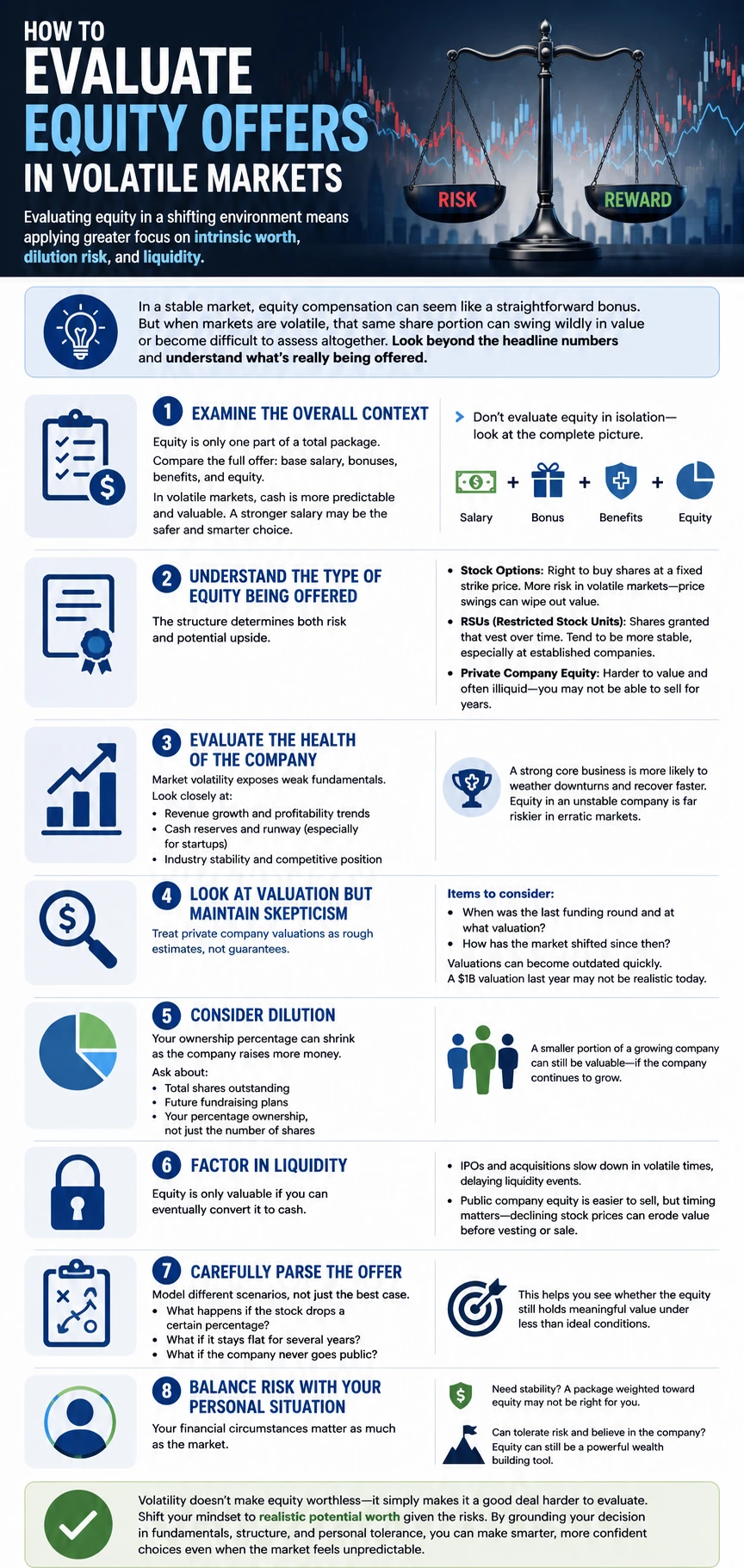
How to Evaluate Equity Offers in Volatile Markets
How to Evaluate Equity Offers in Volatile Markets
Evaluating equity in a shifting environment means applying greater focus on intrinsic worth, dilution risk, and liquidity.
In a stable market, equity compensation can essentially seem like a straightforward bonus. But when markets are volatile, that same share portion can swing wildly in value or become difficult to assess altogether. If you’re weighing a job offer that includes stock options, RSUs, or other forms of remuneration, it’s critical to look beyond the primary numbers and understand what’s really being offered.
Examine the overall context
Equity is only one part of a total package. Before diving into valuation models or strike prices compare the full list of offerings including base salary, bonuses, benefits, and equity. In rapidly fluctuating markets cash becomes more valuable because it’s somewhat predictable. A slightly lower equity offer paired with a stronger salary may actually be the safer and more astute choice.
Understand the type of equity being offered
The structure here determines both risk and potential upside.
Stock options give you the right to buy shares at a fixed strike price. These are ultimately beneficial based on the company’s valuation above that price.
RSU’s (Restricted Stock Units) are typically granted as shares that vest over time, often tied to continued employment or performance milestones. Private company equity is harder to value and often illiquid, meaning you may not be able to sell shares for years. In the type of markets we’re examining, options carry more risk because price swings can easily wipe out their value. RSU’s tend to offer more stability, especially at established ventures.
Evaluate the health of the company
Market volatility exposes business fundamentals that are lacking a strong base. Look closely at:
• Revenue growth and profitability trends.
• Cash reserves and runway for startups in particular.
• Industry stability and competitive position.
A company with a strong core is more likely to weather downturns and recover more rapidly. Equity in an unstable organization becomes significantly riskier when the broader market is erratic.
Look at valuation but maintain skepticism
If you’re joining a private company you’ll likely be told its latest relevant assessments. It’s more productive to treat this number as a rough estimate rather than a guarantee.
Items to consider:
• When was the last funding round and at what valuation?
• How has the market shifted since then?
In these conditions, the numbers can become outdated very quickly. A company estimated to be worth $1 billion last year might struggle to raise capital at the same level today.
Consider dilution
Your ownership percentage can shrink over time as the company raises more money. This is especially important in uncertain markets where companies may need additional funding to stay afloat.
Ask about:
• Total shares outstanding.
• Future fundraising plans.
• Your percentage ownership, not just the number of shares being offered.
A smaller portion of a growing company can still be valuable, but only if the company continues to expand.
Factor in liquidity
Equity is only valuable if you can eventually convert it into cash. In volatile environments, IPOs and acquisitions tend to slow down which can delay liquidity events.
Public company equity is easier to sell, but even then, timing matters a great deal. A declining stock price can erode value prior to your shares vesting or before you choose to sell.
Carefully parse the offer
Instead of assuming best case scenarios, model a few of these more realistic outcomes:
• What happens if the stock drops a certain percentage?
• What if it stays flat for several years?
• What if the company never goes public?
This exercise helps you see whether the equity still holds meaningful value under less than ideal conditions.
Balance risk with your personal situation
Your financial circumstances certainly matter as much as the market. If you rely heavily on stable income, a compensation package weighted toward uncertain equity may not be an ideal approach. On the other hand, if you can tolerate a certain amount of risk and believe strongly in the company, equity can still be a powerful wealth building tool even in unsteady times.
Volatility doesn’t make equity worthless, it simply makes it a good deal harder to evaluate. The key is to shift your mindset to determining what the realistic potential worth may be given the risks involved. By grounding your decision in fundamentals, structure, and personal tolerance, you can make smarter, more confident choices even when the market feels unpredictable.