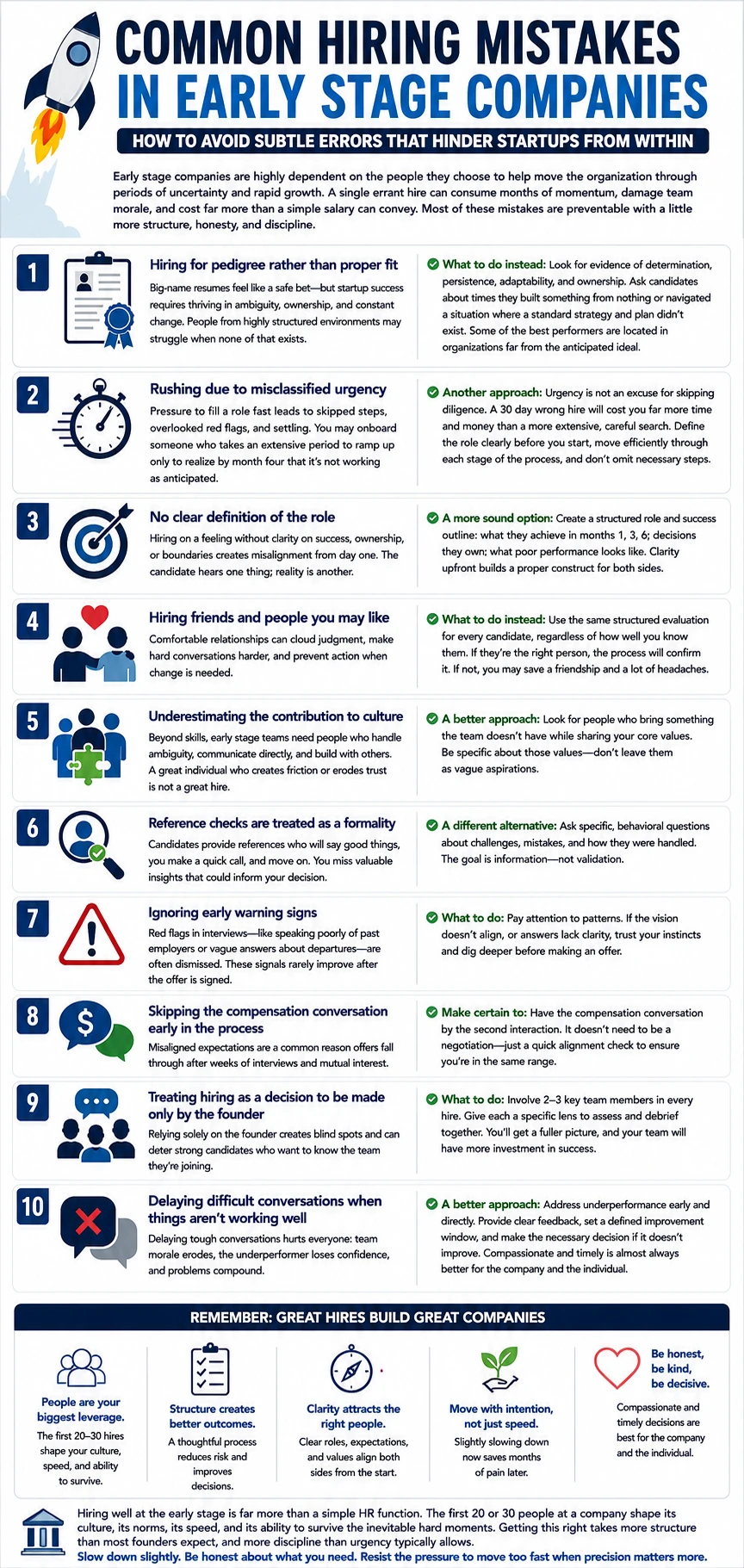
Common Hiring Mistakes in Early Stage Companies
Common Hiring Mistakes in Early Stage Companies
How to avoid some of the errors that that subtly hinder startups from within
Early stage companies are highly dependent on the people they choose to help move the organization through periods of uncertainty and rapid growth. With limited runway, zero margin for error, and many things still being figured out on an impromptu basis, a single errant hire can consume months of momentum, damage team morale, and cost far more than a simple salary can convey. Yet numerous founding teams approach hiring with simple intuition and good intentions but often emerge having made many of the same preventable mistakes.
Here are some of the most common ones we see and what may be a better approach for each.
1. Hiring for pedigree rather than proper fit
Every company has been guilty of this on more than one occasion. A resume from a well-known name feels like an inherent signal of quality. And certainly sometimes it is. To no surprise, we are often asked to present these type of individuals with little room for variance. However, startup companies are a fundamentally different environment filled with ambiguity, fewer resources, and constantly shifting processes. Someone who thrived inside a large, highly structured machine with dedicated support teams, established processes, and a clear job description may struggle to operate in a place where none of those things are effectively in operation.
What to do instead: Look for evidence of determination, persistence, adaptability, and ownership. Ask candidates about times they built something from nothing or navigated a situation where a standard strategy and plan didn’t exist. Some of the best performers are located in organizations far from the anticipated ideal.
2. Rushing due to misclassified urgency
A key person just quit, a product launch is looming, and investors are asking highly pointed questions. The pressure to fill a role rapidly is absolutely legitimate, and it leads founders to compress timelines, skip reference checks, overlook red flags, and settle for what is perceived as a sound enough hire. This may result in onboarding someone who takes an extensive period to ramp up only to realize by month four that it’s not working as anticipated.
Another approach: Urgency is not an excuse for skipping diligence. A 30 day wrong hire will cost you far more time and money than a more extensive, careful search. Define the role clearly before you start, move efficiently through each stage of the process, and don’t omit necessary steps.
3. No clear definition of the role
We see founders often hire based on a simple feeling without specifying what success actually looks like in the first 90 days, what the person will own, or where the boundaries of the role reside. This creates misalignment from day one as the candidate hears one thing in interviews while, in reality, the job is something else entirely.
A more sound option: We construct success outlines as a component of a fully structured position description. What does this person accomplish in month one, month three, month six? What decisions are solely theirs to determine? What does poor performance look like? Clarity up front on these factors provides a proper construct for both sides.
4. Hiring friends and people you may like
Building with people you trust certainly can have potential value, but it can easily drift into hiring people simply because the relationship is comfortable. The difficulty here is that friendship clouds assessment, makes performance conversations harder, and can prevent proper action when a change needs to happen.
What to do instead: Apply the same structured evaluation to every candidate, regardless of how well you know them. If someone from your network is genuinely the right person, the process will confirm it. If it doesn’t, you’ve potentially saved a friendship and a good deal of consternation from many perspectives.
5. Underestimating the contribution to culture
Cultural fit as a term has gained more than a bit of a skewed repute as of late, and rightly so when it becomes a stand in for hiring people who look and think like everyone else. But there’s also something very real beneath the phrase given that early stage companies need people who can handle ambiguity, communicate directly, operate on their own, and contribute to building something with a group. A technically excellent hire who undermines trust, hoards information, or creates friction at every turn is clearly not a good hire.
A better approach: Instead purely seeking those of a perceived match for a preset culture fit, screen for people who bring something the team doesn’t yet have, while sharing the values that make the organization work. Be specific about what those values actually are rather than leaving them as vague aspirations.
6. Reference checks
These are often treated as a formality after you’ve already made up your mind. Candidates provide people who will say good things, you have a brief call and then move to the signing. This is not always a misguided approach as many people will be an obvious stellar hire. However, it may often be useful to fully take advantage of this step.
A different alternative: Ask specific, behavioral questions such as how did they handle a time when they struggled. The goal is information, not validation.
7. Ignoring early warning signs
In interviews, most people are at their best but red flags may still appear. Founders often disregard these and it may result in more difficulties than necessary. A candidate who speaks poorly of former employers is a classic and, unfortunately, something we convey to each individual as a facet of habit at this point. Someone who can’t give a clear answer about why they left their last role is also something to put on the board. A vague sense that the vision they described doesn’t quite match what you’re building must also be take into consideration as these signals rarely get better after the offer is signed.
8. Skipping the compensation conversation early in the process
Misaligned expectations around compensation are a surprisingly common reason offers fall through after weeks of interviews, reference checks, and mutual interest. It’s awkward for many to bring up money early and it may errantly shift the tenor of the overall interaction, so it gets delayed until the very end at which point everyone has already invested significant time.
Make certain to: Have the compensation conversation by the second interaction. It doesn’t need to be a negotiation, just a quick alignment check to make certain everyone is in the same range.
9. Treating hiring as a decision to be made only by the founder
At early stages, founders often own every hire personally. But bringing in a candidate to meet only the CEO creates blind spots as other team members will work closely with this person every day and may catch things the founder missed. It also makes candidates feel like they’re being assessed by a single entity which can deter strong candidates who want to know the team they’re joining.
What to do : Involve two or three key team members in every hire at a level that matters. Give each person a specific angle to assess and debrief together. You’ll get a fuller picture, and your team will have more investment in making new hires succeed.
10. Delaying difficult conversations when things aren’t working well
This might be the most costly mistake of all. The hire isn’t working, the fit isn’t right, and the results aren’t where they should be. But founders tend to delay, hoping things will turn around and feeling responsible because they made the selection. Morale on the surrounding team quietly erodes, and the person in the position, sensing the uncertainty, loses confidence as well.
A better approach: Address underperformance early and directly. Give clear feedback with a defined window to achieve a set goal. If it doesn’t improve, make the necessary decision. Compassionate and timely is almost always better than for the company and the individual.
Hiring well at the early stage is far more than a simple HR function. The first 20 or 30 people at a company shape its culture, its norms, its speed, and its ability to survive the inevitable hard moments. Getting this right takes more structure than most founders expect, and more discipline than urgency typically allows.
Thankfully, most of these mistakes are preventable. They require slowing down slightly, being honest about what you actually need, and resisting the pressure to move too fast when precision matters more.