
VCs Are Pursuing Centaurs With Greater Regularity in 2026. Why?
VCs Are Pursuing Centaurs With Greater Regularity in 2026. Why?
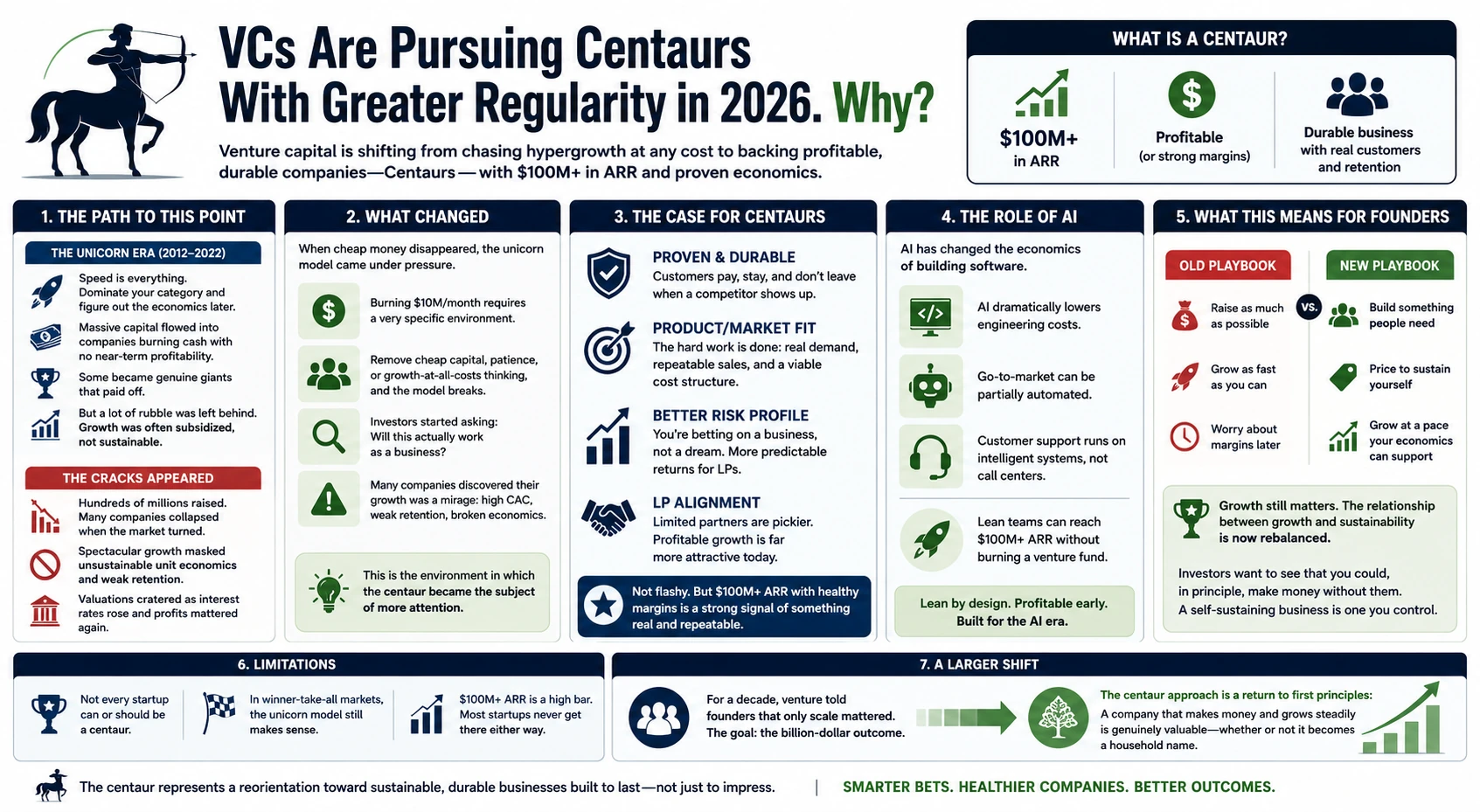
For a good number of years the venture capital world seemingly was primarily focused on finding the next billion dollar company before anyone else does. That approach essentially defined an entire generation of startup investing, and it worked fairly well for a number of entities and individuals.
Now a more subtle shift appears to be occurring that perhaps is not getting quite the amount of attention it deserves. Many of the shrewdest investors in the business are moving away from chasing hypergrowth at any cost and leaning toward something they’re (amusingly at best) calling the Centaur. These are companies that have crossed $100 million in annual recurring revenue and, more crucially, are actually making money rather than burning toward what is presumably guaranteed profitability someday. This very well may be the most important shift in venture thinking in a decade.
The path to this point
To understand why this matters, it’s helpful to briefly examine the extremes that took place during the unicorn focused era. From roughly 2012 to 2022, the prevailing logic was that speed is everything. Dominate your category and figure out the economics later. Investors poured money into companies that had never turned a profit and had no real short-term plans to do so. The goal was to get large fast enough that no others in the same domain could catch you. Some companies did just that and produced genuine giants that paid off.
However, this approach also led to a good deal of rubble. Companies raised hundreds of millions of dollars and then collapsed when the market turned. Businesses with spectacular growth numbers turned out to be subsidized by venture dollars rather than actual customer demand. Startups went public at insane valuations and then watched those numbers crater when interest rates rose and investors suddenly remembered that profits are a thing.
What changed
When cheap money disappeared, the entire logic of the unicorn model came under pressure. A startup burning $10 million a month needs a very specific environment to survive that includes readily available follow on capital, extremely patient investors, and a market that rewards growth over everything else. Take away any one of those things, and the calculus falls apart relatively quickly.
A lot of companies found out the hard way that their growth had essentially been a mirage. Their customer acquisition costs were unsustainable, retention was soft at best, and their primary economics were more than likely never going to work at scale. Investors started asking if a particular approach would actually work as a business.
This is the environment in which the centaur became the subject of more attention.
The case for focusing on these companies
The centaur is not an overly tantalizing idea for those steeped in a culture where a massive hit was of primary concern. A venture pulling in $100 million in recurring revenue with healthy margins doesn’t make for a particularly thrilling headline or press release. However, this level of production along with strong retention and reasonable margins tends to mean something durable. Customers are paying, remaining as viable sources of income, and not defecting the moment a competitor shows up. It means the company has already done the hard work of finding product/market fit, building a repeatable sales approach, and proving that its cost structure can support strong growth.
From an investor’s perspective, backing a centaur is a fundamentally different bet than working with a unicorn. You’re not betting on a dream. The risk profile is different and the return may be more modest, but it’s also more predictable. In a world where LP’s are getting pickier about where their money goes, this has become a lot more attractive than it used to be.
The role of AI
There’s certainly another reason the centaur model is gaining momentum right now, and it has everything to do with artificial intelligence. AI has dramatically lowered the cost of building software, and a small team today can build and ship a product that would have required dozens of engineers only a few years ago. If your engineering costs are a fraction of what they used to be, and your go to market function can be partially automated while customer support runs on intelligent systems rather than a call center, you can reach $100 million in ARR without torching a venture fund to get there.
Some of the most interesting companies being funded right now are doing exactly this. They’re lean by design and profitable early because they’ve built with these processes in mind from the ground up. These are the businesses investors are quietly getting excited about.
What this means for founders
If you’re building a company right now, this era has real implications for how you think about your projected path. The old approach called for raising as much as possible, grow as fast as you can, and worry about margins later. The new model that we are seeing with greater regularity calls for building something people genuinely need, price it so you can sustain yourself, and grow at a pace that your economics support.
This certainly doesn’t mean growth doesn’t matter. What it does outline is that the relationship between growth and sustainability has been rebalanced. Investors are no longer willing to fund the gap indefinitely, and they want to see that you could, in principle, make money without them. This understandably may feel more constraining for many, but a business that can support itself is one you actually control.
Limitations
Clearly not every startup can or should be a centaur. There are still industries where the winner take all dynamic applies and the most viable way to succeed is to grow faster than your competitors and worry about margins once you’ve locked up the market. In those cases, the unicorn model still makes sense, and the capital is still available for companies that can credibly make that case.
$100 million in ARR is not a small bar. Most startups never get there regardless of how profitable they are along the way.
But as a signal of what investors value and an indicator of where the best venture organizations are aiming their attention, the centaur matters. It represents a genuine reorientation away from growth at all costs and toward something more sustainable, durable, and often more interesting to build.
A larger shift
What’s most likely happening is a maturation of the industry. Venture capital spent a decade essentially telling founders that the only thing that mattered was scale. All should geared the pursuit of the billion dollar outcome. The centaur approach seems to be venture capital remembering something it used to embrace. A company that makes money and grows steadily is genuinely valuable, even if it never becomes a household name.