
Scaling Sales Engineering Teams in Rapidly Growing SaaS and AI Companies
Scaling Sales Engineering Teams in Rapidly Growing SaaS and AI Companies
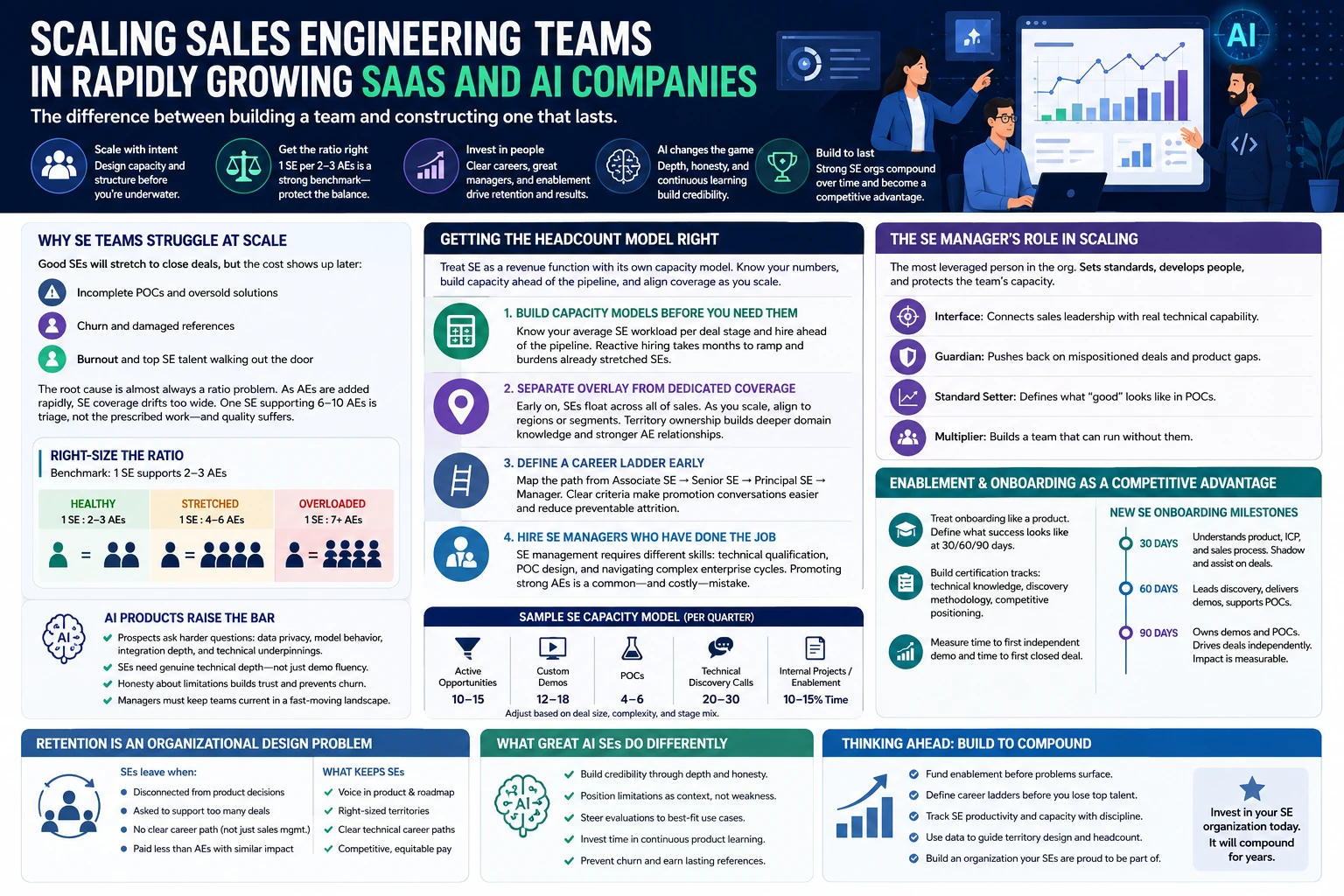
The SEs and SE managers who thrive through hypergrowth understand the difference between simply building a team and constructing one that lasts
Sales Engineering is often one of the most poorly understood functions in the SaaS and AI world. When a company is small, the SE role is relatively straightforward in that it generally requires one to be technical enough to answer hard questions, be adept enough to know when to stop answering them, and close the gap between what the product does and what the prospect believes it can do. That works fairly well at ten people or so but starts to break down somewhere above 25 based on our experience.
As SaaS and AI companies scale, the SE function faces pressures that most sales leadership is not prepared for. You cannot hire your way out of poor team design, and it’s difficult at best to attempt to compensate SEs generously enough to make up for unclear territory, undefined career paths, or being asked to cover more accounts than is reasonable. Yet these are exactly the traps that rapidly growing companies fall into on a regular basis because the urgency of revenue targets tends to crowd out the equally essential factor of building a sustainable organization. How are certain companies scaling SE teams in these environs without exhausting their best performers while others are less successful?
Why SE teams struggle at scale
There is often a delayed effect in this construct. A sales group that is too thin may miss quota while an SE team that is understaffed will still close deals for a period of time because good practitioners are resourceful and will generally find ways to stretch as needed. The cost, however, ultimately shows up elsewhere in the form of deals where a proper proof of concept never happened, customers who were oversold and churn in less than a year, and SEs who leave for companies where they feel like partners rather than a simple gear in the machine.
The root cause based on our work with these individuals over the years is almost always a ratio problem. SE to AE balances tend to drift wide during periods of rapid sales hiring because adding account executives is often a more rapid process and seems more directly connected to revenue than adding technical support. The commonly cited benchmark of one SE per two to three AE’s is not a universal law, but it reflects something real about the cognitive and logistical limits of the role. An SE covering six AE’s is not doing the prescribed work. Rather, they are effectively conducting triage at this juncture. Indeed, we recently worked with an individual who at one point was supporting 10 representatives located across the country. He’s much happier in his new role.
For AI companies specifically, the problem is compounded by product complexity. Prospects asking about AI capabilities are rarely asking simple questions. They want to understand data privacy, model behavior, integration depth, and often the technical underpinnings of something the product team itself has not yet fully documented. SE’s in this environment need genuine technical depth, not just demo fluency. You cannot stretch that skill set across an unreasonable book of business and expect quality.
Getting the headcount model right
Scaling SE staff starts with treating the team as a revenue function with its own capacity model rather than a shared resource pool. This means being honest about what an SE can actually support in a given quarter including the number of active opportunities, how many custom demonstrations are involved, how many proof of concept engagements are required, and the slate of technical discovery calls to tend to. Once you have that number, the headcount math becomes fairly straightforward. The problem, of course, is that most companies do not do this calculation until the team is already underwater.
Build capacity models before you need them
Know your average SE workload per deal stage and hire ahead of the pipeline rather than behind it. SE’s brought aboard reactively may take months to properly ramp up and are usually onboarded by other SE’s who are already stretched.
Separate overlay from dedicated coverage
In the early stages, SE’s often float across all of sales. As you scale, regional or segment specific alignment becomes important. Those who own a territory develop domain knowledge and AE relationships that generalist coverage is far more difficult to produce.
Define a career ladder before you have to improvise one
SE career progression is notoriously murky at many companies. Without a clear path from associate SE to senior SE to management, you will lose your best people to competitors who have figured this out. The conversation about a promotion is much easier when the criteria existed before the ask.
Hire SE managers who have done the job
SE management is not a natural transition from sales management. The skills are different as an SE manager needs to understand technical qualification, POC design, and the specific pressures SE’s face during complex enterprise cycles. Promoting a strong AE into an SE management role is a common and very often costly mistake.
The SE Manager’s role in scaling
At scale, the SE manager becomes the most leveraged person in the organization. A good SE leader acts as the primary interface between sales leadership and actual technical capability. They push back when a deal is being positioned incorrectly, identify when a product gap is becoming a competitive liability, and set the standard for what good looks like in a proof of concept. That standard either compounds or erodes over time. Those who succeed here build a team that can essentially run without them.
As teams grow, SE managers face a common dilemma of becoming the escalation point for every difficult technical question. This may seem productive as it keeps deals moving but, in reality, it often prevents the team from developing the depth to handle those questions themselves, and it makes the manager an unnecessarily narrow pathway in a function that should be moving at the pace of the sales cycle.
The managers who scale teams well tend to invest heavily in structured enablement by documenting evaluation frameworks, building POC templates and success criteria guides, creating internal knowledge bases that capture institutional knowledge that remains viable when a senior SE leaves. This work certainly seems slow and administrative compared to working a live deal, and it pays dividends for years.
Enablement and onboarding as competitive advantages
Fast growing companies often treat SE onboarding as a short orientation followed by shadowing senior team members. At small scale this works reasonably well. At larger scales it becomes a mechanism for propagating both good habits and bad ones, with no real way to distinguish between them at times.
The best SE organizations we’ve worked with treat onboarding as essentially a product. They define what a new SE should know at 30/60/90 days and build certification tracks around technical knowledge, discovery methodology, and competitive positioning. They tend to measure time to first independent demo and time to first closed deal as feedback loops for the onboarding program itself.
In AI companies this matters even more because the product realm tends to be broader and less intuitive than traditional SaaS. A new SE who cannot confidently explain how the model handles edge cases, or who cannot speak to the data architecture during a security review probably is not ready to represent the product in an enterprise cycle. Curtailing the technical depth of onboarding in favor of getting people in front of accounts faster is a form of questionable efficiency that tends to show up in lost deals.
Retention as an organizational design problem
SE continuity is a topic that comes up most urgently after someone skilled has already left and the conversation becomes reactive. The root causes, which are almost always structural rather than personal, tend to stay in place and the cycle repeats.
Sales Engineers leave for a relatively small set of reasons. They may feel disconnected from product decisions despite having the closest view of prospect objections. They are asked to support far too many deals. They don’t see a path forward that does not involve moving into sales management, which many we have worked with consistently have no interest in. They are paid less than their AE counterparts while very often carrying similar influence on deal outcomes.
Addressing these issues is not wholly a compensation problem in most cases. Instead, it’s essential to incorporate overall organizational design into the calculus. SE’s need structured mechanisms to bring product feedback into the roadmap conversation. Proper segments and territories small enough to allow genuine expertise are essential as are career paths that value deep technical and commercial skill, not just people management. Companies that build these structures tend to retain their SE’s.
What AI products change about the SE role
Selling AI products has introduced a new set of challenges for Sales Engineering teams that go beyond the usual domain complexity. Prospects evaluating AI solutions are often simultaneously excited and skeptical, particularly given the advances made in the past couple of year alone. The SE’s job in this environment is not just to demonstrate capability, it is to build technical credibility while navigating a good deal of uncertainty.
This requires SE’s who can have honest conversations about what the product does not do as well as what it excels at. Overselling AI capabilities is one of the fastest ways to produce churned customers and damaged references. The best SE’s at AI companies have learned to position limitations as context rather than weakness, and to steer evaluations toward the use cases where the product genuinely excels.
It also requires that SE managers stay current with an offering that changes faster than in traditional SaaS. Model updates, new integrations, and shifting competitive dynamics can reshape what a great demo looks like in a matter of weeks. Building time into team schedules for internal product learning, rather than treating it as something SE’s should absorb on their own time, is a sign of an SE organization that takes the complexity of its product seriously.
Thinking ahead
The companies that build strong Sales Engineering organizations tend to share one trait that we see on a regular basis – they treat the SE role as a function well worth investing in. Enablement programs are funded before the team complains about the lack of them. Career ladders are outlined before losing their first senior SE to a competitor with a better structure. SE productivity numbers are tracked with the same care they give to sales metrics, and they use that data to make decisions about territory design and headcount rather than waiting for anecdotal evidence of problems. Building an organization they deserve to work in is one of the most consequential investments a rapidly growing company operating in these spaces can make.
Renascent Solutions AI CXO/Sales/Sales Engineering Recruitment