
What Open Roles Are Really Costing Your Organization
What Open Roles Are Really Costing Your Organization
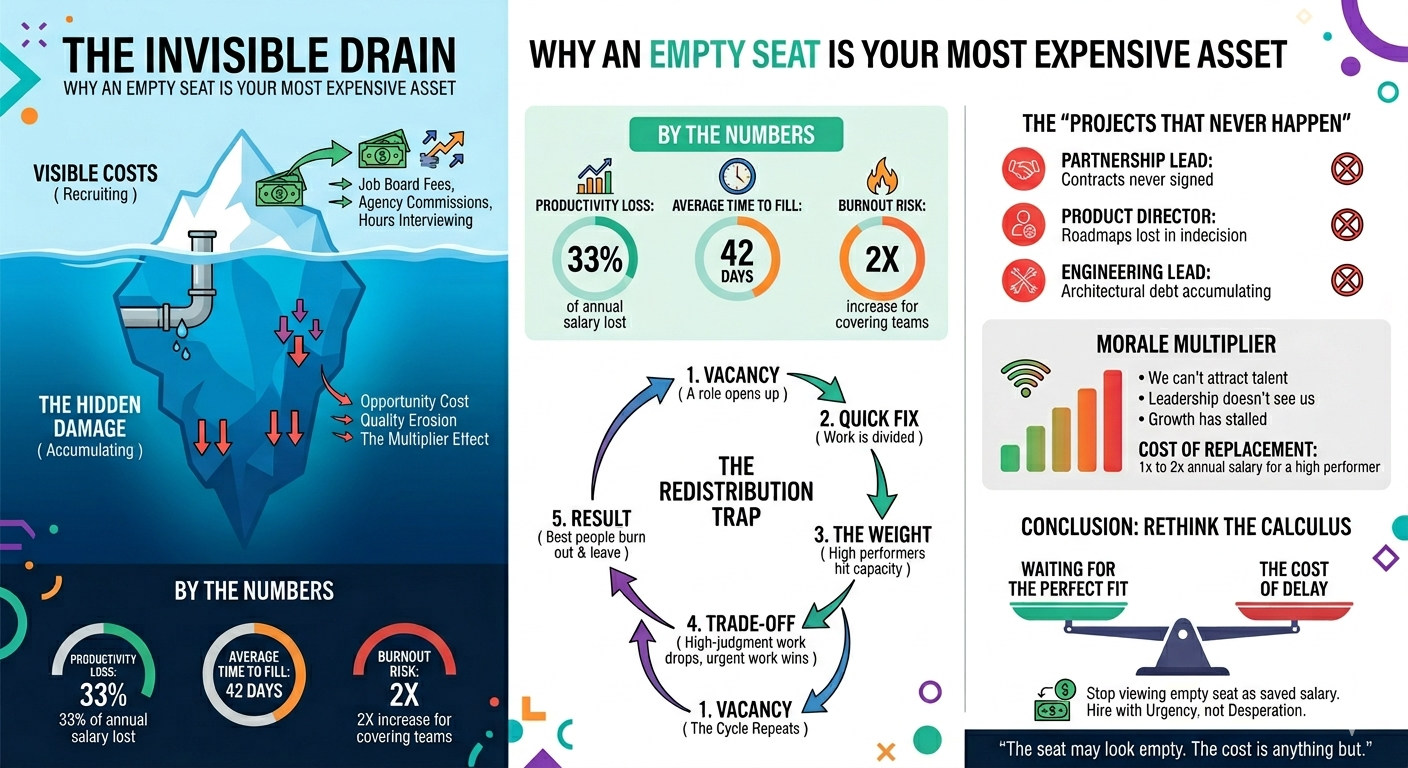
Every unfilled seat on your organization chart isn’t just a gap in headcount, it’s a drain on revenue, morale, and momentum that compounds with every passing week.
When a critical role goes unfilled, most leaders think about the recruiting costs that may include job boards, agency fees, and hours of interviewing. But that’s only the visible part of the necessary items that arise. The real damage often runs deeper, accumulating in ways that rarely appear on a single line of any budget.
Opportunity cost, by definition, is what you give up by not doing something. Applied to hiring, it means every week that a key position sits vacant your organization is choosing (even if unintentionally) to forgo the value that person would have created. This number is rarely zero, particularly for senior, specialized, or cross-functional roles.
• 33% of annual salary is lost per unfilled role in productivity costs
• It takes 42 day on average to fill a position across industries
• There is twice the burnout risk increase for teams covering vacant roles
The redistribution trap
The instinctive response to a vacancy is often redistribution of current employees and responsibilities. Managers divide the work among existing team members, frame it as temporary, and move on. This may feel responsible in the short term as work gets done, deadlines are met, and the situation looks manageable from the outside.
However, redistribution has a compounding cost. The people absorbing the extra load are typically already doing their jobs at capacity. When you add a second slate of responsibilities on top of that something has to give. Quality drops, timelines are stretched, or most often the highest-judgment, highest-leverage work quietly gets deprioritized in favor of what’s urgent. Over time this creates a slower, more insidious problem – your best performers, the ones capable enough to absorb extra work, are the most likely to burn out and leave. Unfilled roles, left unaddressed, often have a way of multiplying themselves.
The projects that never happen
Beyond the day-to-day workload impact, consider what a key role is actually positioned to create. A partnership lead who isn’t hired can’t develop the channel alliances that might have expanded your market. A product director opening that stays vacant means roadmap decisions get made in committees, often slowly and with less clarity. An engineering lead who isn’t in place means architectural debt accumulates while everyone waits for direction.
These are not hypothetical losses. They are readily measurable if you’re willing to take the time and effort to do so. Contracts are not signed, features go unshipped, and essential processes are not built. Each of these represents a competitive positions, customers, and revenue that is never earned. Most organizations choose not to track this because it requires imagining a counterfactual notion. What would have happened if that person had been here? It can be uncomfortable to quantify, but leaders who do the exercise often come away with a different sense of urgency about the cost of waiting.
The morale multiplier
There is a softer cost that nonetheless lands hard on the bottom line. When teams operate shorthanded for extended periods a message is transmitted which is not necessarily the one leadership intends.. People wonder whether the vacancy will actually be filled. They ask whether leadership understands how stretched thin they have become. Most importantly, they start recalibrating their own effort and expectations accordingly.
High performers in particular are acutely sensitive to organizational dysfunction. A sustained open role signals either that the company can’t attract talent or doesn’t prioritize filling it. Neither interpretation is good for retention. And the cost of losing a strong contributor (typically estimated at one to two times their annual salary when you factor in recruiting, onboarding, and lost productivity) makes a prolonged search look even more expensive in retrospect.
Rethinking the calculus of delay
None of this is an argument for reckless hiring or for filling seats with the wrong people. A bad hire compounds costs in its own way. The argument, rather, is for taking vacancy cost seriously as a real number when making resourcing decisions. That means building a realistic estimate of what a role’s output is worth per quarter. It also means accounting for the downstream effects on team capacity and morale. Proactively addressing this issue requires being honest about whether a prolonged search is being driven by genuine selectivity or by a slower, vaguer reluctance to commit.
Consequently, the organizations that hire with urgency rather than desperation tend to be the ones that compound their talent advantages year over year. They understand that every week of delay is a week of value lost, and they treat their open roles with the same seriousness they’d give any other strategic investment sitting idle. The seat may look empty. The cost is anything but.