
Latent Signals That Help to Predict Executive Success
Latent Signals That Help to Predict Executive Success
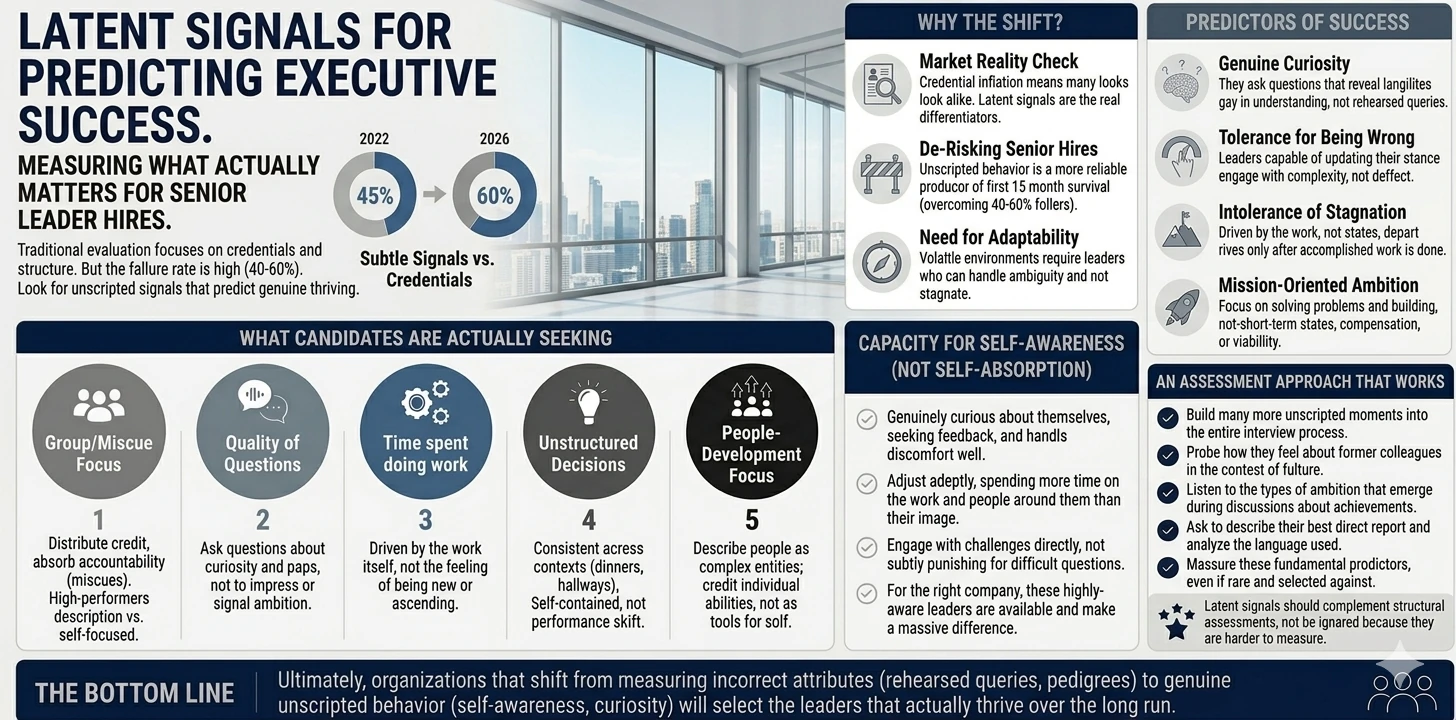
The best executive assessments happen in unscripted moments thus make certain to build more of them into your process.
Most companies spend an extended period of time carefully evaluating executive candidates. They scrutinize resumes, conduct panel interviews, check references, and commission all encompassing assessments. Nonetheless, the failure rate for senior leaders remains much higher than it effectively should be. Indeed, current studies consistently put it somewhere between 40% and 60% within the first 18 months of the hire.
The problem typically isn’t a lack of proper information. Rather, it’s that organizations keep measuring incorrect attributes. Traditional executive evaluation focuses on credentials, track record, and performance in structured settings. But the signals that actually predict whether a leader will thrive tend to be more subtle and often far more revealing. Here are a few items to take into consideration during the process.
How they feel about former colleagues
We’ve found it very instructive to ask an executive candidate about a past miscue and listen for the group of individuals they describe who were part of the event.
High performing leaders tend to distribute credit generously and absorb accountability personally. Those who may not be as adept, by contrast, tend to operate with a an approach where successes were theirs alone and failures had external causes such as market conditions, a difficult board, or an underperforming team they inherited. Either approach will most likely be reproduced during their tenure with your company.
The quality of their questions
During the portion of the interview process where candidates are invited to ask their own questions many use this juncture to signal ambition or engagement. These are perfectly OK, but they do tend to be rehearsed queries that only provide a pedestrian result.
The executives who tend to excel will ask questions that reveal genuine curiosity that follow something the interviewer said and that relay a tangible gap in the candidate’s understanding. They’re comfortable not knowing things, and they’re interested in the answer. The executives who struggle often ask questions designed to simply impress.
Their relationship with monotony
Elite executives are, as a rule, tolerant of ambiguity but deeply intolerant of stagnation. Pay attention to how candidates describe the moments that led them to leave previous roles. A productive pattern typically shows that they had accomplished what they and the company expected and they are seeking additional, interesting challenges that are no longer available in their current environment. An less than ideal response reads as disconnected from accomplishment with each departure often framed as someone else’s problem.
What you’re probing for here is the difference between a leader driven by the work itself and one propelled by the feeling of being new, ascending, or impressive. The former can weather the long trudge of any hard undertaking. The latter generally seems to require a good deal of unnecessary change.
How they function when a decision is not being made
In formal settings, most executives tend to look and act fairly similar. The differentiation shows up in unstructured moments such as the dinner before the board meeting, the hallway conversation before the interview officially begins, or an offhand comment about a particular subject.
High performing executives tend to be remarkably consistent across various contexts. The version of them that exists when nothing is at stake closely resembles the model that is employed when everything is crucial. They’re simply themselves.
Executives who eventually derail often display a notable shift between high stakes and low stakes environs. They can be more dismissive with assistants than with board members or suspiciously more candid in an array of situations.
Their tolerance for being wrong
Leaders who go on to succeed tend to engage with a challenge directly. They update, push back with evidence, or acknowledge the complexity of it. What they generally don’t do is deflect, convey confidence they don’t feel, or subtly punish you for asking a question they may not have a precise answer for. This capacity for self tempering is one of the most reliable predictors of executive effectiveness. It’s also one of the rarest traits to find, because the systems that produce senior leaders actively select against it.
Ambition
Ambition is certainly necessary. But it comes in an array of types, and not all of them age well in an executive role.
Ambition oriented toward the work involves building something, solving things, or changing something in the environment. Ambition oriented toward status, titles, compensation, visibility, and validation is another things entirely.
Both types can produce high performance in the short run. The difference shows up when significant adversity appears. The former type tends to intensify focus while the latter often leans to self-protection. The leader who was impressive on the way up may become a liability as things may falter internally.
What they say about the people below them
Ask an executive to describe their best direct report who they helped to developed. Then ask what made that person successful. Executives who build strong organizations tend to describe their people as complex entities and credit their individual abilities. Leaders who are less adept here often describe their best people as reflections of their own approach and proficiencies. It’s a subtle distinction, but it reveals something fundamental about whether an individual sees talent development as something they do for others or to them.
Differentiation
Ultimately, what ties all of these signals together is a single underlying trait – the capacity for self awareness without self absorption. The executives who succeed over the long run tend to be genuinely curious about themselves and will seek feedback, effectively handle uncomfortable information, and adjust adeptly. They spend more time thinking about the work and the people around them than about their own image and position. That combination is a bit more difficult to screen for, but properly doing so is well worth the time.