
The Future of Demand Generation in 2026
The Future of Demand Generation in 2026
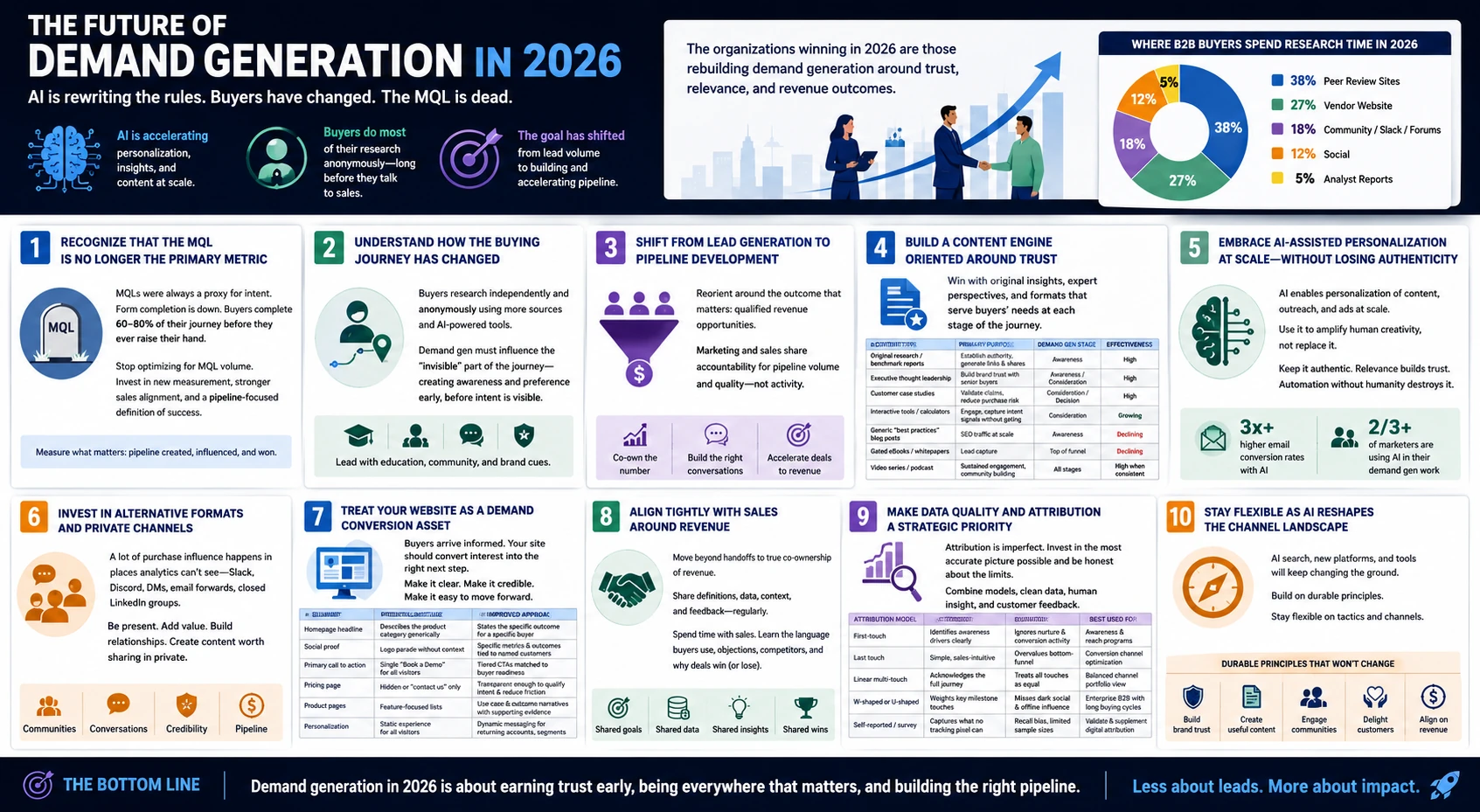
How the discipline is being fundamentally redrawn by AI, shifting buyer behavior, and the demise of the MQL
Demand generation is undergoing one of the most significant transformations in its history. The playbooks that drove consistent pipeline through 2020 are losing effectiveness at a noticeable rate, and the organizations succeeding today are those willing to rethink the discipline from its core principles. What follows is a practical examination of the forces reshaping demand generation, the tactics that are gaining traction, and the areas where we are seeing marketers make deliberate decisions about where they invest time and budget.
Recognize that the MQL is no longer the primary metric
For the better part of two decades, the marketing qualified lead served as the lead currency of demand generation. Gating content, scoring form fills, and handing off anyone who crossed a numerical threshold to sales became the default operating model. The problem is that this approach was always a proxy for intent rather than a direct signal of it, and buyers have simply stopped neatly adhering to this format. Form completion rates have fallen sharply across industries as buyers (including myself) increasingly expect to access information without surrendering their contact details. More importantly, they complete the vast majority of their evaluation process before ever engaging with a sales representative.
Organizations clinging to MQL volume as the primary success metric risk optimizing for an activity that no longer reliably predicts a realistic pipeline. The shift demands a different measurement infrastructure, relationship with the sales organization, and a revamped view of what constitutes demand generation success in the first place.
Understand how the buying journey has fundamentally changed
The modern B2B buyer conducts the overwhelming majority of their research independently and anonymously. Analyst data consistently points to buyers completing 60 to 80 percent of the decision process before initiating contact with a vendor. The implications of this have only grown more pronounced as buyers gain access to an expanding ecosystem of peer review platforms, analyst content, community forums, and AI powered research tools that allow them to build a sophisticated view of the competitive landscape without speaking to a single salesperson.
What this means from a practical standpoint is that demand generation must now work harder to influence the unviewable portion of the process. Creating awareness and preference before intent signals become visible is the central challenge, and the organizations doing this well are those investing in educational content, community presence, and brand cues that reach buyers in the research phase rather than only at the point of declared interest.
Where B2B Buyers Spend Research Time in 2026
• Peer Review Sites – 38%
• Vendor Website – 27%
• Community / Slack / Forums -18%
• Social -12%
• Analyst Reports – 5%
Shift from lead generation to pipeline development as the primary objective
A framework based on the pipeline reorients the entire demand generation function around the outcome that actually matters to the business – qualified revenue opportunities. This is not simply a renaming exercise as it requires marketing to take shared accountability for pipeline volume and quality alongside sales, to measure itself against those outcomes rather than activity volume, and to build programs that are explicitly designed to create and accelerate sales conversations rather than fill a lead database. This is a big shift for many.
Practically, this change involves a much tighter operating relationship with the sales team. Marketing needs visibility into which types of conversations are working and why, what objections are emerging in the sales process, and which accounts are showing buying signals without having yet engaged. This information should directly shape content development, targeting decisions, and campaign priorities.
Build a content engine oriented around trust, not just traffic
The volume of content produced across every industry has increased enormously, and AI generated information at scale has accelerated that trend dramatically. In this environment, material that simply covers a topic no longer creates differentiation. The organizations now earning the trust of buyers are those producing items that reflect genuine expertise and provides insight that cannot be found elsewhere.
This means investing in original research, producing material that draws on the distinctive experience of internal subject matter experts, and being willing to say something with a point of view. It also requires being thoughtful about format. Long-form editorial content, well-produced video, and interactive tools each provide different aspects of the research journey and should be developed with those specific units in mind rather than produced generically.
|
Content type |
Primary purpose |
Demand gen stage |
Effectiveness |
|---|---|---|---|
|
Original research / benchmark reports |
Establish authority, generate links and shares |
Awareness |
High |
|
Executive thought leadership |
Build brand trust with senior buyers |
Awareness / Consideration |
High |
|
Customer case studies |
Validate claims, reduce purchase risk |
Consideration / Decision |
High |
|
Interactive tools / calculators |
Engage, capture intent signals without gating |
Consideration |
Growing |
|
Generic “best practices” blog posts |
SEO traffic at scale |
Awareness |
Declining |
|
Gated eBooks / whitepapers |
Lead capture |
Top of funnel |
Declining |
|
Video series / podcast |
Sustained engagement, community building |
All stages |
High when consistent |
Embrace AI assisted personalization at scale without losing authenticity
AI tools now make it technically feasible to personalize content, outreach, and ad creative at a scale that was simply not possible with human resources alone. Dynamic landing pages that adjust messaging based on firmographic or behavioral signals, AI assisted email sequences that adapt based on engagement patterns, and generative content tools that can produce first drafts at volume are all mature enough now to deploy in a serious demand generation program. The organizations moving fastest here are treating this new tool as a force multiplier for human creativity rather than a replacement for it.
The risk that deserves close attention is the erosion of authenticity that comes from over automating buyer interactions. Personalization that feels mechanical or that clearly relies on surface level data signals can damage the very trust it is intended to build. The standard to apply is whether this type of message or experience would feel genuinely relevant and valuable to the recipient rather than simply technically customized. Email conversion rates are averaging numbers over three times higher using AI, and over 2/3 of those operating in these roles are now using it in some form.
Invest in alternative formats
Content sharing and conversations that happen in channels that are invisible to standard analytics (private Slack communities, Discord servers, direct messages, email forwards, and closed LinkedIn groups) are emerging as strong points of focus. A substantial portion of the word of mouth that drives purchase decisions happens in these channels, yet most demand generation programs are built entirely around measurable, attributable touchpoints that can’t effectively pull data from these sources.
The strategic response is not to try to surveil these conversations but to invest in being genuinely present and valuable in the communities where your buyers gather. This means participating meaningfully in relevant entities and industry forums, supporting user communities around your product, developing genuine relationships with the practitioners who are influential in your category, and creating content that is shareable in private contexts because it is genuinely useful rather than because it is designed to go viral. The payoff is longer term and harder to attribute, but the pipeline influence tends to be substantial.
Treat your website as a demand conversion asset and not just a simple brochure
For most B2B companies, the site remains the single highest leverage asset available, yet it is frequently under optimized relative to the budget invested in driving traffic to it. Buyers arrive having already formed a substantial portion of their view of your category and having conducted significant independent research. The job of the website is not to explain what you do at a general level but to convert a visitor’s existing interest into a meaningful next step.
This requires being quite honest about the conversion experience. Is it immediately clear what problem the company solves and for whom? Does the site offer credible evidence in the form of specific customer outcomes, third-party validation, and relevant use case detail? Are the calls to action calibrated to where buyers actually are in the process rather than asking every visitor to book a demo before they have enough information to know whether that is worthwhile? Investing in conversion rate optimization and personalization on the website frequently outperforms equivalent investment in additional traffic acquisition.
|
Element |
Potential mistake |
Improved approach |
|---|---|---|
|
Homepage headline |
Describes the product category generically |
States the specific outcome delivered for a specific buyer |
|
Social proof |
Logo parade without context |
Specific metrics and outcomes tied to named customers |
|
Primary call to action |
Single “Book a Demo” for all visitors |
Tiered CTAs matched to buyer readiness |
|
Pricing page |
Hidden or “contact us” only |
Transparent enough to qualify intent and reduce friction |
|
Product pages |
Feature focused lists |
Use case and outcome narratives with supporting evidence |
|
Personalization |
Static experience for all visitors |
Dynamic messaging for returning accounts, known segments |
Align tightly with sales around revenue, not just activity metrics
The tension between marketing and sales is one of the most reliably documented dynamics in B2B organizations, and it rarely serves either function well. The demand generation teams producing the best pipeline results are those that have moved beyond a handoff model toward genuine co-ownership of revenue. This requires shared definitions of what constitutes a qualified opportunity, shared visibility into pipeline data, regular joint reviews of what is working and what is not, and a willingness on marketing’s part to be held accountable for outcomes that extend beyond the initial touchpoint.
It also means that demand generation leadership needs to spend meaningful time with the sales team and make a full effort to understand the actual language buyers use, the objections that arise most frequently, the competitive dynamics in specific segments, and the deals that fell apart. These are invaluable input for building programs that create pipeline rather than simply generating activity. The organizations where marketing and sales genuinely trust each other tend to have structurally improved coverage thus the cultural investment required to build that relationship is well worth making.
Make data quality and attribution a strategic priority
Attribution in demand generation has always been imperfect at best, and the deprecation of third-party cookies, increasing privacy regulations, and the growth of latent social offerings have made it even more so. The response to this should not be to abandon measurement but to invest in building the most accurate possible picture of how marketing contributes to revenue while being forthright about the limits of what any model can tell you.
Multi-touch attribution constructs provide a more complete view, but they also require clean and complete data to produce useful results. Many organizations significantly underestimate the ongoing work required to maintain data quality across their marketing and CRM systems. Self-reported attribution, surveys asking customers how they heard about you, and regular pipeline reviews with sales to understand which programs are actually showing up in conversations are all valuable complements to automated attribution tools.
|
Attribution Model |
Strength |
Limitation |
Best Used For |
|---|---|---|---|
|
First-touch |
Identifies awareness drivers clearly |
Ignores all nurture and conversion activity |
Understanding reach and awareness programs |
|
Last touch |
Simple, sales-intuitive |
Overvalues bottom-funnel, ignores pipeline build |
Conversion channel optimization |
|
Linear multi-touch |
Acknowledges the full journey |
Treats all touches as equal regardless of influence |
Balanced channel portfolio view |
|
W shaped or U shaped |
Weights key milestone touches appropriately |
Still misses dark social and offline influence |
Enterprise B2B with long buying cycles |
|
Self reported/survey |
Captures what no tracking pixel can |
Recall bias, limited sample sizes |
Validating and supplementing digital attribution |
Stay genuinely flexible as AI reshapes the channel landscape
The pace of change in demand generation channels and tools has accelerated to the point where a strategy built in detail for a 24-month horizon is likely to require substantial revision before that window closes. The rise of AI powered search and answer engines is already beginning to reshape organic behavior in ways that will affect content strategy significantly. Platforms that represent major distribution channels today may shift in importance as buyer demographics and behavior evolve. New tools for identifying buying intent, for personalizing experiences, and for automating outreach are reaching maturity at an exceptionally rapid rate.
The practical response is to build programs on durable principles while maintaining genuine flexibility in the specific tactics and channels used to execute against them. Investing in building brand trust, creating genuinely useful content, maintaining excellent relationships with customers and the communities your buyers inhabit, and aligning closely with sales around pipeline outcomes are all principles that will remain sound regardless of how the channel landscape shifts.