
How to Align Sales Quotas With a Product Roadmap That Keeps Shifting
How to Align Sales Quotas With a Product Roadmap That Keeps Shifting
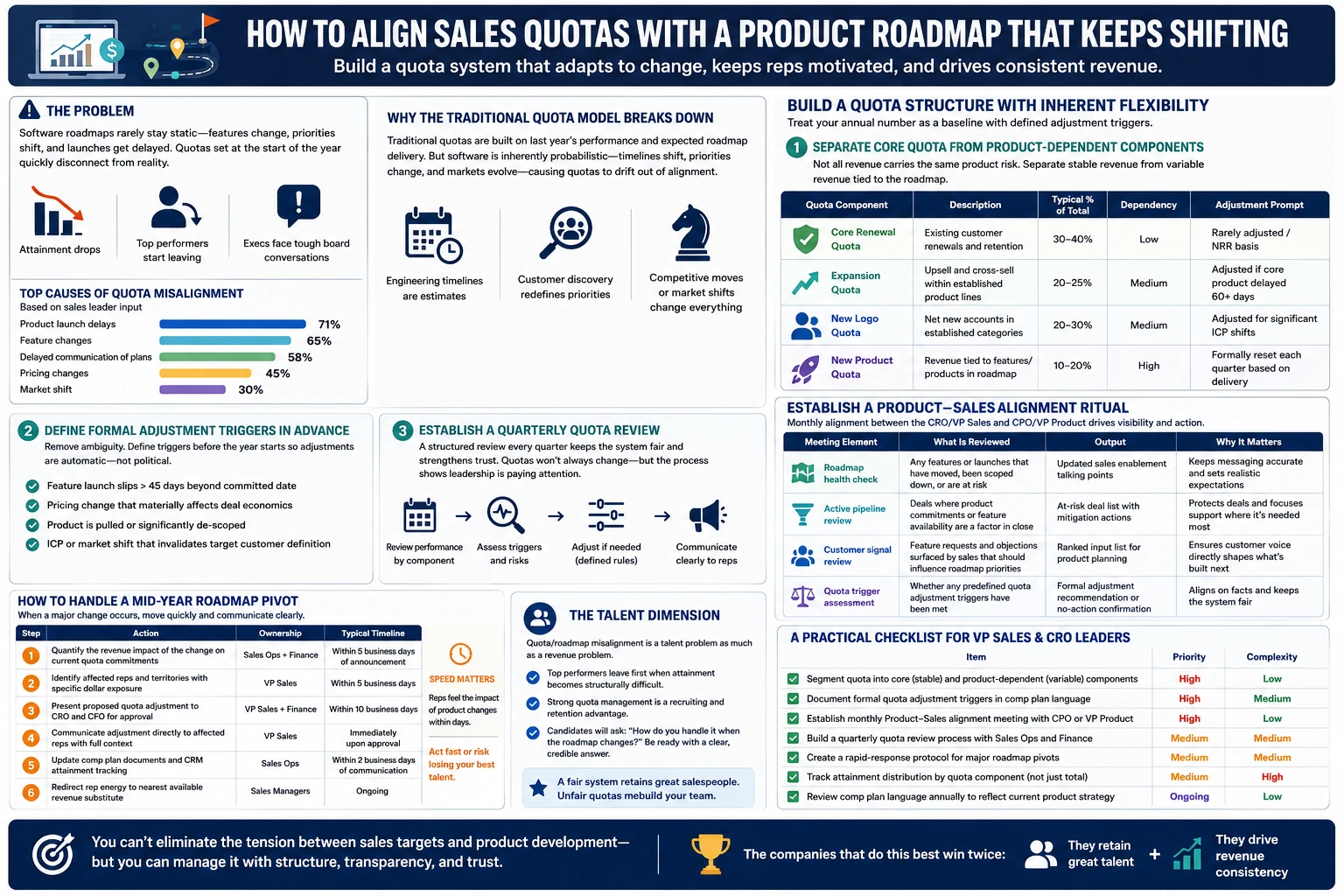
In software and SaaS companies the product roadmap rarely remains static
Features continually change, priorities shift, and launches that were planned for Q2 land two quarters later. For VP Sales and CRO leaders, this creates a chronic and often frustrating problem in that quotas set at the beginning of the year quickly become disconnected from what sales reps are actually being asked to achieve.
When that gap widens, the consequences are fairly predictable. AE’s feel set up to fail thus attainment rates drop, top performers start looking around, and executives find themselves in uncomfortable conversations with boards about revenue shortfalls that were not about market demand or team effort, but about structural misalignment between sales targets and product reality.
Thankfully this can be solved, and the companies that do so build a genuine competitive advantage in talent retention and revenue consistency. Here’s a practical framework for doing exactly that.
Why the Traditional Quota Model Breaks Down
Most quota processes follow a familiar rhythm. Finance sets a revenue number and sales leadership allocates it across territories and reps. The derived amount reflects last year’s performance adjusted upward for growth assumptions, and is often anchored to features or product lines that the roadmap is expected to deliver.
The problem is that software templates are inherently probabilistic as engineering timelines are estimates, customer discovery can redirect priorities in short order, and competitor moves/ acquisitions/shifts in buyer behavior can cause product leadership to reprioritize an entire plan in a single planning session.
Causes of quota misalignment based on sales leader input:
• Product launch delays – 71%
• Feature changes – 65%
• Delayed communication of plans – 58%
• Pricing changes – 45%
• Market shift – 30%
Build a quota structure that has inherent flexibility
The first structural change most organizations need to make is to stop treating the annual number to be obtained as a fixed contract and approach it as a baseline with defined adjustment triggers. This is about setting up the rules for how standards can be amended before the year starts, rather than negotiating under pressure after something goes wrong.
There are three components to a properly constructed adaptive quota model:
1. Separate core quota from a product-dependent template
Not all revenue targets carry the same product risk. Renewal revenue, cross selling into established product lines, and expansion within mature accounts are relatively immune to roadmap changes. New product introductions, upsells tied to features in development, and new market categories are highly dependent on delivery.
Structuring quota into these two realms allows you to hold firm on the stable portion while building in explicit adjustment language for the variable aspect.
|
Quota component |
Description |
Typical % of total |
Dependency |
Adjustment prompt |
|---|---|---|---|---|
|
Core Renewal Quota |
Existing customer renewals and retention |
30–40% |
Low |
Rarely adjusted/NRR basis |
|
Expansion Quota |
Upsell and cross-sell within established lines |
20–25% |
Medium |
Adjusted if core product delayed 60+ days |
|
New Logo Quota |
Net new accounts in established categories |
20-30% |
Medium |
Adjusted for significant ICP shifts |
|
New Product Quota |
Revenue tied to features/products in roadmap |
10-20% |
High |
Formally reset each quarter based on delivery |
2. Define formal adjustment triggers in advance
Ambiguity is certainly the enemy here. If adjustment conversations happen on a case-by-case basis, they become negotiating sessions that erode trust and consume management time. The better approach is to define the triggers clearly before the year starts so that adjustments are relatively automatic rather than political.
Examples of these events include: a feature launch that slips more than 45 days beyond the committed date, a pricing change that materially affects deal economics, a product being pulled entirely, or a shift in ICP that invalidates a territory’s target customer definition.
The companies with the healthiest sales cultures we work with are the ones where reps trust that the system is fair. That is built before the year starts.
3. Establish a quarterly quota review
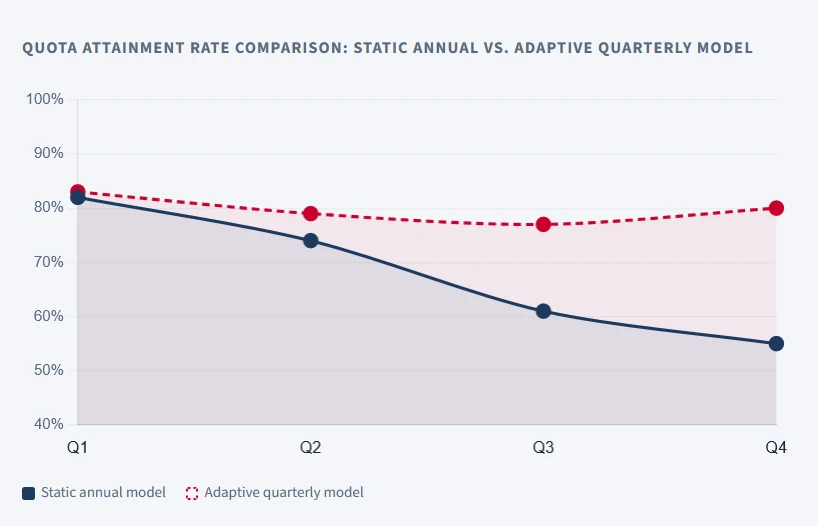
Annual quotas with quarterly checkpoints outperform plans that lock everything in on January 1 and revisit nothing until the end of the year. A structured review at this time does not mean quotas always change. Indeed, in most cases they will not. But the process signals to the sales team that leadership is paying attention and that the system is designed to stay fair.
Establish a product/sales alignment ritual
Quota structure is only half the solution. The other component is information flow and sales leaders need to know about roadmap changes as soon as they are substantive, not after the fact when reps are already in deals they cannot close. The most effective mechanism that we’ve seen is a monthly meeting between the CRO or VP Sales and the CPO or VP Product Management.
Meeting Element
What Is Reviewed
Output
Roadmap health check
Any features or launches that have moved, been scoped down, or are at risk
Updated sales enablement talking points
Active pipeline review
Deals where product commitments or feature availability are a factor in close
At-risk deal list with mitigation actions
Customer signal review
Feature requests and objections surfaced by sales that should influence roadmap priorities
Ranked input list for product planning
Quota trigger assessment
Whether any predefined quota adjustment triggers have been met
Formal adjustment recommendation or no-action confirmation
|
Meeting Element |
What Is Reviewed |
Output |
|---|---|---|
|
Roadmap health check |
Any features or launches that have moved, been scoped down, or are at risk |
Updated sales enablement talking points |
|
Active pipeline review |
Deals where product commitments or feature availability are a factor in close |
At-risk deal list with mitigation actions |
|
Customer signal review |
Feature requests and objections surfaced by sales that should influence roadmap priorities |
Ranked input list for product planning |
|
Quota prompt assessment |
Whether any predefined quota adjustment triggers have been met |
Formal adjustment recommendation or no-action confirmation |
This meeting works when both leaders treat it as a mutual accountability session. Product needs to hear where gaps are affecting revenue while sales needs to understand where promises are being made to customers that the product cannot fully support. Both sides benefit from the discipline.
How to handle a mid-year roadmap pivot
Even with the best systems in place, there will be quarters where a significant change requires a more substantial response. A major product delayed by two quarters, a strategic shift to a new market segment, or a decision to sunset a product line all have direct implications for quota attainability that cannot be handled through a routine adjustment.
|
Step |
Action |
Ownership |
Typical timeline |
|---|---|---|---|
|
1 |
Quantify the revenue impact of the change on current quota commitments |
Sales Ops + Finance |
Within 5 business days of announcement |
|
2 |
Identify affected reps and territories with specific dollar exposure |
VP Sales |
Within 5 business days |
|
3 |
Present proposed quota adjustment to CRO and CFO for approval |
VP Sales + Finance |
Within 10 business days |
|
4 |
Communicate adjustment directly to affected reps with full context |
VP Sales |
Immediately upon approval |
|
5 |
Update comp plan documents and CRM attainment tracking |
Sales ops |
Within 2 business days of communication |
|
6 |
Redirect rep energy to nearest available revenue substitute |
Sales managers |
Ongoing |
The speed of the response matters enormously. Reps in deals affected by a product change will feel the impact within days. If leadership takes three weeks to communicate a quota adjustment, those AE’s will have most likely already started updating their resumes.
The talent dimension
Quota/roadmap misalignment is not only a revenue problem, it’s also is a talent issue. The reps who leave first when attainment becomes structurally difficult are usually the best ones because they have options. Those who stay are often individuals who may have fewer alternatives or are simply waiting for the market to improve. That dynamic, left unaddressed, degrades a sales organization faster than any market downturn.
For leaders building or reconstructing a sales team in a company with an active product roadmap, this means that the quality of the quota management process is a recruiting and retention asset. Candidates at the VP and director level will ask about it directly. Your answer tells them whether the company understands the link between product and sales, and whether they will be set up to succeed.
When recruiting top sales talent into high-growth software companies, the question that comes up consistently is invariably some version of: “How does the company handle it when the roadmap changes?” A clear, credible answer to that is itself a competitive advantage in the talent market.
|
Item |
Priority |
Complexity |
|---|---|---|
|
Segment quota into core (stable) and product-dependent (variable) components |
High |
Low |
|
Document formal quota adjustment triggers in comp plan language |
High |
Medium |
|
Establish monthly Product-Sales alignment meeting with CPO or VP Product |
High |
Low |
|
Build a quarterly quota review process with Sales Ops and Finance |
Medium |
Medium |
|
Create a rapid-response protocol for major roadmap pivots |
Medium |
Medium |
|
Track attainment distribution by quota component (not just total) |
Medium |
High |
|
Review comp plan language annually to reflect current product strategy |
Ongoing |
Low |
There is no quota model that eliminates the friction between sales targets and product development. The two functions move at different speeds and answer to different pressures. The goal is not to eliminate that tension. Rather, it is to manage it with enough structure and transparency that sales teams remain motivated and leaders retain the talent they have worked hard to recruit.
The companies that do this best have a CRO and CPO who maintain a genuine working relationship where the rules for adjustment are written down before they are needed, and where reps know that if the product changes beneath them they will not be left holding a quota that no longer reflects reality. This organizational discipline is what separates companies that retain great salespeople from organizations that are perpetually rebuilding their teams.