
The Commercialization of Low Earth Orbit: Marketing to the New Space Economy
The Commercialization of Low Earth Orbit: Marketing to the New Space Economy
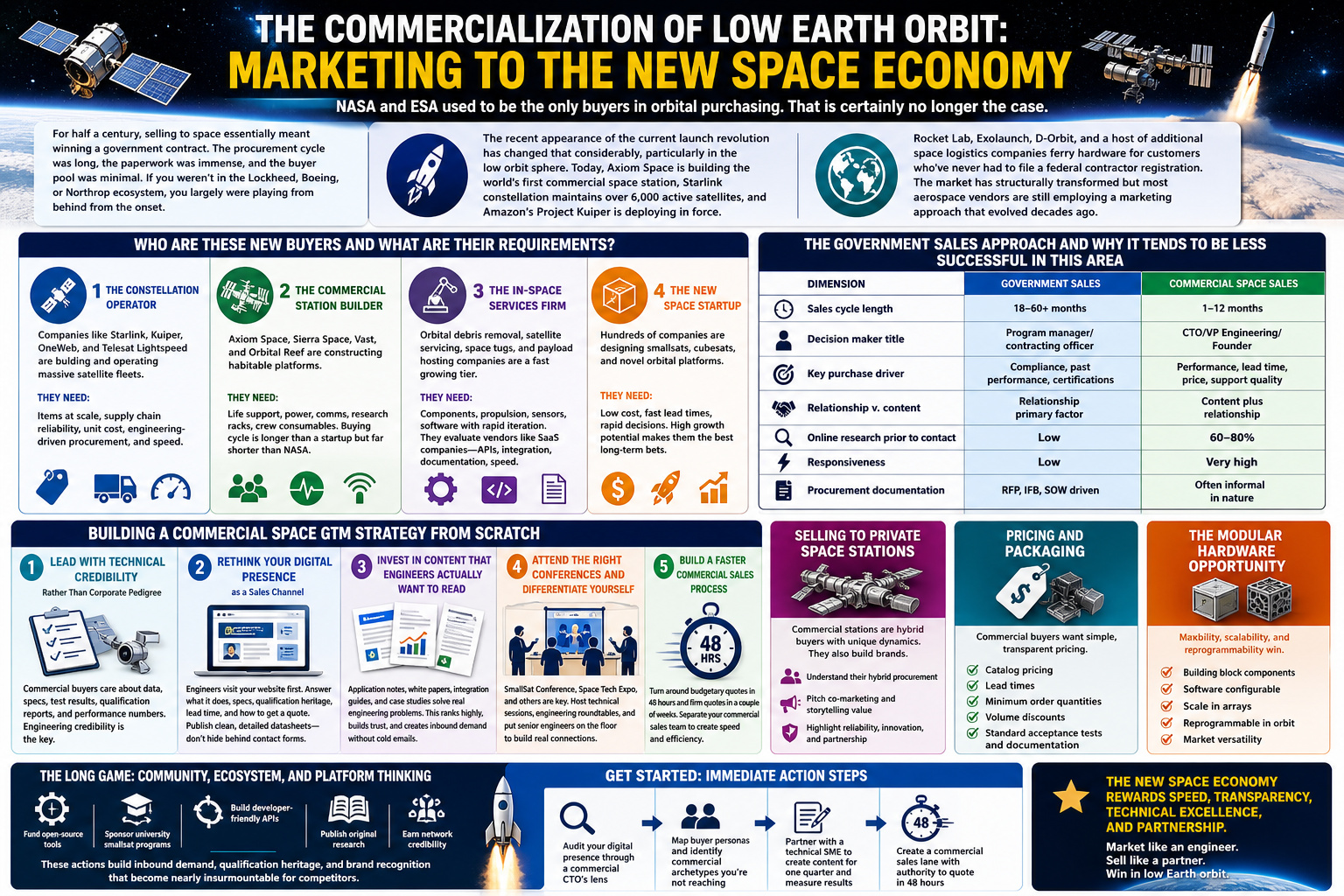
NASA and ESA used to be the only buyers in orbital purchasing. That is certainly no longer the case.
For half a century, selling to space essentially meant winning a government contract. The procurement cycle was long, the paperwork was immense, and the buyer pool was minimal. If you weren’t in the Lockheed, Boeing, or Northrop ecosystem, you largely were playing from behind from the onset. The recent appearance of the current launch revolution has changed that considerably, particularly in the low orbit sphere.
Today, Axiom Space is building the world’s first commercial space station, Starlink constellation maintains over 6,000 active satellites, and Amazon’s Project Kuiper is deploying in force. Rocket Lab, Exolaunch, D-Orbit, and a host of additional space logistics companies ferry hardware for customers who’ve never had to file a federal contractor registration. The market has structurally transformed but most aerospace vendors are still employing a marketing approach that evolved decades ago.
Who are these new buyers and what are their requirements?
The first mistake aerospace marketers tend to make is treating commercial space as a single monolith. The procurement culture of a VC-backed satellite startup is almost nothing like that of an entity on the opposite spectrum, and both are entirely different from the internal procurement teams at some of the aforementioned programs. Understanding buyer archetypes is and essential first step.
• The Constellation Operator
Companies like Starlink, Kuiper, OneWeb, and Telesat Lightspeed are building and operating massive satellite fleets. They buy items at scale and value supply chain reliability and unit cost above all else. Engineering-driven procurement rather than committee-driven acquisition is at the forefront and the time it takes to close matters greatly.
• The Commercial Station Builder
Axiom Space, Sierra Space, Vast, and Orbital Reef are constructing habitable platforms. Their requirements span life support systems, power management, communications, research rack hardware, and crew consumables. The buying cycle is longer than a startup but far shorter than NASA’s International Space Station procurement, for example. They also have marketing departments of their own and are sensitive to branding value.
• The In-Space Services Firm
Orbital debris removal, satellite servicing, space tugs, and payload hosting companies are a fast growing tier in this realm. Astroscale, ClearSpace, Impulse Space, and others are building service businesses along with the requisite hardware. This prompts a need for components, propulsion subsystems, sensors, and software with rapid iteration cycles. Many within these organizations come from software environs and tend to evaluate vendors the way a SaaS company weighs APIs. Namely, can they integrate a component with proper haste and does the documentation make sense to all of those invested.
• The New Space Startup
Hundreds of companies are designing smallsats, cubesats, and novel orbital platforms. They typically have constrained budgets and aggressive timelines thus they can be expected to make vendor decisions much more rapidly than those in other areas. However, they may be some of the best long-term bets given the potential growth.
The government sales approach and why it tends to be less successful in this area
Legacy aerospace marketing was built specifically to demonstrate compliance, build relationships with program officers, navigate FAR/DFARS, and wait for what hopefully will be a positive result. That’s a somewhat sensible strategy when the customer is the Department of Defense or NASA’s Science Mission Directorate simply because they have no choice but to follow the process as well. Commercial customers, however, take a much different approach.
|
Dimension |
Government Sales |
Commercial Space Sales |
|---|---|---|
|
Sales cycle length |
18-60+ months |
1-12 months |
|
Decision maker title |
Program manager/contracting officer |
CTO/VP Engineering/Founder |
|
Key purchase driver |
Compliance, past performance, certifications |
Performance, lead time, price, support quality |
|
Relationship v. content |
Relationship primary factor |
Content plus relationship |
|
Online research prior to contact |
Low |
60-80% |
|
Responsiveness |
Low |
Very high |
|
Procurement documentation |
RFP, IFB, SOW driven |
Often informal in nature |
Building a Commercial Space GTM Strategy From Scratch
Lead with Technical Credibility Rather Than Corporate Pedigree
Commercial space buyers aren’t overly concerned about how long you’ve been in business. They care more about data, your technical specifications, test results, qualification reports, and performance numbers. Engineering credibility is the key to this market.
Rethink Your Digital Presence as a Sales Channel
A commercial space engineer evaluating your propulsion subsystem will visit your website before they email you. This is your first sales call and it should answer what the product does, the specs, the qualification heritage, typical lead time, and how to get a quote. Companies that wall all technical information behind contact us forms lose commercial customers at the onset. Those who publish clean, detailed datasheets in accessible formats rise to the top.
Invest in Content That Engineers Actually Want to Read
Technical content marketing is the highest ROI channel in commercial aerospace. This includes application notes, white papers, integration guides, and case studies that solve real engineering problems. This content often ranks highly in searches, builds trust with engineers, and creates inbound demand without a barrage of cold emails.
Attend the Right Conferences and Differentiate Yourself
AIAA and IAC remain important, but the gravitational center of commercial space networking has shifted. SmallSat Conference, Space Tech Expo, and others have taken an important place in the schedule. The vendors who win commercial relationships host working technical sessions, engineering roundtables, and put senior engineers on the floor to complement reps.
Build a Faster Commercial Sales Process
Operators will not wait an extended period for a quote. Build a commercial sales structure that can turn around a budgetary quote in 48 hours and a firm quote in a couple of weeks. This likely requires separating your commercial sales team from the government proposal team, but it results in a system characterized by greater speed and efficiency.
Selling to Private Space Stations
Commercial space stations represent a unique category of buyer that didn’t exist a decade ago, and they have unique marketing dynamics worth understanding separately. Axiom Space, for example, is simultaneously a contractor (it has NASA contracts for ISS modules) and a commercial platform operator. Its procurement approach is hybrid where some acquisitions run through formal processes while others happen via engineering to engineering conversations at conferences.
The most important thing here is to understand that commercial station buyers are building brands of their own. If your product is reliable, innovative, and compelling, they may be interested in co-marketing by publicizing that their life support systems, communications hardware, or research equipment comes from you. This is a form of garnered media that has essentially no equivalent in government contracting, and able commercial vendors are learning to pitch the storytelling value of their partnership alongside the technical value of their product.
Pricing and Packaging
Government contracts are typically cost-plus or firm fixed price with deeply negotiated terms. Commercial buyers want something closer to what they experience in the rest of their supply chain such as a catalog price, a lead time, a minimum order quantity, and the possibility of volume discounts. If your current pricing structure requires a statement of work to generate a number, you may have a commercial pricing problem from the onset.
The answer for most aerospace suppliers is to develop a distinct commercial product line (even if the underlying hardware is identical to what you sell to government customers) with a separate part numbering structure, published catalog pricing, and a standardized set of acceptance tests and documentation packages that don’t require bespoke negotiation every time. This work is largely invisible to engineers but transformative for commercial sales velocity.
The modular hardware opportunity
Commercial constellation operators and smallsat builders are increasingly drawn to building block hardware components that can be configured in software, scaled in arrays, or reprogrammed in orbit. If your product line has this flexibility, it’s likely undermarketed to commercial audiences who prize versatility over engineering.
The Long Game: Community, Ecosystem, and Platform Thinking
The most durable commercial space marketing strategy isn’t a campaign. Rather, it’s building a position inside the engineering community that generates inbound demand continuously. The companies doing well here are funding open-source simulation tools for mission planning, sponsoring university smallsat programs that become talent pipelines, building developer friendly APIs for their software defined hardware, and publishing original research that outlines their own qualification data. The suppliers who understand this earliest will accumulate network credibility, qualification heritage with commercial operators, and brand recognition in engineering communities that become nearly insurmountable for others.
Reorienting a marketing and sales organization from government first to include commercial options is a multi year program. The first steps can be achieved immediately by auditing your digital presence under the purview of a commercial CTO doing a supplier evaluation. Map your current buyer personas and identify the commercial archetypes you’re not currently reaching. Utilize a technical subject matter expert as part of a content creation partnership for one quarter and measure the inbound traffic it generates. Create a commercial sales lane with authority to quote in 48 hours.