
Transitioning a Top AE to Sales Manager: Why It Often Fails and How to Fix It
Transitioning a Top AE to Sales Manager: Why It Often Fails and How to Fix It
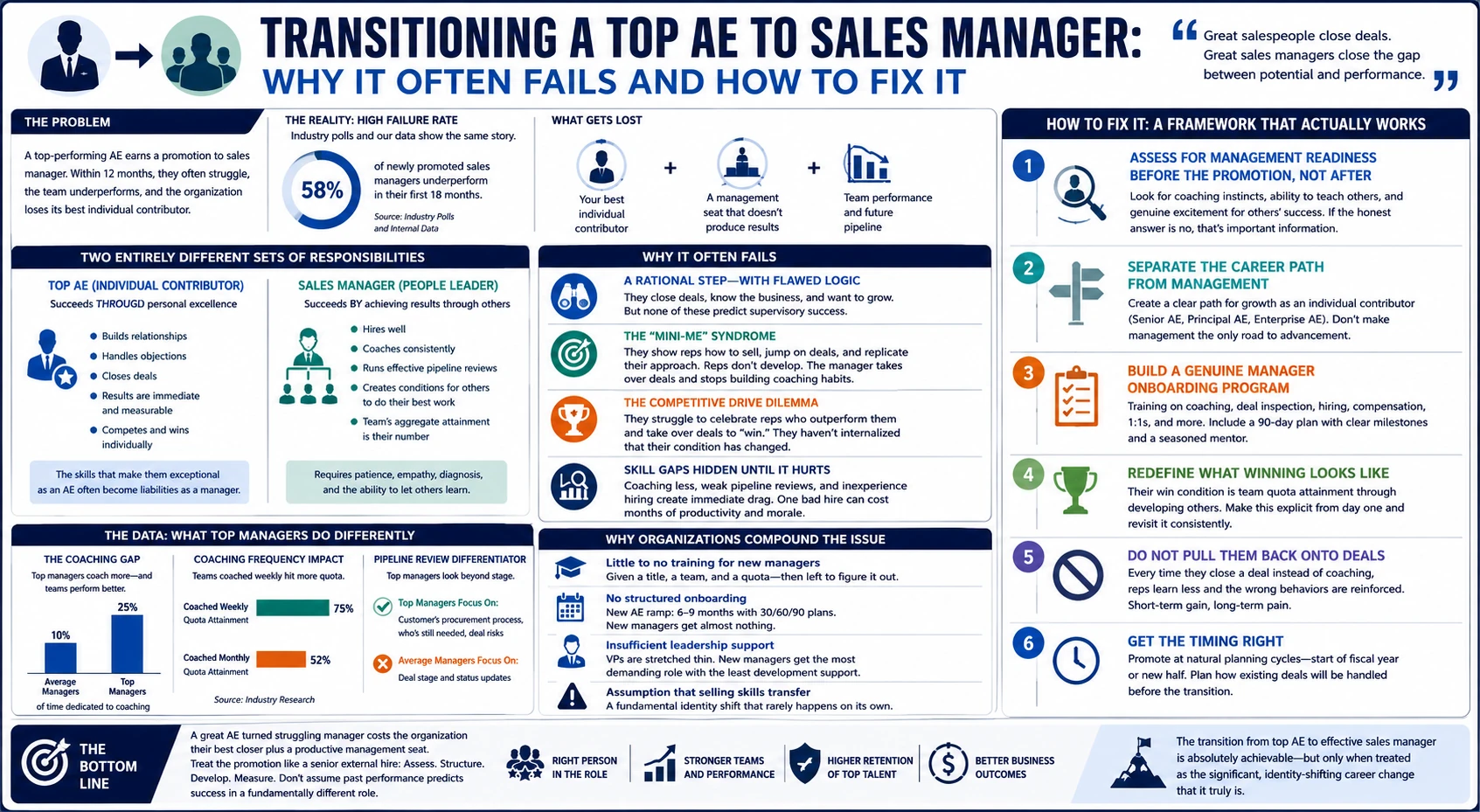
There is an organizational move that takes place in sales organizations that results in a seemingly high failure rate
A top-performing account executive may close out another strong quarter and leadership, wanting to reward performance and retain the talent, offers a promotion to sales manager. The individual accepts the new role and within twelve months they very often may be struggling as the team underperforms and, in the process, the organization has lost its best individual contributor.
Industry polls and our own data convey the belief by many companies that promoting a top-performing individual contributor to sales manager is often a bad idea. This certainly is not to say that it can’t work. Rather, why does it so often result in less than expected achievement and what changes when organizations get it right.
Two entirely different sets of responsibilities
One of the most persistent myths in sales management is that great selling and managing share a common foundation. A top AE succeeds through personal excellence, competitive drive, and individual accountability. Their results are immediate and measurable, and they are attained by being better than their peers at building relationships, handling objections, and closing deals. The skills that make them exceptional are, in many respects, the exact abilities that often become liabilities once they become a manager.
A sales leader, on the other hand, succeeds by achieving results through others. Their team’s aggregate attainment is their number, which means their personal performance depends entirely on hiring well, coaching consistently, running effective pipeline reviews, and creating conditions in which a group of people can do their best work. The skills required are fundamentally different and require patience, empathy, the ability to diagnose skill gaps, and the willingness to let people learn through mistakes rather than stepping in to fix everything personally. This is a transition he transition that many people simply cannot make.
It seems to be a rational step
Organizations promote top AE’s for understandable reasons. They’ve demonstrated the ability to close deals, which suggests credibility with the team as a whole. They know the product, the competitive landscape, and the customer and have made it known that they want to stay and grow. A management title is the most visible path up. This allows leadership to retain a high performer and fill an open slot at the same time. What this logic may miss is that none of those factors predict supervisory success.
The new manager often arrives with a very specific vision of what good sales leadership looks like. They will show the team how they sell, join deals to help them close, and essentially replicate their own approach across the group. The consequences of this approach are often predictable. Reps do not develop because the manager jumps in before they can learn. The manager, frustrated that the team is not performing the way they did, spends increasing time on deals they have effectively taken over. They stop building the coaching habits that actually compound into strong team performance and performance against quota decreases.
The competitive drive dilemma
Top salespeople are, almost by definition, intensely competitive. They keep close watch on the leaderboard, compare themselves to peers, and maintain a strong desire to win.
However, this is often not properly directed in the new position as many will struggle to genuinely celebrate a rep who exceeds their own former numbers or resist developing talent that might outperform them. They take over deals in the final stage not just because it is the easier path but because closing is still the skill that feels like winning to them. They have not yet internalized that their condition has changed.
What top managers tend to do differently
The data on high-performing sales leaders is fairly consistent and certainly instructive. Those who are effective in the role tend to dedicate roughly 25% of their time to coaching, compared to about 10% for average managers. That gap translates directly into team performance as teams where reps are coached weekly reach about 75% of quota. When coaching drops to monthly, attainment falls to just north of 50%.
Top managers are also distinctive in how they operate pipeline reviews. Rather than focus solely on the stage of the deal, they also place importance on what the customer’s procurement process look like and who still needs to be involved. Most newly promoted managers have never been trained to make this distinction so they default to status checks and their reps stop growing.
Recruitment is another dimension where the skill gap is often invisible until it creates real damage. A high performing AE may have never hired anyone thus they have no framework for evaluating talent, no experience with interview design, and no instinct for who will actually succeed in that environment. A single bad hire costs the team productivity, morale, and often the manager’s own time for months. This is where our services have proven to be invaluable.
Why organizations can compound the issue
Most newly promoted sales directors receive little if any meaningful management training. They are given the title, a team, and a quota, and then largely left to figure it out. The expectation, implicit but often very pervasive, is that the skills that made them a great AE will surely transfer with some adjustment. This is a fundamental identity shift and it rarely happens on its own.
The absence of a structured onboarding process for new managers is striking given how carefully most organizations ramp new sales reps. Industry average ramp time for a new AE is six to nine months, with structured 30/60/90 day plans, coaching sessions, and milestone reviews. The typical new sales manager gets nothing close to this.
There is also a structural problem with the support available to new managers. Their own boss, typically a VP of Sales or Director, is often stretched too thin to provide the kind of consistent coaching the new manager needs to develop well thus they assume one of the most demanding roles in the organization with the least dedicated development infrastructure around them.
How to Fix It: A Framework That Actually Works
The organizations that we’ve seen make this transition successfully do several things differently from those that do not.
Assess for management readiness before the promotion, not after
The qualities that predict managerial success are not the same as the skills that drive individual selling performance. Look for evidence that the candidate already demonstrates coaching instincts. Do they help teammates without being asked? Do they articulate their own approach in ways that others can replicate? Are they genuinely excited by others’ success? If the honest answer is no, that is important information to utilize.
Separate the career path from management
One of the most useful structural changes a sales organization can make is creating a clear route for individual contributors to grow in compensation, title, and recognition without requiring a move into management. When the only road to career advancement runs through a management role, high performers accept promotions they are not suited for because there is no alternative. Senior AE, Principal AE, and Enterprise Account Executive tiers can provide meaningful expansion without forcing people into positions that do not fit them.
Build a genuine manager onboarding program
The transition into management deserves structured support at least as rigorous as what the organization provides to new reps. That means explicit training on coaching methodology, deal inspection frameworks, hiring practices, compensation plan design, and how to run a one on one conversation that develops a rep rather than just extracting deal status. It also means a 90-day plan with clear milestones along with a mentor who is ideally a senior manager who has made this transition successfully and can provide a real world reference point.
Redefine what winning looks like
The manager needs to internalize their new success metric from day one. Their win condition is now team quota attainment rather than personal achievement, and the path to it runs entirely through the development of other people. Making this explicit, and revisiting it consistently in the manager’s own meetings with their leader, is more important than any specific tactical skill.
Do not pull them back onto deals
The instinct, especially early in the transition when the team is struggling, is to let the new manager get involved in deals to help the team hit the number. This is a short-term fix that creates an extended problem. Every time the manager closes a deal instead of coaching a rep to do so the AE learns less and the manager reinforces the wrong approach. The team’s current quarter number may benefit, but the ability to perform independently next quarter will not.
A thought regarding timing
One factor that is often overlooked when considering this type of transition is timing within the sales year. Promoting a top AE mid-year, particularly in a period when they are in the middle of a large pipeline, creates an immediate conflict. Do they see out the deals they have been working or hand them off? Either path creates drag and neither is ideal. When the promotion is being considered, the question of how the existing deals in play get managed is worth answering precisely well before the transition date. Those in late stages typically stay with the promoting rep through closure. Clean transitions happen at natural planning cycles thus the start of the fiscal year or beginning of a new half.
An honest calculation is necessary
Every organization eventually faces the version of this question. Is a particular individual better deployed as a manager or as a senior individual contributor? Getting that answer wrong is costly in multiple ways. A great AE turned struggling manager costs the organization their best closing resource plus a functional management seat. The question of what to do next, whether to move them back into an individual contributor role, create a new structure, or part ways entirely, is far harder to answer than the original promotion question would have been.
The organizations that handle this well are the ones that treat the promotion decision with the same rigor they would apply to a senior external hire. They assess, structure, develop, and measure all essential items outline above. Most importantly, they do not assume that performance in one role predicts excellence in a fundamentally different one.
The transition from top AE to effective sales manager is absolutely achievable and we’ve been a part of many. However, it requires treating it as the significant, identity shifting career change that it actually is, rather than a simple, natural next step.