
Hiring a CRO for a Tech Company – What Most Boards Get Wrong
Hiring a CRO for a Tech Company – What Most Boards Get Wrong
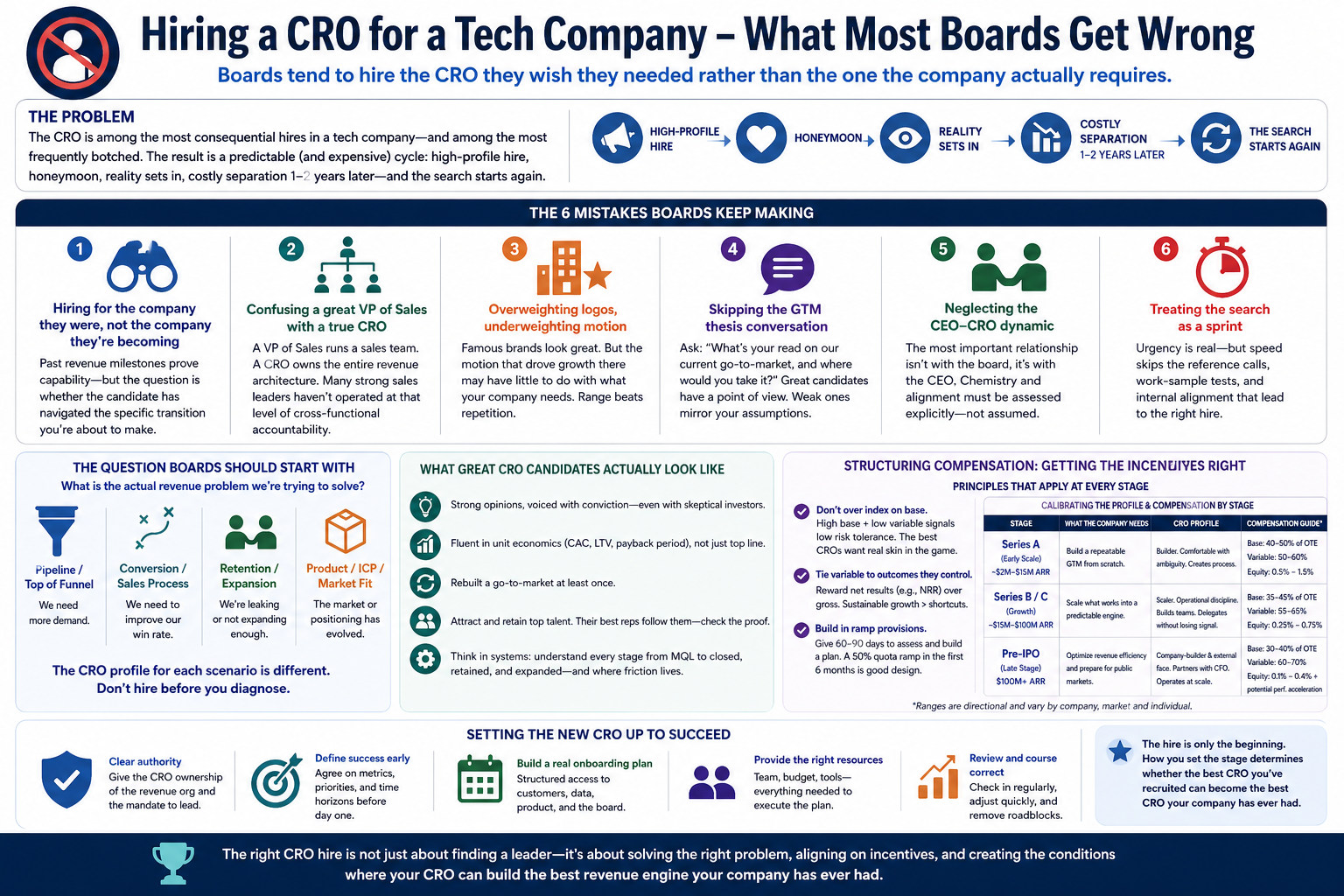
Boards tend to hire the CRO they wish they needed rather than the one the company actually requires.
The Chief Revenue Officer is among the most consequential hires a tech company can make, and among the most frequently botched. That mismatch is expensive, and it’s almost always avoidable. This is not because boards lack intelligence or seriousness, but often this comes about due to the fact that the role is genuinely complex, the signals are easy to misread, and the pressure to fill the seat quickly tends to compress exactly the kind of deliberate, rigorous thinking the decision demands. The result often is a predictable pattern that includes a high-profile hire, a honeymoon period, a gradual dawning that something isn’t quite right, and a costly separation 1 to 2 years later. Then the cycle starts again. Understanding why this happens and what to do differently begins with diagnosing the most common failure points at the board level.
The 6 mistakes boards keep making
Hiring for the company they were, not the company they’re becoming
The CRO who thrived in a $10M ARR land-and-expand model is not automatically the right person to lead a $100M ARR enterprise organization. Boards often anchor on past revenue milestones as proof of capability, but the relevant question is whether a candidate has navigated the specific transition the company is about to undergo.
Confusing a great VP of Sales with a true CRO
These are different jobs. A VP of Sales runs a sales team. A CRO owns the entire revenue architecture that includes aligning sales, marketing, customer success, and often product around a unified commercial strategy. Many strong sales leaders have never had to operate at that level of cross-functional accountability, and placing them in a CRO seat without proper readiness sets everyone up to fail.
Overweighting logos, underweighting motion
Boards love recognizable brand names on a resume. But the motion that drove growth at those companies may have little to do with what your company needs. A candidate who rode a product-led growth wave at one firm and a high-touch enterprise team at another has range. A candidate who did the same thing at five famous companies may be a specialist in disguise.
Skipping the GTM thesis conversation
The single most revealing interview question for a CRO candidate is deceptively simple: “What’s your read on our current go-to-market, and where would you take it?” A great candidate has a specific, differentiated point of view within two conversations. A weaker candidate gives you a mirror that reflects your own assumptions back at you with enthusiasm. Boards that don’t push hard on this question hire echo chambers.
Neglecting the CEO–CRO dynamic
The most important relationship in a CRO’s success isn’t with the board, it’s with the CEO. If the CEO is founder-led and deeply involved in sales, a CRO who needs full autonomy will chafe in a number of ways. If the CEO wants to step back from revenue, a CRO who defers upward will frustrate many involved. Boards must assess this chemistry explicitly and not simply assume it will work itself out.
Treating the search as a sprint
When a revenue gap is widening, urgency is understandable. But a compressed search systematically skips the reference calls and other relevant actions that reveal how someone actually operates under pressure, the work-sample conversations that test real thinking, and the internal alignment that ensures the company is ready to receive a new leader. Speed in CRO hiring almost always costs more time in the end.
The question boards should start with
Before evaluating a single candidate, a board needs an honest answer to the question of what is the actual revenue problem we’re trying to solve? Although this sounds obvious, it rarely gets answered with precision. Is the issue pipeline generation and thus a marketing and top-of-funnel problem? Perhaps it’s a conversion issue which leads us to a sales process and qualification dilemma. It’s also essential to determine if retention and expansion are primary concerns which may indicate a customer success and product blocking point. Perhaps the the ICP has evolved and the go-to-market hasn’t caught up. The CRO profile for each of these scenarios is meaningfully different and a hire made before this diagnosis is complete is often a guess at best.
What great CRO candidates actually look like
These individuals tend to have strong opinions and are willing to hold them in the room with skeptical investors. They can speak fluently about unit economics (CAC, LTV, payback period) not just top line metrics. They’ve rebuilt a go-to-market at least once rather than simply inherited and optimized one. They attract strong salespeople, which means you can check this with reference calls and other forms of proof. If a number of their best reps follow them from company to company we can certainly deem this as a strong factor of competence.
Critically, these executives understand that revenue in a tech company is a system rather than a function. They think about how marketing qualified leads become sales opportunities that lead to closed business along with retained and expanded accounts, and they can identify where friction resides at each stage. That type of systems-thinking orientation is often the sharpest differentiator between a VP of Sales with a new title and an actual Chief Revenue Officer.
Structuring compensation: getting the incentives right
Compensation for a CRO is one of the most consequential (and most frequently errantly structured) elements of the hire. Get it wrong and you either lose the candidate, attract the wrong one, or create misaligned incentives that undermine performance from day one. The core principle here is that CRO compensation should reflect the maturity of the revenue engine, the risk profile the company is asking the executive to accept, and the time horizon over which results are expected. These variables shift significantly by stage which is why a one-size-fits-all approach almost always misfires.
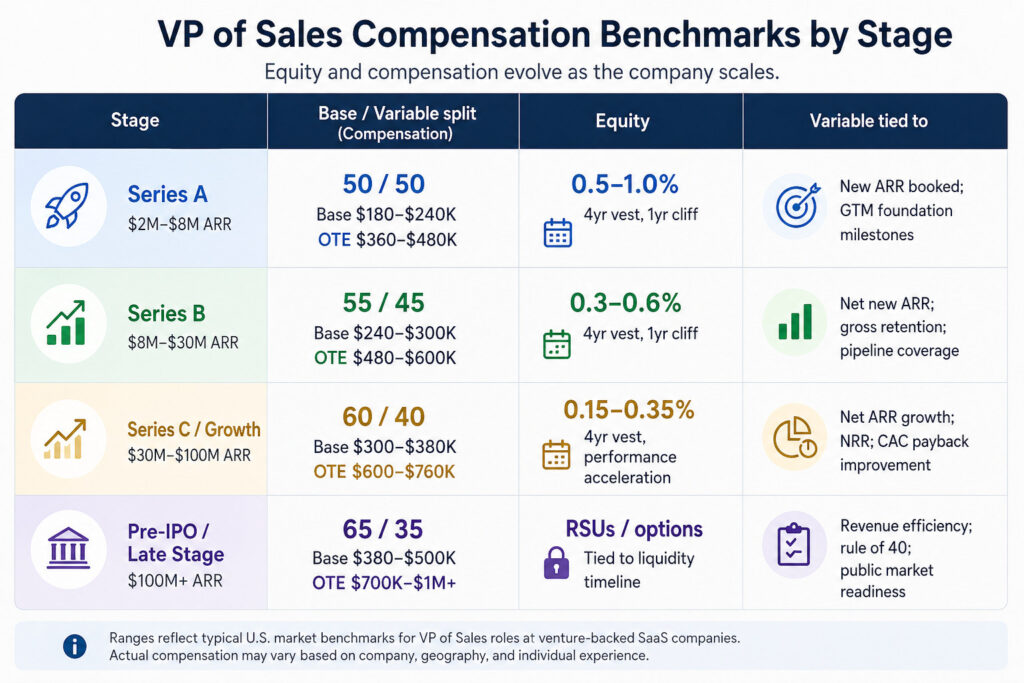
A few principles that apply regardless of stage:
Don’t over index on base salary. A CRO who negotiates hard for a high base and soft variable is signaling something about how they think about risk and accountability. The best revenue leaders want meaningful skin in the game and they’re confident in their ability to hit the number.
Tie variable numbers to outcomes they can actually control. Paying a CRO on gross revenue without accounting for churn or pricing mix creates an incentive to close bad business. Net revenue retention may often be a far better primary metric at growth stage and beyond as it rewards building a sustainable revenue engine, not just a leaky one that books at a more rapid pace.
Build in ramp provisions. A CRO joining a new company generally needs 60 to 90 days to properly assess the existing team, understand the pipeline, and form a credible go to market view before committing to a number. Boards that set full quota from month one often force CROs into short-term tactics that undermine long-term architecture. A 50% quota ramp in the first half year is good design in addition to building the confidence of all parties.
Revisit equity benchmarks annually. At earlier stages equity is a primary attraction and retention tool. During later movement the dilution math changes and many strong candidates will be comparing your offer against liquid compensation elsewhere. Boards that are inflexible on equity ranges often lose candidates in the final step of a search for reasons that were entirely predictable.
Calibrating the profile by stage
Beyond compensation, the right CRO profile shifts meaningfully as a company scales. At Series A, you’re often hiring a builder who can create repeatable processes from scratch, is comfortable without infrastructure, and won’t be paralyzed by ambiguity. The job is to find what works, not to optimize what already does.
At Series B and C, the profile shifts toward a scaler. You need someone who has managed teams of meaningful size, can delegate without losing signal, and brings enough operational discipline to turn early traction into a predictable operation. The ability to recruit and develop talent matters as much as personal sales excellence at this stage.
At pre-IPO scale, the CRO is increasingly a company-builder and an external face of the company. Someone who can operate alongside a CFO on efficiency metrics, can speak credibly to public market investors about the revenue model, and has the ability to manage an organization of hundreds without losing strategic clarity. This is a fundamentally different person than the Series A builder, and boards that use the same search criteria across stages consistently make expensive category errors.
Setting the new CRO up to succeed
Even the right hire will underperform in the wrong conditions. Boards can influence this more than they often realize. That means ensuring the CRO has clear authority over the revenue organization. It also requires agreeing on success metrics before the start date rather than after. Building a real onboarding plan that includes structured access to customers, the data, the product team, and the board itself is also essential. The hire is only the beginning. How you set the stage determines whether the best CRO you’ve ever recruited can actually become the best CRO your company has ever had.