
How Leadership Expectations Are Changing in the Era of AI
How Leadership Expectations Are Changing in the Era of AI
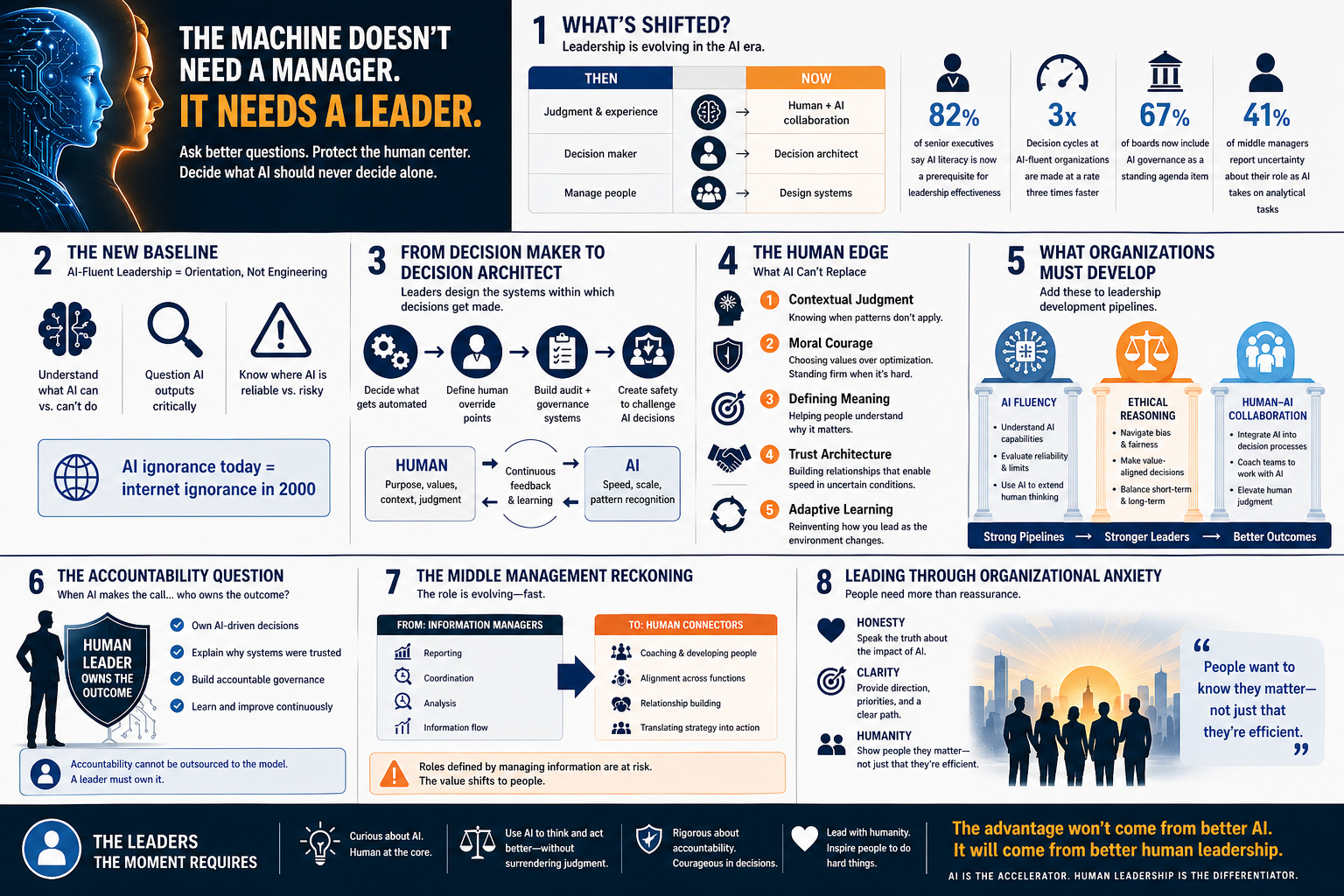
The machine doesn’t need a simple manager, it needs a leader who can ask the right questions, maintain the human center, and decide what the algorithm should never decide alone.
Something fundamental has shifted in the nature of what organizations now need from the people perched at the top. For decades, leadership was largely a function of judgment, experience, and the ability to mobilize other humans. The arrival of capable artificial intelligence has inserted a new variable into the management equation, and the organizations that recognize this earliest will build the most cogent and durable competitive advantage.
The executives who thrive in the next decade will not be those who fear AI or blindly deploy it. They will be those who have developed a new kind of intelligence about the product itself and understand what machines can do, what they can’t, and where the difference matters most.
The New Baseline
Leadership has always had a minimum set of competencies that are simply expected of anyone holding authority in an organization. For most of the twentieth century, that mark was built around functional expertise where one knew the domain, understood how to read a P&L report, and was adept at managing people through a hierarchy. The rise of digital business increased various demands by adding technology fluency and data literacy to the expected repertoire. AI has ushered in an entirely new set of competencies that must be fully addressed.
Today a leader who cannot engage substantively with AI-driven decisions is in the same position as a manager in twenty five years ago who didn’t understand the internet. They may still be capable in many respects, but they are operating with a structural blind spot in an environment that increasingly runs on the very thing they can’t see.
• 82% of senior executives say AI literacy is now a prerequisite for leadership effectiveness
• Decision cycles at organizations with AI-fluent leadership teams are made at a rate three times faster than those without
• 67% of boards now include AI governance as a standing agenda item
• 41% of middle managers report uncertainty about their role as AI takes on analytical tasks
This doesn’t mean every leader needs to understand the mathematics of large language models or be capable of training a neural network. The new baseline is more about orientation than technical depth. Having a genuine curiosity about AI capabilities, a working understanding of where AI systems are reliable and where they are not, and the practical ability to engage critically with AI-generated output rather than accepting it as simply authoritative.
From Decision Maker to Decision Architect
One of the most profound shifts in current leadership expectations concerns the nature of decision making itself. For most of organizational history, a leader’s central value was their ability to make sound choices as they related to corporate functions. This required synthesizing information, applying judgment, and selecting a proper course of action. AI is changing that equation in ways that are still being worked out.
The highest leverage leaders in an AI-powered organization are not the ones making the most decisions. Rather, they are the ones designing the systems within which decisions get made. As these products take over an increasing share of routine and even complex analytical decisions, the leader’s role shifts from being the primary decision maker to covering the architecture of decision making processes. That entails determining which options should be automated and determining those that will require human judgment. It means designing the governance structures that ensure AI driven decisions can be properly audited and challenged along with creating the cultural conditions in which people feel empowered to override a model when their instinct says something is wrong.
This is an inherently different skill set than traditional decision making as it requires systems thinking, a strong comfort with abstraction, and a willingness to exercise authority over processes rather than emphasize specific choices. It is, in some respects, a more demanding kind of leadership that is not yet what most organizations select or develop their managers for.
Human Skills Are the Differentiator
Paradoxically, the rise of AI has made distinctly human leadership capabilities more valuable. When machines can analyze data faster, generate options more comprehensively, and model scenarios at scale, what often remains as the irreducible contribution of the human leader.
Thus we must explore the things AI cannot do well such as building trust, navigating ambiguity with wisdom, making value laden judgments, holding the long-term alongside the short-term, and inspiring people to bring their full selves to complete difficult work. These capabilities have always mattered, but they are now becoming the primary differentiator between leaders who add genuine value and those whose role is being quietly absorbed by systems that are cheaper and faster.
Contextual Judgment
The ability to apply wisdom that is situationally sensitive in ways that no training dataset can fully capture. AI optimizes for patterns while great leaders recognize when the pattern doesn’t apply.
Moral Courage
The willingness to make unpopular calls, to say what a model’s output won’t outline, and to hold to a value when optimization pressure veers in a different direction. This is solely human territory.
Defining Meaning
Helping people understand not just what the organization is doing, but why it matters. AI can summarize strategy but only a human can make it feel worth fighting for.
Trust Architecture
Building internal and external relationships that allow organizations to move fast in uncertain conditions. Trust is not a feature that can be deployed at a time of pure inference.
Adaptive Learning
Not just learning new information, but fundamentally updating how one leads in response to a changing environment. The directors who thrive will be those who can genuinely reinvent their operating model.
What Organizations Must Now Develop
The governance pipeline looks different when AI is a permanent member of the team. Recognizing the shift in what leadership demands is one thing, but building an organization that systematically implements those capabilities is quite another. Most executive development programs were designed for a much different era. They emphasize functional depth, strategic frameworks, and interpersonal effectiveness. These certainly remain relevant, but they are now incomplete at best.
The organizations that will build the best leadership pipelines for the AI era are those that add three new dimensions to their development architecture: AI fluency, ethical reasoning, and the ability to use AI tools as extensions of one’s own thinking rather than replacements for it.
The Accountability Question
One of the most consequential leadership challenges in the AI era is accountability. When an AI system makes a recommendation that leads to a bad outcome, who is responsible? When a decision is made by an algorithm that no single person fully understands, how does the organization learn from its mistakes?
Accountability cannot be outsourced to the model itself. A human leader must still own the outcome and be prepared to explain not just what happened but why the system was trusted to decide and implement it.
These are not abstract philosophical questions. They are live organizational challenges being grappled with right now in finance, healthcare, legal, and consumer technology and they require leaders who have both the courage to claim accountability for AI influenced decisions and the wisdom to build systems that make that accountability meaningful rather than merely ceremonial.
This is an area where leadership expectations are changing faster than the institutions that are supposed to develop leaders. Boards are beginning to ask harder questions about AI governance. Regulators are developing frameworks that impose accountability on human decision makers for algorithmic outcomes. The leaders who will be most valuable are those who get ahead of this and treat accountability not as a liability to be minimized but as a fundamental component of their leadership identity.
The Middle Management Reckoning
No conversation about AI and leadership expectations would be complete without addressing the layer of the organization that is most directly in the midst of these. As AI takes over an increasing share of the coordination, synthesis, and reporting functions that have historically defined mid-level leadership roles, the value proposition of the inner tier director is being forced to rapidly evolve.
The middle managers who will thrive are those who make the transition from information aggregators to human connectors. Their value will increasingly lie not in what they know or can analyze but in their ability to develop people, build cross-functional relationships, and translate the organization’s strategic intent into day-to-day action in ways that require genuine human engagement. The ones who resist this evolution and cling to roles defined by the management of information rather than the development of people will find their positions genuinely at risk. We’ve already seen this in a number of recent cases where we were retained to fill this type of vacancy.
Organizations that understand this are already beginning to redefine their leadership development investments accordingly. They are creating explicit pathways for mid-level leaders to build coaching and facilitation skills, and they are rewriting job descriptions to reflect what only humans can do.
Leading Through Organizational Anxiety
The emotional and psychological dimensions of leadership require extensive thought regarding their development and application. AI is entering workplaces where many people are already anxious about the future of their roles, their skills, and their economic security. The quality of leadership during this transition will have a profound effect on whether organizations emerge from it stronger or fractured.
Leaders today are expected to be able to acknowledge the simultaneous truth that AI will create enormous organizational value and that it will, in many cases, displace the work of specific people. What people need from their leaders right now is not false reassurance but honesty, clarity, and the genuine sense that the organization is thinking about them as humans rather than resources to be optimized. That requires a kind of emotional courage that has always been fairly rare in organizations and is now more essential than ever.
The Leaders the Moment Requires
What emerges from all of this is a portrait of a new kind of manager who will define the AI era by bringing genuine technical curiosity without losing sight of the human component. They will be comfortable with ambiguity and rigorous about accountability. They will use AI to think and act more proficiently without surrendering their judgment to it. They will also understand that in a world of increasingly capable machines, the most irreplaceable thing a leader can offer is their humanity.
The organizations that get this right will find themselves with something that no model can replicate – a culture of human leadership that makes the technology work better, not the other way around.
Renascent Solutions AI CXO/Sales/Sales Engineering Recruitment