
Hiring Your First Sales Leader: What Founders Get Wrong
Hiring Your First Sales Leader: What Founders Get Wrong
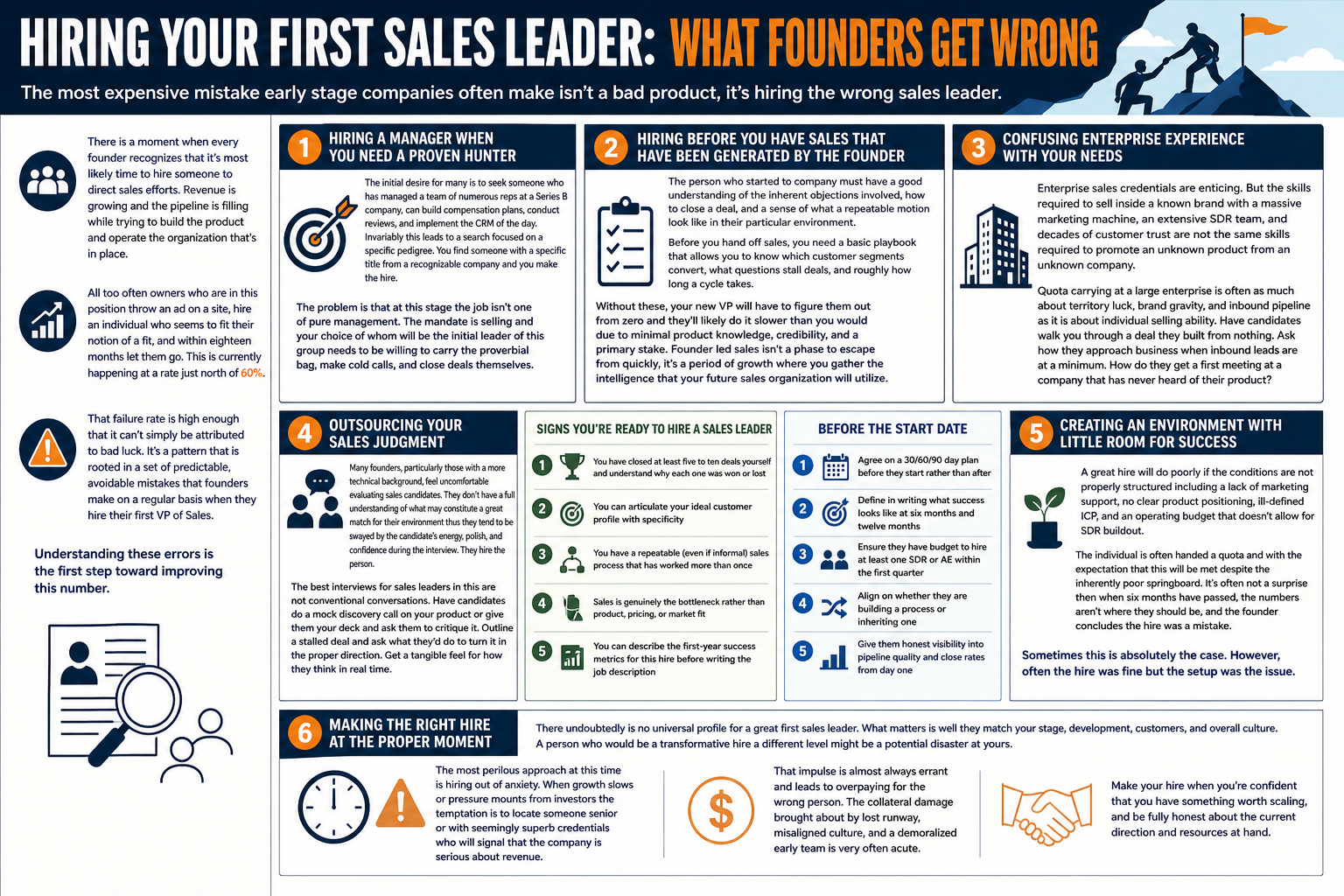
The most expensive mistake early stage companies often make isn’t a bad product, it’s hiring the wrong sales leader.
There is a moment when every founder recognizes that it’s most likely time to hire someone to direct sales efforts. Revenue is growing and the pipeline is filling while trying to build the product and operate the organization that’s in place. All too often owners who are in this position throw an ad on a site, hire an individual who seems to fit their notion of a fit, and within eighteen months let them go. This is currently happening at a rate just north of 60%.
That failure rate is high enough that it can’t simply be attributed to bad luck. It’s a pattern that is rooted in a set of predictable, avoidable mistakes that founders make on a regular basis when they hire their first VP of Sales. Understanding these errors is the first step toward improving this number.
Issue 1: Hiring a manger when you need a proven hunter
The initial desire for many is to seek someone who has managed a team of numerous reps at a Series B company, can build compensation plans, conduct reviews, and implement the CRM of the day. Invariably this leads to a search focused on a specific pedigree. You find someone with a specific title from a recognizable company and you make the hire.
The problem is that at this stage the job isn’t one of pure management. The mandate is selling and your choice of whom will be the initial leader of this group needs to be willing to carry the proverbial bag, make cold calls, and close deals themselves. They need to be able to figure out why customers buy your offering before they can teach anyone else how to replicate the process. Someone who has spent five years managing a mature sales organization has often lost the ability (or the desire) to do the individual contributor work and would much rather build a team. This is a completely understandable place to reside, but it often leads to an errant match.
Issue 2: Hiring before you have sales that have been generated by the founder
The person who started to company must have a good understanding of the inherent objections involved, how to close a deal, and a sense of what a repeatable motion look like in their particular environment. Before you hand off sales, you need a basic playbook that allows you to know which customer segments convert, what questions stall deals, and roughly how long a cycle takes. Without these, your new VP will have to figure them out from zero and they’ll likely do it slower than you would due to minimal product knowledge, credibility, and a primary stake. Founder led sales isn’t a phase to escape from quickly, it’s a period of growth where you gather the intelligence that your future sales organization will utilize.
Signs you’re ready to hire a sales leader
You have closed at least five to ten deals yourself and understand why each one was won or lost
You can articulate your ideal customer profile with specificity
You have a repeatable (even if informal) sales process that has worked more than once
Sales is genuinely the bottleneck rather than product, pricing, or market fit
You can describe the first-year success metrics for this hire before writing the job description
Issue 3: Confusing enterprise experience with your needs
Enterprise sales credentials are enticing. Someone who has closed seven-figure deals an established organization carries an implicit promise that they can do the same thing for you in short order. But the skills required to sell inside a known brand with a massive marketing machine, an extensive SDR team, and decades of customer trust are not the same skills required to promote an unknown product from an unknown company.
Quota carrying at a large enterprise is often as much about territory luck, brand gravity, and inbound pipeline as it is about individual selling ability. Take away these advantages and some of those high performers become disoriented when it comes to generating their own pipeline. This certainly doesn’t imply that enterprise experience is a non-starter, it simply means you have to examine things with a great deal of precision. Have candidates walk you through a deal they built from nothing. Ask how they approach business when inbound leads are at a minimum. How do they get a first meeting at a company that has never heard of their product?
Issue 4: Outsourcing Your Sales Judgment
Many founders, particularly those with a more technical background, feel uncomfortable evaluating sales candidates. They don’t have a full understanding of what may constitute a great match for their environment thus they tend to be swayed by the candidate’s energy, polish, and confidence during the interview. They hire the person
The best interviews for sales leaders in this are not conventional conversations. Have candidates to do a mock discovery call on your product or give them your deck and ask them to critique it. Outline a stalled deal and ask what they’d do to turn it in the proper direction. Get a tangible feel for how they think in real time.
Issue 5: Creating an environment with little room for success
A great hire will do poorly if the conditions are not properly structured including a lack of marketing support, no clear product positioning, ill-defined ICP, and an operating budget that doesn’t allow for SDR buildout. The individual is often handed a quota and with the expectation that this will be met despite the inherently poor springboard. It’s often not a surprise then when six months have passed, the numbers aren’t where they should be, and the founder concludes the hire was a mistake. Sometimes this is absolutely the case. However, often the hire was fine but the setup was the issue. A sales leader can’t be expected to create pipeline from nothing under those type of circumstances nor sell a product that the market doesn’t comprehend.
Before the start date
Agree on a 30/60/90 day plan before they start rather than after
Define in writing what success looks like at six months and twelve months
Ensure they have budget to hire at least one SDR or AE within the first quarter
Align on whether they are building a process or inheriting one
Give them honest visibility into pipeline quality and close rates from day one
Issue 6: Making the right hire at the proper moment
There undoubtedly is no universal profile for a great first sales leader. What matters is well they match your stage, development, customers, and overall culture. A person who would be a transformative hire a different level might be a potential disaster at yours. The most perilous approach at this time is hiring out of anxiety. When growth slows or pressure mounts from investors the temptation is to locate someone senior or with seemingly superb credentials who will signal that the company is serious about revenue. That impulse is almost always errant and leads to overpaying for the wrong person. The collateral damage brought about by lost runway, misaligned culture, and a demoralized early team is very often acute. Make your hire when you’re confident that you have something worth scaling, and be fully honest about the current direction and resources at hand.