
How to Train Your Sales Team on the Complex Ethics of Selling AI Products
How to Train Your Sales Team on the Complex Ethics of Selling AI Products
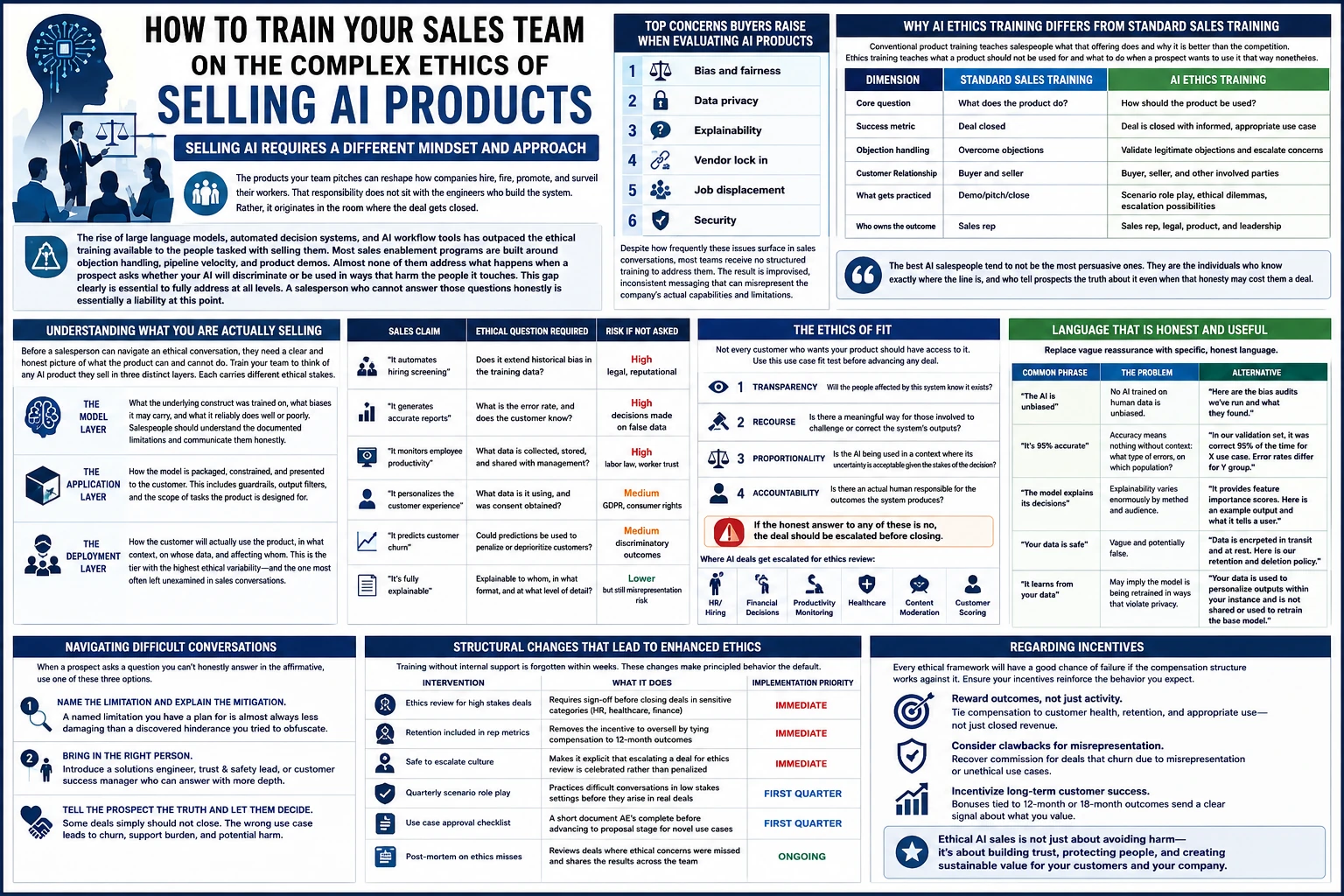
Selling AI requires a different mindset and approach
The products your team pitches can reshape how companies hire, fire, promote, and surveil their workers. That responsibility does not sit with the engineers who build the system. Rather, It originates in the room where the deal gets closed.
The rise of large language models, automated decision systems, and AI workflow tools has outpaced the ethical training available to the people tasked with selling them. Most sales enablement programs are built around objection handling, pipeline velocity, and product demos. Almost none of them address what happens when a prospect asks whether your AI will discriminate or be used in ways that harm the people it touches. This gap clearly is essential to fully address at all levels. A salesperson who cannot answer those questions honestly is essentially a liability at this point.
Top concerns buyers raise when evaluating AI products:
1. Bias and fairness
2. Data privacy
3. Explainability
4. Vendor lock in
5. Job displacement
6. Security
Despite how frequently these issues surface in sales conversations, most teams receive no structured training to address them. The result is improvised, inconsistent messaging that can misrepresent the company’s actual capabilities and limitations.
Why AI ethics training differs from standard sales training
Conventional product training teaches salespeople what that offering does and why it is better than the competition. Ethics training teaches what a product should not be used for and what to do when a prospect wants to use it that way nonetheless.
The discomfort is intentional as your team needs to sit with the reality that closing a deal is not always the right outcome. That runs counter to every incentive structure in a sales organization, which is why the training must be explicit, repeated, and modeled from the top.
The best AI salespeople tend to not be the most persuasive ones. They are the individuals who know exactly where the aforementioned line is, and who tell prospects the truth about it even when that honesty may cost them a deal.
|
Dimension |
Standard Sales Training |
AI Ethics Training |
|---|---|---|
|
Core question |
What does the product do? |
How should the product be used? |
|
Success metric |
Deal closed |
Deal is closed with informed, appropriate use case |
|
Objection handling |
Overcome objections |
Validate legitimate objections and escalate concerns |
|
Customer Relationship |
Buyer and seller |
Buyer, seller, and other involved parties |
|
What gets practiced |
Demo/pitch/close |
Scenario role play, ethical dilemmas, escalation possibilities |
|
Who owns the outcome |
Sales rep |
Sales rep, legal, product, and leadership |
Understanding What You Are Actually Selling
Before a salesperson can navigate an ethical conversation, they need a clear and honest picture of what the product can and cannot do. This sounds obvious, but AI products are notorious for being oversold in ways that create downstream harm, both for customers and for the people their systems affect. Train your team to think of any AI product they sell in three distinct layers. Each carries different ethical stakes.
• The model layer: what the underlying construct was trained on, what biases it may carry, and what it reliably does well or poorly. Salespeople do not need to be machine learning engineers, but they should understand the documented limitations and be able to communicate them honestly.
• The application layer: how the model is packaged, constrained, and presented to the customer. This includes guardrails, output filters, and the scope of tasks the product is designed for. Understanding this component helps reps explain why the product behaves differently in varying contexts.
• The deployment layer: how the customer will actually use the product, in what context, on whose data, and affecting whom. This is the tier with the highest ethical variability, and it is the one most often left unexamined in sales conversations.
|
Sales claim |
Ethical question required |
Risk if not asked |
|---|---|---|
|
“It automates hiring screening” |
Does it extend historical bias in the training data? |
High, legal, reputational |
|
“It generates accurate reports” |
What is the error rate, and does the customer know? |
High, decisions made on false data |
|
“It monitors employee productivity” |
What data is collected, stored, and shared with management? |
High, labor law, worker trust |
|
“It personalizes the customer experience” |
What data is it using, and was consent obtained? |
Medium, GDPR, consumer rights |
|
“It predicts customer churn” |
Could predictions be used to penalize or deprioritize customers? |
Medium, discriminatory outcomes |
|
“It’s fully explainable” |
Explainable to whom, in what format, and at what level of detail? |
Lower but still misrepresentation risk |
The ethics of fit
Not every customer who wants your product should have access to it. This is the hardest concept to instill in a quota-driven sales team, but it is often the one that matters most.
Sales organizations that sell AI at scale will eventually face a situation where a prospect wants to use the product in a way that is legal but potentially harmful, or technically within the terms of service but ethically indefensible. Your team needs a clear internal standard for how to handle those situations before they arise.
The use case fit test that applies
Before advancing any deal, ask the rep to answer four questions about the prospect’s intended application:
1. Transparency : Will the people affected by this system know it exists?
2. Recourse: Is there a meaningful way for those involved to challenge or correct the system’s outputs?
3. Proportionality: Is the AI being used in a context where its uncertainty is acceptable given the stakes of the decision?
4. Accountability: Is there an actual human responsible for the outcomes the system produces?
If the honest answer to any of these is no, the deal should be escalated before closing. Where AI deals get escalated for ethics review:
• HR/hiring
• Financial decisions
• Productivity monitoring
• Healthcare
• Content moderation
• Customer scoring
Language that is honest and useful
Sales language around AI has developed a set of shorthand phrases that sound reassuring but often convey very little. Training your team to replace these expressions with forthright, specific terminology is one of the highest-value interventions you can make.
|
Common Phrase |
The problem |
Alternative |
|---|---|---|
|
“The AI is unbiased” |
No AI trained on human data is unbiased |
“Here are the bias audits we’ve run and what they found” |
|
“It’s 95% accurate” |
Accuracy means nothing without context: what type of errors, on which population? |
“In our validation set, it was correct 95% of the time for X use case. Error rates differ for Y group.” |
|
“The model explains its decisions” |
Explainability varies enormously by method and audience |
“It provides feature importance scores. Here is an example output and what it tells a user.” |
|
“Your data is safe” |
Vague and potentially false |
“Data is encrypted in transit and at rest. Here is our retention and deletion policy.” |
|
“It learns from your data” |
May imply the model is being retrained in ways that violate privacy |
“Your data is used to personalize outputs within your instance and is not shared or used to retrain the base model.” |
The shift from vague reassurance to specific honesty does not just reduce ethical risk, it also builds trust with the sophisticated buyers who increasingly examine these claims. Procurement teams at large enterprises now routinely include AI ethics questionnaires in vendor evaluations and reps who can answer them with specificity close deals faster.
Navigating difficult conversations
The most important skill in AI sales is knowing what to do when a prospect asks a question your AE cannot honestly answer in the affirmative. The instinct is to deflect, soften, or redirect thus training goal is to replace that instinct with something better.
Three options
1. Name the limitation and explain the mitigation involved . A named limitation you have a plan for is almost always less damaging than a discovered hinderance you tried to obfuscate.
2. Bring in the right person. Not every ethical question is a reason to lose the deal. Some are a reason to introduce a solutions engineer, a trust and safety lead, or a customer success manager who can answer with more depth.
3. Tell the prospect the truth and let them decide. Some deals simply should not close. A prospect who buys a product for a use case it was not designed for will churn, create support burden, and potentially harm real people.
Structural changes that leads to enhanced ethics
Training without internal support is often forgotten within weeks, and ethics training is no exception. The following changes create the conditions for principled behavior to become the default rather than the exception.
|
Intervention |
What it does |
Implementation priority |
|---|---|---|
|
Ethics review for high stakes deals |
Requires sign-off before closing deals in sensitive categories (HR, healthcare, finance) |
Immediate |
|
Retention included in rep metrics |
Removes the incentive to oversell by tying compensation to 12-month outcomes |
Immediate |
|
Safe to escalate culture |
Makes it explicit that escalating a deal for ethics review is celebrated rather than penalized |
Immediate |
|
Quarterly scenario role play |
Practices difficult conversations in low stakes settings before they arise in real deals |
First quarter |
|
Use case approval checklist |
A short document AE’s complete before advancing to proposal stage for novel use cases |
First quarter |
|
Post-mortem on ethics misses |
Reviews deals where ethical concerns were missed and shares the results across the team |
Ongoing |
Regarding incentives
Every ethical framework will have a good chance of failure if the compensation structure works against it. Sales reps who are rewarded purely for closed revenue, with no downstream accountability for what they sold or how it was used, will find ways to rationalize behavior that maximizes the number.
Those serious about ethical AI sales will ensure that the conversation eventually reaches the commission plan. Some organizations are experimenting with clawback provisions for deals that churn due to misrepresentation, or with bonuses tied to customer health scores at 12 months. These changes are difficult to implement and politically charged, but they are often the clearest signal a leadership team can send about what it actually values.
Renascent Solutions Artificial Intelligence Sales Recruitment