
Rapid Hiring and the Cost of Building an AI Team Without Sufficient Governance
Rapid Hiring and the Cost of Building an AI Team Without Sufficient Governance
The pressure to build an AI team has arrived almost overnight
Boards have begun to demand AI strategies, CEOs are asking how many engineers had the word AI in their title, and competitors announce new hires with a seeming barrage of press releases. Thus we’re seeing a pattern of data scientists being pulled from academia, machine learning engineers drawn from an array of environs, and heads of AI installed with broad mandates and seemingly vague authority. The result in a great deal of corporate structures has been turbulence as it couldn’t be said with confidence what any given AI system was actually doing because no one had been given the job of properly tracking such matters.
The numbers behind the difficulties
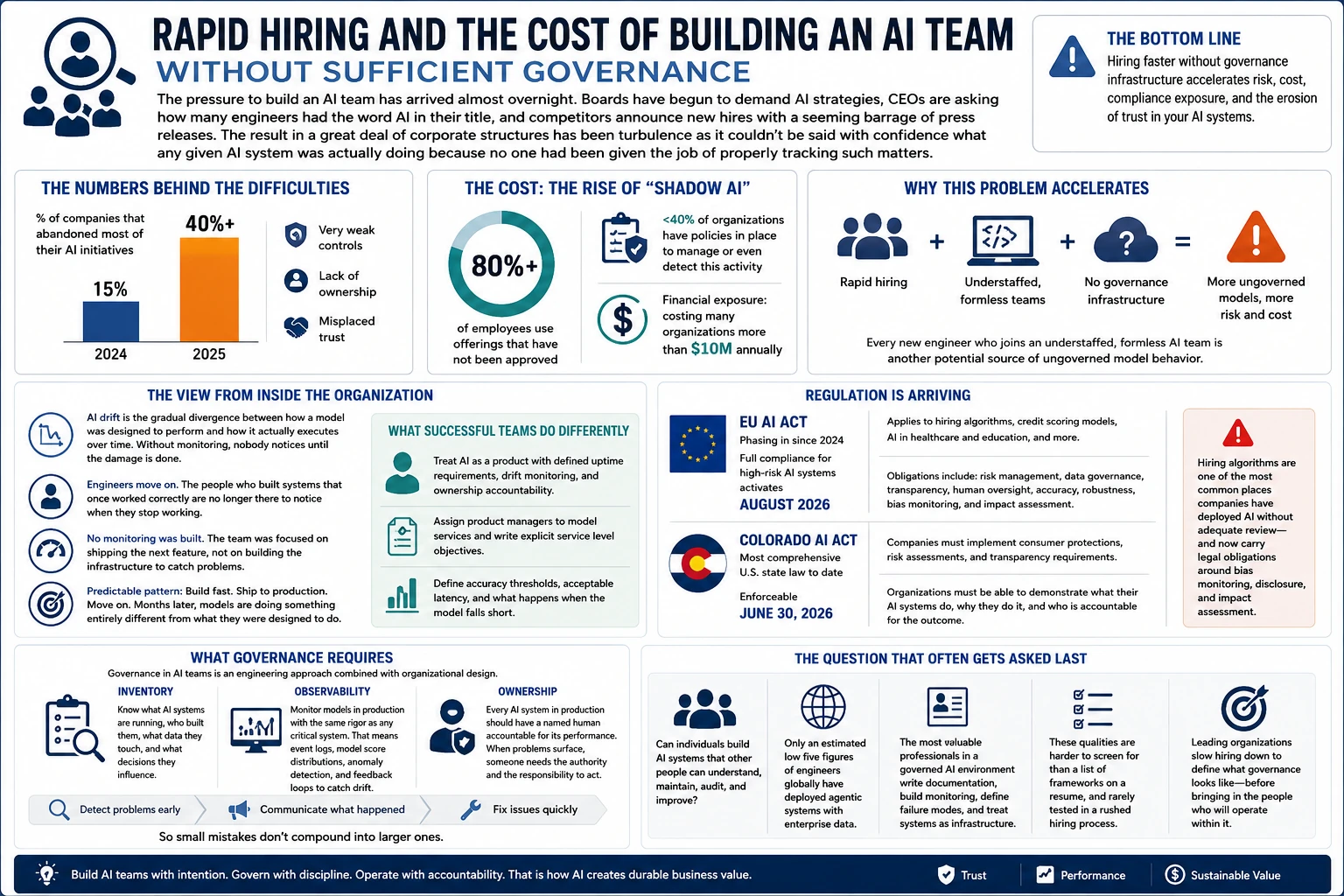
In 2025 more than 40% of companies abandoned most of their AI initiatives, a number that was up sharply from about 15% in 2024. The primary fracture points appear to revolve around very weak controls, a lack of ownership, and simple misplaced trust.
The cost
Parallel to the AI hiring surge, a latent tier of ungoverned AI tools has grown inside most large organizations. Employees adopt an array of implements without informing IT, and business units deploy models without involving security teams. The result is what now amusingly being referred to as shadow AI.
The scale of this problem is rather significant as surveys have shown that over 80% of employees use offerings that have not been approved. Most crucially, less than 40% of organizations have policies in place to manage or even detect this activity. The financial exposure is significant, costing many organizations more than $10 million annually.
This is not a problem that strong hiring alone can solve. Indeed, hiring faster without governance infrastructure accelerates it. Every new engineer who joins an understaffed, formless AI team is another potential source of ungoverned model behavior.
The view from inside the organization
One of the most potentially harmful failure modes in ungoverned AI teams is the gradual divergence between how an AI system was designed to perform and how it actually executes tasks over time. The model will keep running on assumptions that may have aged out months ago, and because it is not being monitored systematically, nobody notices until the damage is done.
AI drift is already inside the workforce systems of companies ranging from startups to large enterprises. Engineers who built systems that once worked correctly are no longer there to notice when they stop working correctly. The monitoring infrastructure that would catch the problem was never built because the team was more focused on shipping the next feature.
The pattern is quite predictable based on many we talk with. A company hires a capable AI team under intense pressure to deliver. The team builds quickly. Models reach production and then the team moves on to the next project. Nobody is assigned to watch what the first set of models is doing, and months later they are addressing something entirely different from what they were designed to do.
Successful teams, on the other hand, treat AI as a product with defined uptime requirements, drift monitoring, and ownership accountability. They assign product managers to model services and write explicit service level objectives including what accuracy threshold the model must maintain, what latency is acceptable, and what happens when it falls short.
Regulation
Organizations that have delayed governance investment are now facing more strict deadlines. The regulatory landscape around AI has moved from principle to enforcement faster than most legal teams anticipated.
The EU AI Act emerged in 2024 and has been phasing in relevant obligations. The critical next milestone is August 2026 when full compliance requirements activate for high risk AI systems including hiring algorithms, credit scoring models, and AI used in healthcare and education. Colorado’s AI Act, the most comprehensive US state law to date, becomes enforceable on June 30, 2026.
For companies that rushed to hire AI talent without building the governance infrastructure to oversee the systems, this is a genuine exposure. Hiring algorithms (one of the most common places companies have deployed AI without adequate review) now carry legal obligations around bias monitoring, disclosure, and impact assessment. Organizations that cannot demonstrate what their AI systems do, why they do it, and who is accountable for the outcome are not ready for the compliance environment that is already at the front door.
The response to all of this is, more often than not, reactive. Patches will be applied to the immediate problem and a promise will be filed to do better. But the structural conditions that produced the difficulties have not changed.
What governance requires
Governance in AI teams is not primarily a compliance exercise. It’s more of an engineering approach combined with organizational design. Start with outcomes, not experiments. Define the business result you need, assign a named owner, and measure success against that goal. Keep an inventory of every model, feature, and automation, and govern them with standards and approval processes. Detect problems early, communicate what happened, and fix issues quickly so small mistakes don’t compound into larger ones. The companies that are navigating this well utilize three things that struggling organizations consistently lack.
Inventory
They know what AI systems are running, who built them, what data they touch, and what decisions they influence.
Observability
Models in production need monitoring with the same rigor applied to any other critical system. That means event logs, model score distributions, anomaly detection, and feedback loops that catch when a system has drifted from its intended behavior.
Ownership
Every AI system in production should have a named human accountable for its performance. When problems surface, someone needs the authority and the responsibility to act.
The question that often gets asked last
Organizations that are building strong AI teams have started asking if an individual can build AI systems that other people can understand, maintain, audit, and improve.
The selection of people with genuine production AI experience is currently relatively small. Indeed, estimates put the number of engineers who have actually deployed agentic systems with enterprise data in the low five figures globally. This scarcity creates pressure to hire fast from a limited pool, often without clear criteria for what the organization actually needs.
The professionals most valuable in a governed AI environment are not necessarily those with the most impressive model credentials. They are those who write documentation, build monitoring, define failure modes before deployment, and treat the systems they build as infrastructure that other people will depend on. These qualities are harder to screen for than a list of frameworks on a resume, and they are rarely the ones that get tested in a rushed hiring process.
The organizations that have understood this have slowed down their hiring enough to define what governance looks like before bringing in the people who will need to operate within it.
Renascent Solutions AI CXO/Sales/Sales Engineering Recruitment