
Why Culture Fit Is Limiting Your Leadership Pipeline
Why Culture Fit Is Limiting Your Leadership Pipeline
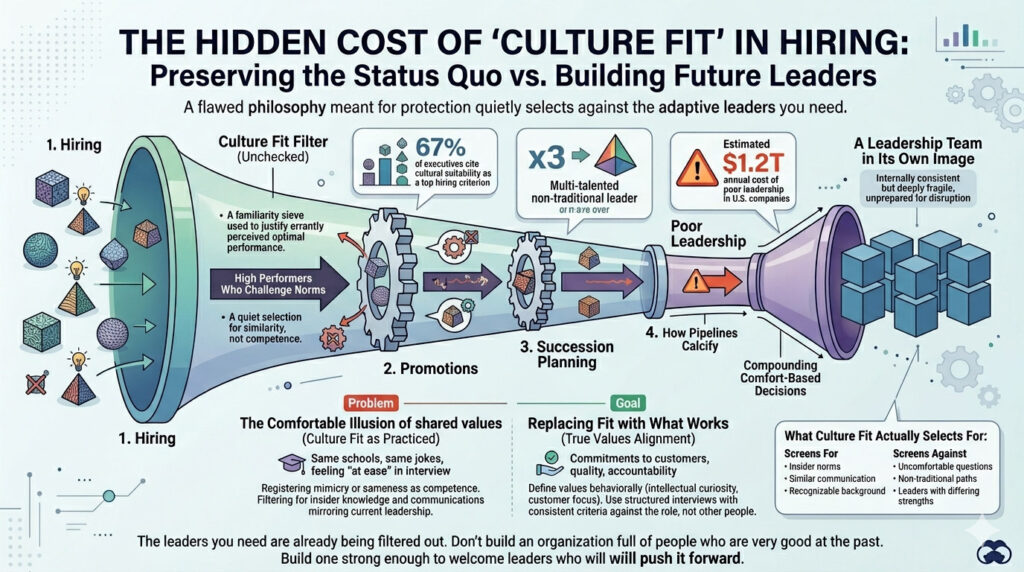
The hiring philosophy meant to protect your organization is quietly selecting against the very leaders you’ll need most.
Every hiring manager has come to the conclusion that a particular candidate is brilliant but not really a culture fit. It sounds like a fine bit of prudence and may offer a seemingly inherent piece of protection. However, when you follow that approach through promotions, succession planning, and an extended period of compounding decisions you may often find something troubling at the end. Namely, a leadership team built in its own image that is increasingly unable to lead anyone different from itself.
Culture fit, as most organizations practice it, was never a neutral talent filter. It was always a familiarity sieve employed to justify an often errantly perceived notion of optimal performance. Unfortunately, when this approach is left unchecked it may often lead to a system that produces less than exceptional leaders.
• 67% of executives cite cultural suitability as a top hiring criterion
• High performers who are perceived as being the type to challenge norms are three times more likely to be passed by in the hiring and promotion processes
• $1.2T estimated annual cost of poor leadership in U.S. companies
The comfortable illusion of shared values
In theory, hiring for culture fit means finding people who align with your organization’s deepest values such as honesty, accountability, and ambition. In practice, however, it often means finding people who went to similar schools, laugh at the same references, and make you feel at ease in a forty-five minute interview. That comfort can be misleading precisely because it feels like a recognizable signal. When a candidate makes the panel laugh, when they lean in at the same moments, when they instinctively frame problems the way your current leaders do it registers as competence. But it may simply be mimicry, or worse, genuine sameness. Bold, adaptive candidates are often eliminated in early screening for failing to fit the culture that currently exists rather than the culture one should be building.
How pipelines calcify
The damage doesn’t happen in the course of a single hiring decision. Rather, it accumulates. Each round of promotions slightly overemphasizes people who resemble those who promoted them. Each leadership development cohort is seeded with candidates who, from their perspective, show promise. Unfortunately, in organizations without structured criteria, this often tends to mean potential as perceived by leaders who see themselves in those candidates.
Over the course of five or ten years, the pipeline narrows. Not because of explicit exclusion but due to the compounding effect of thousands of small comfort-based decisions. The result is a leadership group that is impressively credentialed, internally consistent, and in many cases deeply fragile because it was never tested against real cognitive or experiential range. This becomes apparent at exactly the wrong moments – market disruptions, cultural upheaval, or organizational crisis.
What culture fit actually selects for
When we honestly examine what culture fit tends to screen the pattern is consistent. It is often employed to select for insider knowledge of organizational norms, communication styles that mirror senior leadership, and backgrounds that feel recognizable to existing decision-makers. Conversely, it tends to screen against people who ask uncomfortable questions early, candidates from non-traditional paths, and leaders whose strengths show up differently than the stated template.
These screened-out candidates are not necessarily poor hires. Indeed, many of them are the adaptive, challenging, perspective-shifting leaders that organizations desperately need and will spend significant budget trying to hire when they finally recognize that the current approach is less than ideal.
Replacing fit with something that actually works
The answer certainly is not to abandon values alignment. Rather, it’s to be ruthlessly precise about what you mean. There is a significant difference between culture fit and values alignment that must be taken into consideration. Do they share our commitments to customers, to quality, to accountability?
Organizations that build strong pipelines tend to do three things differently. First, they define their values in behavioral terms that don’t depend on background or communication style. Intellectual curiosity isn’t about what college someone attended, it’s observable in how they engage with problems they’ve never seen before. Second, they use structured interviews with consistent criteria, scoring candidates against the role rather than against each other or against an implicit template. Finally, they actively examine where their pipeline narrows and ask why rather than assuming attrition at any stage is neutral. The ultimate goal is not a culture of disagreement. It’s a culture strong enough to welcome leaders who will push it forward rather than simply reflect it back.
The leaders you need are already being filtered out
Somewhere in your organization (or in your last few rounds of hiring) there are people who were passed over because they were perhaps perceived as a bit difficult, didn’t quite fit, or needed too much explanation. Certainly some of them were without question genuinely poor fits for your team. But many may have been early-stage versions of the bold, disruptive, adaptive leaders you’ll be searching for at considerable expense in a down the road.
Culture fit, as practiced, doesn’t protect organizations, it preserves them in a form that is static, comfortable, and increasingly unequipped for what may arise next. The pipeline doesn’t die all at once. It narrows quietly, decision by decision, until you look up one day and realize you’ve built an organization full of people who are very good at the past.