
A Guide to Navigating Security Clearances in Hiring
A Guide to Navigating Security Clearances in Hiring
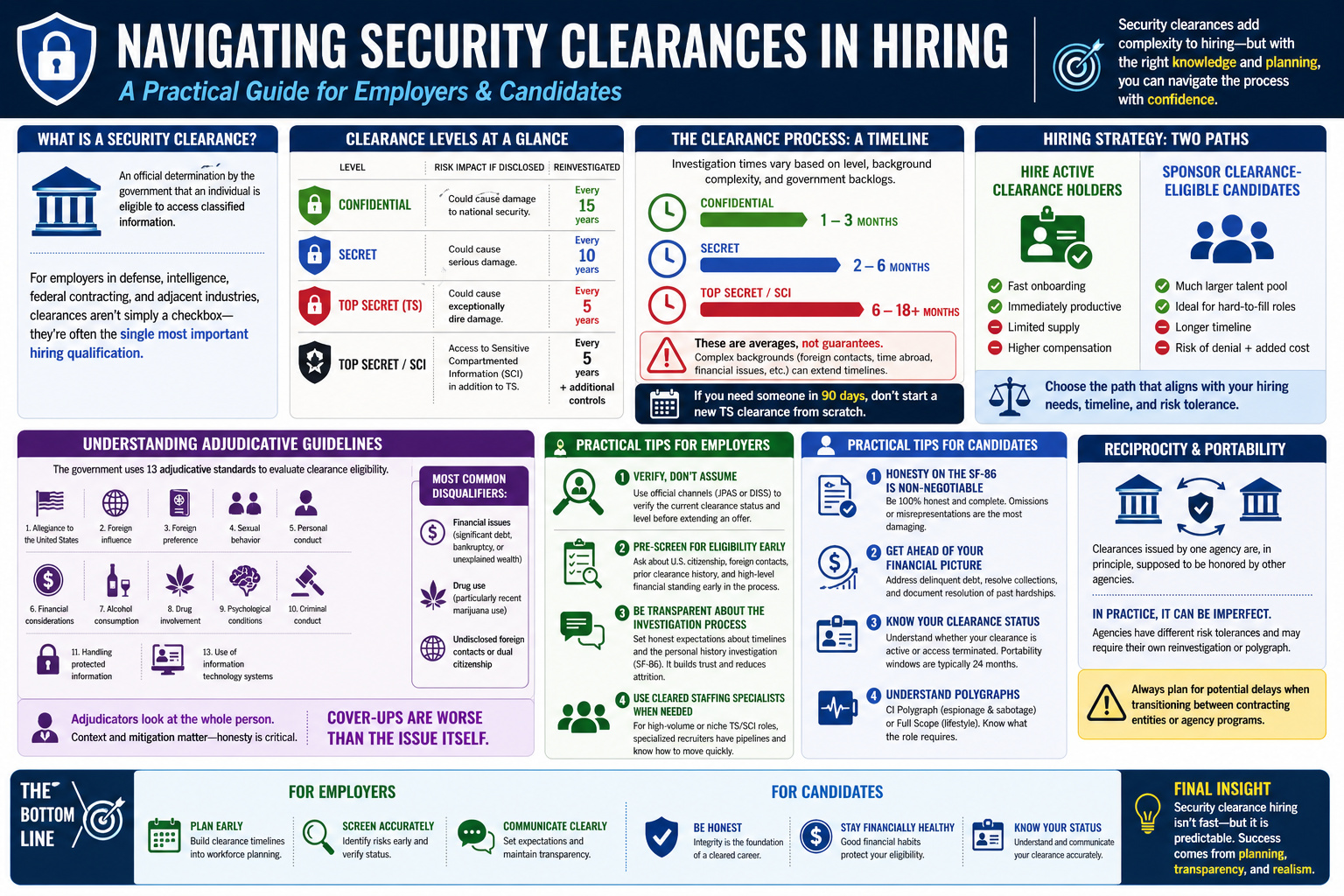
Whether you’re an employer filling a sensitive role or a candidate seeking this type of position, the security clearance process can seem daunting. Here’s how to navigate it with confidence.
A security clearance is an official determination by the government that an individual is eligible to access classified information. For employers in defense, intelligence, federal contracting, and adjacent industries clearances aren’t simply a checkbox. Rather, they’re often perhaps the single most important hiring qualification.
There are three primary clearance levels:
Confidential – Access to information that could cause damage to national security if disclosed. Reinvestigated every 15 years.
Secret – Access to information that could cause serious damage. Reinvestigated every 10 years.
Top Secret (TS) – Access to information that could cause exceptionally dire damage. Reinvestigated every 5 years. Often comes with a Sensitive Compartmented Information (SCI) designation resulting in a TS/SCI credential.
For hiring managers, knowing which level a role requires (and understanding the implications of each) is the foundation of an effective clearance related recruiting strategy.
The Clearance Process: A Timeline Employers Must Plan Around
One of the most common mistakes employers make is underestimating how long the process takes. The investigation varies widely depending on the level requested, the applicant’s background complexity, and current government processing backlogs. Here’s a general framework to follow:
• Confidential: 1 – 3 months
• Secret: 2 – 6 months
• Top Secret / SCI: 6 – 18+ months
These timelines are averages more than guarantees. A candidate with foreign contacts, extended time abroad, or financial issues in their history may take longer to process regardless of their professional qualifications thus it’s essential to build clearance timelines into your workforce planning. If you need a cleared employee in seat in 90 days, hiring someone who needs to initiate a TS clearance from scratch is almost certainly not the right path.
Hiring Cleared v. Clearance Eligible Candidates
Employers face a fundamental strategic choice at the outset of every cleared hire. Do you require an active clearance, or will you sponsor a candidate who is clearance eligible?
Hiring for an Active Clearance
Candidates with active clearances are a finite and very competitive resource. They tend to command premium salaries and have multiple options in front of them at any given time. The advantage here is speed as an active clearance holder can often be onboarded and productive much faster, especially if the clearance is in proper scope and requires only a brief reinvestigation.
Sponsoring a Clearance Eligible Candidate
If you’re willing to sponsor, your talent pool expands dramatically. A clearance eligible candidate is typically a U.S. citizen who hasn’t held a clearance before who has a clean background that encompasses criminal history, financial issues, foreign influences, and substance abuse patterns. Sponsoring comes with certain costs (time, government fees, and the risk of denial), but it’s often the right call for difficult to fill technical roles where cleared candidates are scarce.
Understanding Adjudicative Guidelines: What Actually Disqualifies Someone?
The government uses 13 adjudicative standards to evaluate clearance eligibility. Employers and candidates alike benefit from understanding them, because many assume that any blemish is a potential dealbreaker when, in reality, context and mitigation matter a great deal.
The 13 guidelines cover:
• Allegiance to the United States
• Foreign influence
• Foreign preference
• Sexual behavior
• Personal conduct
• Financial considerations
• Alcohol consumption
• Drug involvement
• Psychological conditions
• Criminal conduct
• Handling protected information
• Outside activities
• Use of information technology systems
The most common disqualifying factors in practice are financial issues including significant debt, bankruptcy, or unexplained wealth. Drug use (particularly recent marijuana use, despite state-level legalization) and undisclosed foreign contacts or dual citizenship also are primary reasons for dismissal of consideration. Adjudicators are trained to look at the person as a whole when considering these possible red flags. A candidate who disclosed a past drug issue, sought treatment, and has been clean for years may be cleared while and individual who hid the same issue and was later discovered may not be.
Practical Hiring Tips for Employers
Verify, Don’t Assume
Candidates sometimes overstate their clearance status or believe an expired clearance can be quickly reinstated. Use official channels, specifically JPAS (Joint Personnel Adjudication System) or its successor, DISS (Defense Information System for Security) to verify the current status and level before extending an offer contingent on it.
Pre-Screen for Eligibility Early
Ask targeted eligibility questions early in your process regarding U.S. citizenship, foreign contacts, any prior clearance history, and high-level financial standing. This surfaces potential issues before you’ve invested significant interview resources.
Be Transparent About the Investigation Process
Candidates, especially those new to cleared work, are often anxious about the the lengthy personal history form used to initiate an investigation. Setting honest expectations builds trust and reduces attrition during the wait.
Use Cleared Staffing Specialists When Needed
For high-volume cleared hiring or niche technical roles requiring TS/SCI with polygraph, specialized cleared recruiting pros have existing pipelines and know how to move quickly in this environment. The cleared labor market operates differently from the commercial tech market where niche expertise pays off.
Practical Hiring Tips for Candidates Seeking Cleared Positions
Honesty on the SF-86 Is Non-Negotiable
The SF-86 is comprehensive and covers the last decade (or more) of your life, including addresses, employment, foreign travel, finances, and personal associations. The single most damaging thing you can do in the clearance process is omit or misrepresent information. Adjudicators know that people have complicated histories and they’re far more troubled by concealment than by the underlying facts.
Get Ahead of Your Financial Picture
One of the most common clearance disqualifiers is financial. If you’re considering a cleared career path, start addressing delinquent debt, resolving collections, and building a clean record now. Proactively explaining past financial hardship (job loss, medical crisis) with documented resolution goes a long way.
Your Clearance Has Portability Thus Know Its Status
If you’ve held a clearance with one employer, it may be transferable to a new one within a certain window – typically 24 months within leaving a cleared position. Know the status of your clearance, whether it’s active or access terminated, and communicate it accurately to prospective employers.
The Polygraph
Some roles,particularly those supporting CIA, NSA, and certain DoD programs, require a polygraph examination. These come in two varieties: the Counterintelligence (CI) polygraph (focused on espionage and sabotage) and the Full Scope (lifestyle) polygraph, which covers a broader range of personal conduct. Know what a role requires before you apply.
Reciprocity
Clearances issued by one agency are, in principle, supposed to be honored by other agencies. In practice, this can be imperfect at best. Different agencies have various risk tolerances and may require their own reinvestigation or polygraph even if a candidate holds a current clearance from another organization. Employers and candidates should factor this in when transitioning between contracting entities or agency programs.
Security clearances add complexity to hiring, but that is manageable with the right knowledge and realistic planning. For employers, the keys are early workforce planning, accurate eligibility screening, and forthright communication with candidates about the timeline. For candidates, honesty, financial hygiene, and a clear understanding of your own clearance status are the foundations of a successful cleared career.