
The Rise of the Chief AI Officer
The Rise of the Chief AI Officer
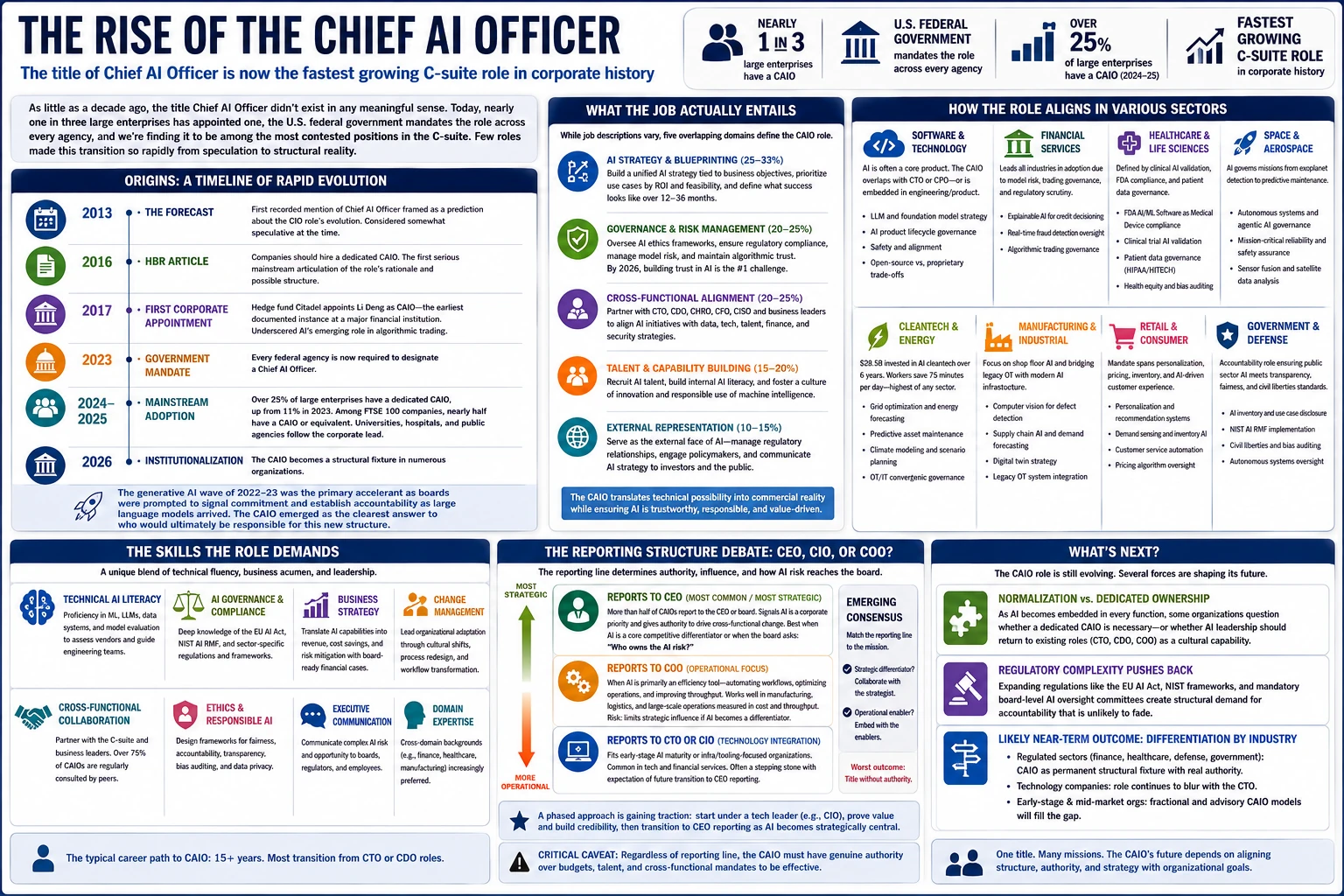
The title of Chief AI Officer is now the fastest growing C-suite role in corporate history
As little as a decade ago, the title Chief AI Officer didn’t exist in any meaningful sense. Today, nearly one in three large enterprises has appointed one, the U.S. federal government mandates the role across every agency, and we’re finding it to be among the most contested positions in the C-suite. Few roles made this transition so rapidly from speculation to structural reality.
How did the position arise, how have the responsibilities attendant to the role been aligned along industry lines, what skills does the job actually require, and who exactly should a CAIO ultimately report to.
Origins
The earliest recorded mention of a Chief AI Officer (notwithstanding a host of relevant characters in an array of science fiction offerings) is generally agreed to have appeared in a 2013 forecast where a prediction was made that the CIO role would eventually evolve into something AI-specific.
The conversation gained more tangible traction in 2016 when Andrew Ng at Baidu published a piece arguing that companies should consider hiring a dedicated Chief AI Officer. His reasoning was fairly simple and put forth the notion that AI was too cross functional, strategically consequential, and technically specialized to be one of many items on a CTO’s task list. It needed a specific owner.
2013 • The Forecast
First recorded mention of Chief AI Officer framed as a prediction about the CIO role’s evolution. Considered somewhat speculative at the time.
2016 • HBR article
Companies should hire a dedicated CAIO. The first serious mainstream articulation of the role’s rationale and possible structure.
2017 • First Corporate Appointment
Hedge fund Citadel appoints Li Deng as CAIO which was the earliest documented instance of the title at a major financial institution. Underscored AI’s emerging role in algorithmic trading.
2023 • Government Mandate
Every federal agency is now required to designate a Chief AI Officer.
2024-2025 • Mainstream Adoption
Over 25% of large enterprises have a dedicated CAIO, up from 11% in 2023. Among FTSE 100 companies, nearly half have a CAIO or equivalent. Universities, hospitals, and public agencies follow the corporate lead.
2026 • Institutionalization
The CAIO becomes a structural fixture in numerous organizations.
The generative AI wave of 2022–23 was the primary accelerant as boards were prompted to signal commitment and establish accountability as large language models arrived. The CAIO emerged as the clearest answer to who would ultimately be responsible for this new structure.
What the job actually entails
The CAIO role tends to withstand overly structured job descriptions, partly because the technology itself is incredibly nebulous. However, there does appear to be a general construct that has developed across industries that encompasses five overlapping domains.
The largest portion of a CAIO’s time (roughly a quarter to a third) goes to AI strategy and blueprinting which entails building a unified plan tied to business objectives, prioritizing use cases by ROI and feasibility, and defining what success with AI actually looks like over a 12 to 36 month time frame. This is where the CAIO earns their seat at the table by translating technical possibility into commercial reality.
Equally important is governance and risk management thus overseeing AI ethics frameworks, ensuring regulatory compliance, managing model risk, and maintaining algorithmic trust. This dimension has grown dramatically as regulators have heightened their expectations here. By 2026, building trust in AI has become the number one challenge organizations face.
Cross-functional alignment consumes another significant portion of the role as the CAIO partners with the CTO on technology infrastructure, the CDO on data strategy and quality, the CHRO on workforce upskilling, the CFO on investment qualification, and the CISO on related security risks.
The CAIO also covers talent and capability building including recruiting AI engineers and data scientists, developing internal AI literacy programs, and fostering what amounts to a new organizational culture around machine intelligence. Increasingly, they serve as the organization’s external focal point on AI managing regulatory relationships, engaging with policymakers, and communicating AI strategy to investors and the public.
How the Role Aligns in Various Sectors
The CAIO title may be fairly universal, but the job description is anything but that. Each industry gears the role toward its own pressures, regulatory constraints, and competitive dynamics.
Software & Technology
In tech companies, AI is often a core product rather than enabling tool, which means the CAIO frequently overlaps with the CTO or CPO. Many pure play tech firms skip the standalone CAIO entirely, embedding AI leadership within engineering or product. Where the role does exist, the mandate centers on competitive differentiation, foundation model strategy, and responsible AI in consumer facing products.
• LLM and foundation model strategy
• AI product lifecycle governance
• Safety and alignment
• Open-source vs. proprietary trade offs
Financial Services
Financial services leads all industries in CAIO adoption, driven by model risk management requirements, algorithmic trading governance, and regulatory scrutiny. The CAIO in a bank or insurer is simultaneously an innovation leader and a compliance partner ensuring that AI driven credit decisions, fraud detection, and customer personalization meet standards regulators demand. JPMorgan Chase, BMO, and Citadel have all made high profile CAIO appointments.
• Explainable AI for credit decisioning
• Real-time fraud detection oversight
• Algorithmic trading governance
Healthcare & Life Sciences
Healthcare ranks second in CAIO adoption. The role here is defined by clinical AI validation, FDA AI/ML compliance, and patient data governance. CAIOs like those at CVS Health, GE HealthCare, and Elevance Health oversee systems that integrate claims, clinical, and social data to drive early interventions and improved patient outcomes that are always within the guardrails of HIPAA and an evolving FDA regulatory framework.
• FDA AI/ML Software as Medical Device compliance
• Clinical trial AI validation
• Patient data governance (HIPAA/HITECH)
• Health equity and bias auditing
Space & Aerospace
NASA appointed its first CAIO following the 2023 White House mandate. The role was described as analogous to an orchestra conductor who does not play the instruments, but ensures every section contributes to a coherent whole. In aerospace, AI governs everything from exoplanet detection to predictive maintenance on aircraft. Lockheed Martin’s Chief AI and Digital Officer frames the near-term future as humans still making final decisions, but AI dramatically accelerating the process.
• Autonomous systems and agentic AI governance
• Mission-critical reliability and safety assurance
• Sensor fusion and satellite data analysis
Cleantech & Energy
With $28.5 billion invested in AI cleantech applications over six years, this space has become one of the most AI-intensive sectors. Workers here report saving an average of 75 minutes per day which is the highest across all industries surveyed. The CAIO in an energy company manages AI that controls microgrids, optimizes EV charging networks, performs predictive maintenance on wind and solar assets, and models climate scenarios. The role sits at the intersection of operational technology and information technology.
• Grid optimization and energy forecasting
• Predictive asset maintenance
• Climate modeling and scenario planning
• OT/IT convergence governance
Manufacturing & Industrial
In manufacturing, AI leadership focuses heavily on shop floor applications that include computer vision for quality control, AI driven supply chain optimization, and digital twin implementations. The CAIO navigates the gap between legacy operational technology and modern AI infrastructure, a challenge that requires as much change management skill as technical knowledge. Siemens has emerged as a benchmark for how massive industrial companies embed AI leadership at the enterprise level.
• Computer vision for defect detection
• Supply chain AI and demand forecasting
• Digital twin strategy
• Legacy OT system integration
Retail & Consumer
Walmart’s public CAIO appointment signals how seriously large retailers now treat AI leadership. In retail, the mandate of the role spans personalization engines, dynamic pricing systems, inventory optimization, and AI driven customer service. The position requires close collaboration with CMOs and CPOs with AI servicing as a customer experience function as much as a technology function. Responsible AI practices matter enormously in consumer facing contexts where biased recommendations or opaque pricing can generate significant reputational damage.
• Personalization and recommendation systems
• Demand sensing and inventory AI
• Customer service automation
• Pricing algorithm oversight
Government & Defense
The federal government’s CAIO mandate (formalized in the March 2024 OMB memorandum and continued under the current administration’s 2025 memo) has produced more than 80 public CAIO appointments across agencies. In defense, the role tends to autonomous weapons governance, intelligence fusion from drone swarms, and maintaining human oversight in adversarial environments. The government CAIO is fundamentally an accountability role ensuring that public sector AI meets transparency, fairness, and civil liberties standards that no private sector governance framework yet fully matches.
• AI inventory and use case disclosure
• NIST AI RMF implementation
• Civil liberties and bias auditing
• Autonomous systems oversight
The skills the role demands
The CAIO position requires a unique combination of abilities that include technical fluency sufficiently strong to credibly evaluate AI systems, and broad enough strategic and communication skills to operate at the board level. The right candidates are rare, and those lacking exceptional aptitude in the following realms will often be disqualified no matter their pedigree.
Technical AI Literacy
Proficiency in ML, LLMs, data systems, and model evaluation sufficient to assess vendor claims and guide engineering teams, not necessarily to build models personally.
AI Governance & Compliance
Deep knowledge of the EU AI Act, NIST AI RMF, sector specific regulations, and responsible AI frameworks which are the fastest growing dimension of the role.
Business Strategy
Ability to translate AI capabilities into revenue growth, cost reduction, and risk mitigation, and to present investment cases in board ready financial terms.
Change Management
AI transformation requires fundamental shifts in processes, culture, and workflows. The CAIO leads organizational adaptation, not just technology deployment.
Cross-functional Collaboration
Partnership with CTO, CDO, CISO, CHRO, CFO, and business unit leaders. Over 75% of CAIO’s are regularly consulted by other C-suite executives on AI decisions.
Ethics & Responsible AI
Framework design for fairness, accountability, transparency, and feasibility including bias auditing, data privacy governance, and stakeholder communication.
Executive Communication
Ability to convey complex AI risk and opportunity in understandable language boards, regulators, and employees can act on. The CAIO is often the public face of an organization’s AI approach.
Domain Expertise
CAIOs with cross-domain backgrounds (finance, healthcare, manufacturing, and others) are increasingly preferred over pure technologists in directly related industries.
The standard career path to CAIO has a typically long time frame of 15 or more years, often moving from ML engineer or data scientist through senior AI leadership before reaching the C-suite. The most common transition paths come from Chief Technology Officer and Chief Data Officer roles, positions that have helped build adjacent skills in technology strategy and data governance.
The Reporting Structure Debate: CEO, CIO, or COO?
No question in CAIO organizational design generates more debate than the reporting infrastructure. The answer ultimately determines whether AI is treated as a strategic priority or an operational function, whether the CAIO has genuine organizational authority or advisory influence, and if AI risk reaches the board unfiltered.
Most common/most strategic
• Reports to CEO
More than half of CAIO’s already report directly to the CEO or board. This structure signals that AI is a corporate priority at the highest level and not just a technology initiative to be managed within existing IT hierarchies. It gives the CAIO authority to drive cross-functional change without navigating internal politics. Best when AI is a core competitive differentiator or when the board is asking who owns the AI risk?
Operational focus
• Reports to COO
When AI is primarily an operational efficiency tool that automates workflows, optimizes supply chains, and improves process throughput reporting to the COO embeds the CAIO in the function where AI creates the most proximate value. This structure works in manufacturing, logistics, and large scale service operations where AI improvement is measured in throughput and cost. It risks limiting the CAIO’s strategic influence if AI later becomes a product differentiator.
Technology integration
• Reports to CTO or CIO
Some organizations, particularly in technology and in early stages of AI maturity, place the CAIO within the technology organization under the CTO or CIO. This structure works when AI is primarily an infrastructure and tooling challenge rather than one of strategy, and often serves as a stepping stone with the expectation that the CAIO will ultimately transition to CEO reporting. Financial services firms sometimes use CIO reporting.
The emerging consensus among practitioners appears to be geared toward matching the reporting line to the respective mission. When AI is a strategic differentiator, the CAIO must effectively collaborate with the strategist. When it’s an operational enabler, it may be more productive to embed the role with the enablers. The worst outcome is granting a title without providing sufficient authority.
One structural pattern gaining traction is the phased approach where the CAIO begins under a technology leader such as the CIO and demonstrates value and building organizational credibility, then transitions to CEO reporting once the role proves central to competitive strategy. This preserves organizational coherence in early AI maturity stages while creating a clear upgrade path.
A critical caveat applies regardless of reporting line in that the CAIO needs genuine authority over budgets, talent, and cross functional mandates in order to be effective. A CAIO who reports to the CEO on paper but lacks resource allocation power is most often an errant approach.
What’s next?
The CAIO role is still in the early stages of evolution, and its future shape is obviously fairly uncertain. Several trends appear to be pulling in different directions.
As AI becomes embedded in every function, some organizations are questioning whether a dedicated CAIO role is necessary or whether AI leadership should devolve back into existing executive roles (CTO, CDO, COO) that have matured to absorb it. The argument is that as AI normalizes it stops requiring a dedicated owner and thus demands organizational culture.
Conversely, regulatory complexity is moving in the opposite direction, demanding more dedicated AI governance. The EU AI Act that expanded requirements, and the emergence of mandatory board level AI oversight committees are creating structural demand for accountability that most likely won’t recede as AI becomes embedded.
The likely near term outcome is probably differentiation by industry. In heavily regulated sectors (finance, healthcare, defense, government) the CAIO will be codified as a permanent structural fixture with genuine authority. In technology companies, the role will continue to blur with the CTO. In early-stage and mid-market organizations, fractional and advisory CAIO arrangements will fill the gap.
Renascent Solutions AI CXO/Sales/Sales Engineering Recruitment