
What to Look For in Your First VP of Sales After Reaching $10M Annual Recurring Revenue
What to Look For in Your First VP of Sales After Reaching $10M Annual Recurring Revenue
Crossing $10 million in Annual Recurring Revenue is one of the most fulfilling milestones in SaaS
It is also, for many founders, the precise moment they make their most expensive hiring mistake by bringing on the wrong VP of Sales. At $10M ARR you have a strong product market fit, a repeatable sales motion taking shape, and a small but capable revenue team that got you to this point. What you do not yet have is a scalable machine. That is exactly what your first VP of Sales is supposed to build. The problem is that the skills required to build and grow that organization are almost entirely different from the abilities required to hire a leader at higher revenue tiers or from a publicly traded company. Importing a sales director from a later stage venture is often one of the most common and painful mistakes founders make at this juncture, and it’s one that we are very attentive to when conducting a search for this role. Recruitment Methodology
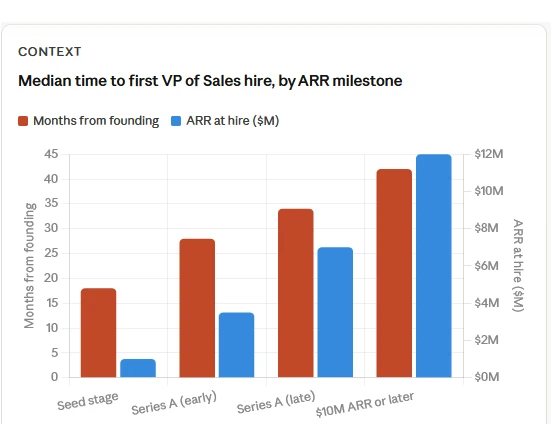
Why $10M ARR is a pivotal inflection point for many companies
Before this revenue achievement, most of a company’s sales impetus tends to be led by the founder. They are often closing deals personally, learning objections in real time, and iterating the pitch based on instinct more often than not. This can work well during the initial growth phase, but somewhere between $5M and $15M ARR most SaaS companies hit a rather predictable ceiling where the founder can no longer be the primary closer and coach simultaneously. Revenue growth slows not because demand has dried up, but because the venture cannot scale without dedicated sales leadership.
What most seek at this stage is someone who can take an informal, founder driven sales process and translate it into a repeatable system geared toward sustainable growth. That means building playbooks, hiring and ramping account executives, establishing a forecasting structure, and instilling a culture of accountability around pipeline generation. The VP of Sales needed at $10M ARR has to be willing to carry a bag, build the process, and coach.
Sales leaders, based on our experience, broadly fall into four archetypes. Understanding which one fits your stage is one of the most important factors to consider prior to opening a search.
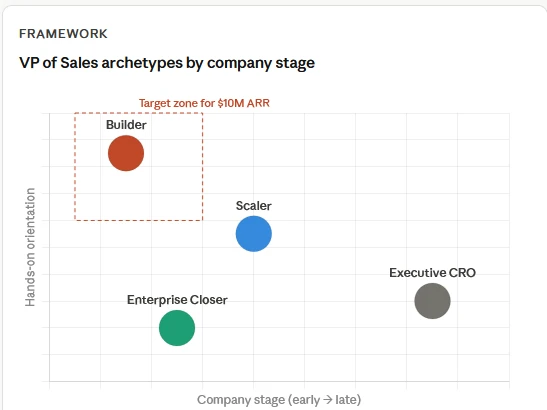
The primary type of individual who tends to succeed at this level is, to no surprise, the builder. They have done the upscaling work before at possibly one or two other SaaS companies between $2M and $20M ARR. They are energized by inherent ambiguity, want to build a structure to follow, and, most importantly, are willing to be deeply hands on during calls, coaching in real time, and personally closing strategic accounts when needed.
The candidates you typically should avoid at this stage are the Executive (career CRO who has managed 200 person teams and has not run a small sales organization in years) and the pure Enterprise Closer (exceptional individual contributor who will dislike the administrative and managerial work they need to address). Scalers can sometimes work depending on their specific background, but it’s crucial to be quite rigorous in your evaluation here.
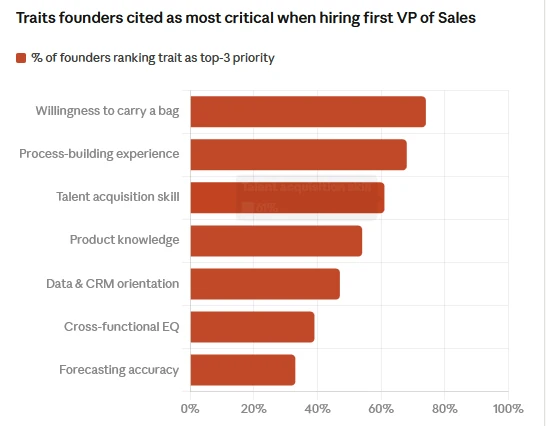
Seven traits that have a strong correlation with success
Within the builder mode, you are looking for a specific combination of traits. Here is a ranked breakdown.
Process architect
Can build pipeline stages, qualification frameworks, and forecasting cadences from scratch, not just manage existing ones.
Talent evaluator
Knows what great AEs look like at this stage and can recruit, interview, and close them independently.
Still carries a bag
Willing and able to get on calls and close complex deals themselves. A player/coach, not purely an instructor.
Data literate
Can build a CRM hygiene culture and interpret funnel metrics to diagnose conversion problems.
Product curious
Understands how to sell to technical buyers and can give honest feedback to the founding team.
Long ramp horizon
Comfortable with the fact that building takes time. Not expecting to jump in and immediately see linear growth.
Cross functional abilities
Builds trust with product and marketing quickly. Does not view them as support functions.
Potential red flags that should be recognized
The emotional pressure to close the VP of Sales search quickly is certainly real for a number of legitimate reasons. Open headcount on the revenue team, a board pushing for growth, and a pipeline full of deals without enough leadership bandwidth all conspire to make a company want to move faster than perhaps they should. Here are a few cautionary items that should be examined no matter how strong the candidate looks on paper.
• Their last two roles were at companies with 50+ person sales teams and, given this, have not operated lean in years and will underestimate how much of the work they will need to do personally.
• They cannot clearly articulate the specific process they built at a previous company. Vague answers about culture and accountability without specific detail suggest they may have managed a system rather than built one.
• They ask for an SDR team before their first 90 days are up. Strong early stage VPs of Sales are willing to generate their own pipeline at first while they evaluate whether SDRs are the right investment during this stage.
• They talk primarily about headcount and budget in their 30-60-90 plan. What you want to see is a strategy centered on customer discovery, pipeline diagnosis, and representative coaching.
• They resist doing a working session or deal review as part of the interview process. The best candidates welcome the chance to demonstrate their thinking and skills on a real problem.
Compensation and equity
Underpaying a VP of Sales at this stage is something to be avoided. A misaligned offer will either cause you to lose the best candidates or, worse, attract less skilled individuals or those who simply are not a proper fit.
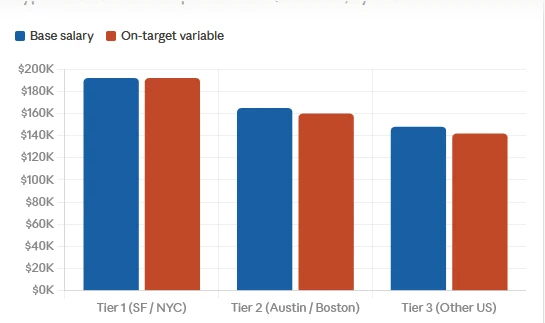
Equity for a first VP of Sales typically falls between 0.3% and 0.7% of fully diluted shares, depending on your valuation, how much was reduced in prior rounds, and how much leverage the candidate has. Do not go below 0.25% for a truly strong candidate as the best sales leaders know their market rate and will move on quickly if the equity does not reflect genuine partnership. What top candidates look for beyond salary
The interview process
A well structured operation gives you necessary information while also demonstrating to the candidate that your company is well worth the risk of joining at this stage. Here is a very condensed outline of a process that works well for most $10M ARR SaaS organizations.
Founder screen
Chemistry and motivation check. Why this company in particular and why now? What is their personal theory of winning in your market? Listen for intellectual curiosity about your specific customers and overall competitive landscape.
Structured competency interview
Behavioral questions anchored to specific situations such as the sales process you built at a prior company. Have them discuss a rep they had to let go and how they handled it. What did their pipeline coverage look like, and why? Specifics are key here.
Live deal review or role play
Share two or three legitimate deals in your pipeline, sanitized if needed. Ask the candidate to run a deal review as if they were already in the role. This is the highest signal exercise in the entire process.
Team and cross functional session
Have the candidate meet two or three of your current AEs and your head of product or marketing. How well will they fit in?
Reference calls
Call former direct reports, not just bosses. Ask about decisions they made under pressure, how they handled possibly missing quota, and whether they would work for this person again. Back-channel through your network to people not on their reference list if possible.
Offer and 30/60/90 day plan
Review together before the final offer. The quality of that document, and how they respond to it, will often tell you as much as the entire rest of the process combined.
What success looks like in the first year
Set clear expectations before the VP of Sales starts. Vague agreements about “building the engine” lead to misaligned evaluations six months later. Here is a reasonable framework for what you should expect across the first four quarters.
• In quarters one and two, the primary deliverables are diagnostic and architectural including a documented sales process, a working qualification framework, a repeatable onboarding program for new AEs, and a functioning CRM hygiene culture. Revenue growth in this period is important but should not be the primary evaluation metric during this period where the foundation is being set.
• By quarter three, there should be measurable improvement in time to close, win rates, and AE ramp speed.
• By quarter four, meaningful data should have been produced that shows whether the hiring bar was raised and if the pipeline is more predictable than it was before the hire. If revenue doubles but the sales organization is chaotic and dependent on the VP personally, that is not an entirely successful first year. Scalability is the primary deliverable.
Many founders struggle with the VP of Sales transition not because they made the wrong hire, but due to the fact that many have difficulty letting go of something they successfully directed. Bringing a strong VP of Sales into a company where the founder continues to shadow every major opportunity, override the process, or jump to key accounts will undermine the hire in short order. The VP will very often either disengage or leave and the reps will be confused about who has authority. As a result, the customer experience will become inconsistent.
The hire only works if you are genuinely ready to hand over the sales component. That means accepting that the VP will lose some deals you think you could have won. It also indicates that you’re willing to let them hire people you might not have selected yourself and ultimately trust the process that they are implementing.
Done right, the VP of Sales you hire at $10M ARR can very well carry you to $50M ARR and beyond. Done improperly, it costs you twelve to eighteen months of growth and enormous organizational disruption/disfunction/general mayhem. Hire a builder who will carry a bag, deem process building as essential, and know how to keep strong talent happy.
Renascent Solutions VP Sales Recruitment