
Questions Boards Should Ask Before an Executive Search
Questions Boards Should Ask Before an Executive Search
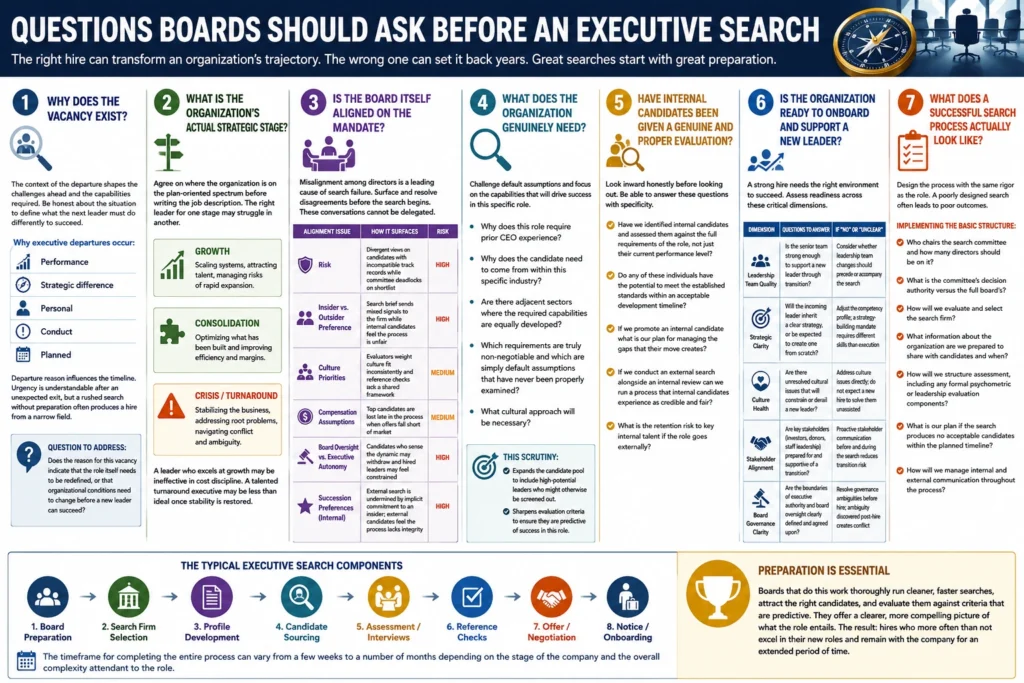
An executive search is clearly one of the most consequential decisions a board will ever make. The right hire can transform an organization’s trajectory while and errant selection can destabilize culture, alarm investors, and set strategy back by a number years. Yet boards routinely launch searches before they have answered the foundational questions that determine whether the process sets the proper structure to increase the chance of success.
The search itself is ultimately often the easier part. The more difficult work lies in preparation that requires honest organizational self-examination, candid alignment among directors, and a clear definition of what the organization actually needs versus what it assumes it requires. Boards that skip this planning stage tend to hire rapidly and wonder why they omitted this step after the new leaders doesn’t perform as anticipated. Here are some considerations that we’ve found to be essential.
1. Why does the vacancy exist?
The circumstances that led to a position being open convey a good deal regarding what an incoming leader will actually face. A planned retirement may create sufficient space for a carefully managed transition while an unexpected departure (especially one tied to performance or conflict within the organization) often leaves a more complicated path ahead.
Boards should be honest about the context here because it greatly shapes the competency profile that we will devise. A turnaround requires different skills and abilities than a growth mandate demands. A culture repair situation can be much different than a technology transformation. If the board can’t articulate why the last person is no longer in the role without glossing over difficult truths, it will struggle to define what the next person must be able to do differently in order to succeed.
Why executive departures occur:
• Performance
• Strategic difference
• Personal
• Conduct
• Planned
The departure reason also influences the search timeline thus boards often feel pressure to move quickly after an unexpected exit. That certainly is understandable, but often counterproductive as a search conducted under urgency and without adequate preparation, tends to produce a hire chosen from a narrow field rather than a properly canvassed group.
Question to address: Does the reason for this vacancy indicate that the role itself needs to be redefined, or that organizational conditions need to change before a new leader can succeed?
2. What is the organization’s actual strategic stage?
Every organization exists somewhere on a relative plan-oriented spectrum. Some are in growth mode and thus requiring a leader who can scale systems, attract talent, and manage the risks of rapid expansion. Others are in consolidation mode and in need of someone who can optimize what has already been built. Another group may be in crisis or turnaround, requiring and executive with the tolerance for conflict and ambiguity that many may lack.
The board must agree on which of these accurately describes the organization’s condition before it can write a meaningful job description. A leader who excels at growth will often be unhappy and ineffective in a cost discipline environment. A talented turnaround executive may be less than ideal once stability is restored.
3. Is the board itself aligned on the mandate?
Director misalignment is one of the most underacknowledged causes of executive search failure. When board members hold differing views about the organization’s direction, the criteria for the new leader will inevitably reflect that conflict. Some directors will be attracted to candidates who represent one vision while others will advocate for candidates representing an entirely different view. The result is either a compromise hire who satisfies no one or a protracted process that damages relationships across a number of realms.
Before the search begins, the board must do the difficult work of surfacing and resolving its own disagreements. That means explicit conversations about risk tolerance, growth ambitions, stakeholder priorities, and the organization’s core identity. Most importantly, these are not conversations that can be delegated to a search committee.
|
Alignment |
How it surfaces |
Risk |
|---|---|---|
|
Divergent views on growth strategy |
Directors favor candidates with incompatible track records while committee deadlocks on shortlist |
High |
|
Disagreement on insider vs. outsider preference |
Search brief sends mixed signals to the firm while internal candidates feel the process is unfair |
High |
|
Unclear culture priorities |
Evaluators weight culture fit inconsistently and reference checks lack a shared framework |
Medium |
|
Different assumptions about compensation range |
Top candidates are lost late in the process when offers fall short of market |
Medium |
|
Tension over board oversight vs. executive autonomy |
Candidates who sense the dynamic may withdraw and hired leaders may feel constrained |
High |
|
Unresolved succession preferences (internal candidate). Succession Planning |
External search is undermined by implicit commitment to an insider while external candidates feel the process lacks integrity |
High |
4. What does the organization genuinely need?
I’ve found that boards tend to build candidate profiles around familiar attributes and gravitate toward candidates with prestigious institutional affiliations, sector experience that mirrors the organization’s own history, and visible public profiles. These preferences are understandable, but they are also frequently disconnected from what the company actually requires. A rigorous board will fully explore and define each item on the desired profile including:
• Why does this role require prior CEO experience?
• Why does the candidate need to come from within this specific industry?
• Are there adjacent sectors where the required capabilities are equally developed?
• Which requirements are truly non-negotiable and which are simply default assumptions that have never been properly examined?
• What cultural approach will be necessary?
This scrutiny serves two purposes. It expands the candidate pool to include high-potential leaders who might otherwise be screened out for superficial reasons. And it sharpens the evaluation process, ensuring that the criteria used to assess candidates are actually predictive of success in this specific role.
5. Have internal candidates been given a genuine and proper evaluation?
This question clearly is essential to fully explore as many organizations launch external searches without honestly assessing whether the right person might already be within the corporate structure. This is actually often appropriate as genuine transformation may require outside perspective. However, it’s sometimes a failure of simple succession planning stemming from a habit of looking outward in these cases. The board should be able to answer the following questions with specificity before deciding to conduct an external search:
• Have we identified internal candidates and assessed them against the full requirements of the role, not just their current performance level?
• Do any of these individuals have the potential to meet the established standards within an acceptable development timeline?
• If we promote an internal candidate what is our plan for managing the gaps that their move creates?
• If we conduct an external search alongside an internal review can we run a process that internal candidates experience as credible and fair?
• What is the retention risk to key internal talent if the role goes externally?
6. Is the organization ready to onboard and support a new leader?
A new executive’s success depends on their own capabilities and also the environment they walk into. Boards that invest heavily in finding the right person and expend next to nothing in preparing the organization for that person’s arrival often find that even strong hires struggle unnecessarily in the first year.
Before the search begins an assessment of organizational readiness must be prepared. This includes the quality of the leadership team the incoming executive will inherit, the clarity of the strategic direction they will be expected to execute, the health of key stakeholder relationships they will need to navigate, and the board’s own capacity to provide appropriate support without crossing into micromanagement.
|
Dimension |
Questions to answer |
If the answer is “no” or “unclear” |
|---|---|---|
|
Leadership team quality |
Is the senior team strong enough to support a new leader through transition? |
Consider whether leadership team changes should precede or accompany the search |
|
Strategic clarity |
Will the incoming leader inherit a clear strategy, or be expected to create one from scratch? |
Adjust the competency profile; a strategy-building mandate requires different skills than execution |
|
Culture health |
Are there unresolved cultural issues that will constrain or derail a new leader? |
Address culture issues directly; do not expect a new hire to solve them unassisted |
|
Stakeholder alignment |
Are key stakeholders (investors, donors, staff leadership) prepared for and supportive of a transition? |
Proactive stakeholder communication before and during the search reduces transition risk |
|
Board governance clarity |
Are the boundaries of executive authority and board oversight clearly defined and agreed upon? |
Resolve governance ambiguities before hire; ambiguity discovered post-hire creates conflict |
7. What does a successful search process actually look like?
Once the board has worked through the substantive questions above, it should turn to the mechanics of the process itself. Who owns different parts of the search? How will decisions be made and by whom? What is the realistic timeline and what are the tradeoffs of compressing it? How will the board maintain confidentiality while also presenting the organization authentically to candidates? These process questions are essential because a poorly designed search quite often results in errant outcomes independent of the quality of the candidates.
Implementing the basic structure:
• Who chairs the search committee and how many directors should be on it?
• What is the committee’s decision authority versus the full board’s?
• How will we evaluate and select the search firm?
• What information about the organization are we prepared to share with candidates and when?
• How will we structure assessment, including any formal psychometric or leadership evaluation components?
• What is our plan if the search produces no acceptable candidates within the planned timeline?
• How will we manage internal and external communication throughout the process?
The typical executive search components:
• Board preparation
• Search firm selection
• Profile development
• Candidate sourcing
• Assessment/interviews
• Reference checks
• Offer/negotiation
• Notice/onboarding
Recruitment Methodology
The timeframe for completing the entire process can vary from a few weeks to a number of months depending on the stage of the company and the overall complexity attendant to the role.
Preparation is essential
Boards that do this work thoroughly tend to run cleaner, faster searches while building candidate profiles that attract the right people. They evaluate candidates against criteria that are predictive and offer a clearer, more compelling picture of what the role entails. The result of utilizing this process results in hires who more often than not excel in their new roles and remain with the company for an extended period of time.
Renascent Solutions Board Recruitment