
Why Fewer Representatives Are Hitting Their Numbers and How Some Companies are Responding
Why Fewer Representatives Are Hitting Their Numbers and How Some Companies are Responding
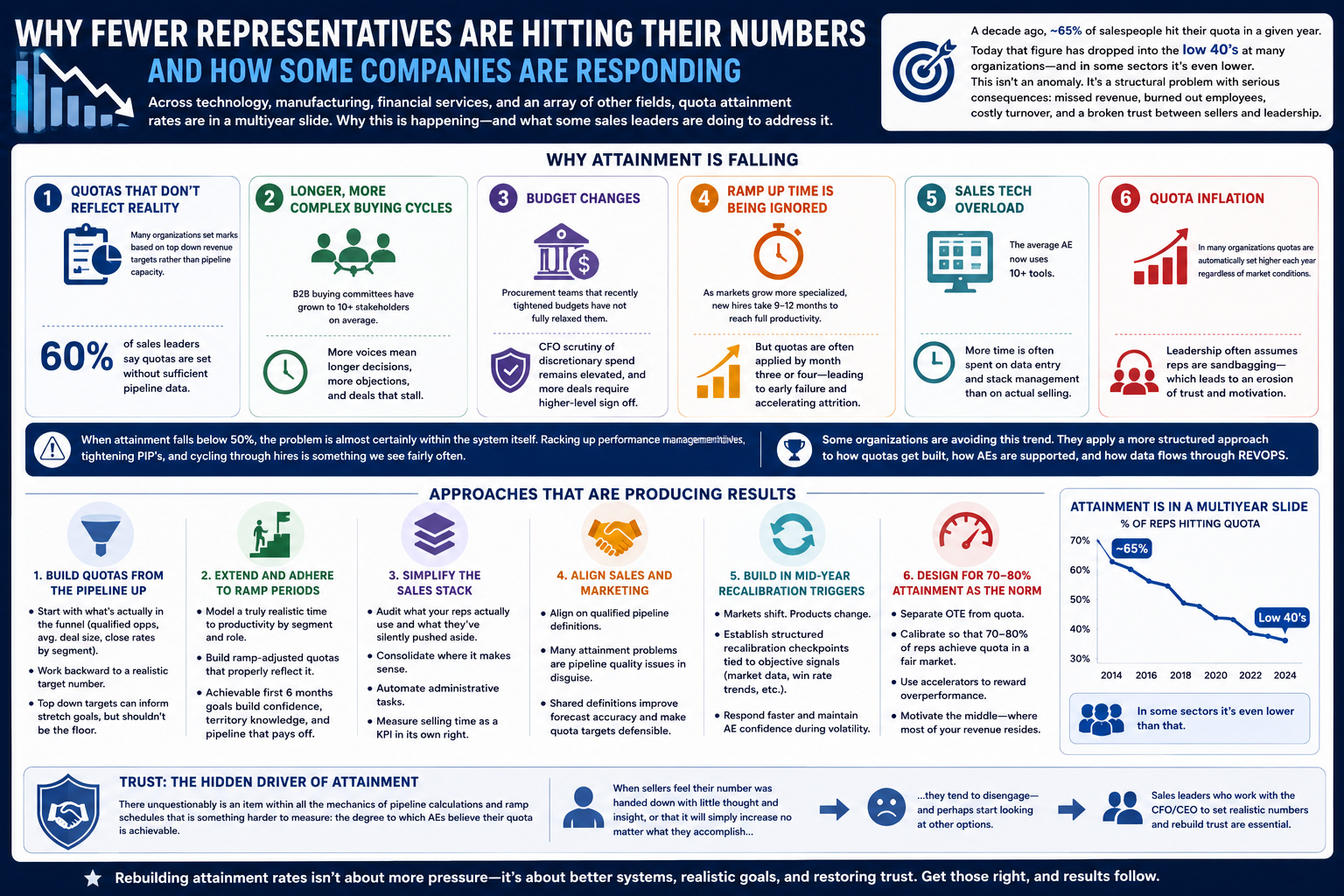
Across technology, manufacturing, financial services, and an array of other fields, quota attainment rates are in a multiyear slide. Why this is happening and what some sales leaders are doing to address it.
Something is amiss in how companies set and pursue sales targets. A decade ago, approximately 65% of salespeople hit their quota in a given year. Today that figure has dropped into the low 40’s at many organizations and in some sectors it’s even lower than that. This clearly isn’t an anomaly given the extensive data produced regarding this subject. It seems to be a structural problem that has significant consequences due to missed revenue, burned out employees, costly turnover, and an increasingly dysfunctional relationship between those who sell and the leadership setting their goals. The causes (macroeconomic, structural, and behavioral) are, as always, interconnected and they require more than simple alterations.
Why attainment is falling
Quotas that don’t reflect reality
Many organizations set marks based on top down revenue targets rather than pipeline capacity. Reps are handed numbers that reflect what the board wants, not what the market will bear. Indeed, about 60% of sales leaders maintain that quotas are set without sufficient pipeline data
Longer, more complex buying cycles
B2B buying committees have grown to 10+ stakeholders on average. More voices mean longer decisions, more objections, and deals that stall
Budget changes
Procurement teams that recently tightened budgets have not fully relaxed them. CFO scrutiny of discretionary spend remains elevated, and many deals require sign off at levels not previously required
Ramp up time is being ignored
As markets grow more specialized, new hires take 9–12 months to reach full productivity. But quotas are often applied at month three or four leading to a higher rate of early failure and accelerating attrition.
Sales tech overload
The average AE now uses 10+ tools. More time is often spent on data entry and stack management than on actual selling
Quota inflation
In many organizations quotas are automatically set higher each year regardless of market conditions. Leadership often assumes reps are sandbagging which leads to an erosion of trust and motivation
When attainment falls below 50%, the problem is almost certainly within the system itself. Racking up performance management initiatives, tightening PIP’s, and cycling through hires is something we see fairly often. There are some, however, who are avoiding this trend. These organizations aren’t doing anything otherworldly. They simply are applying a more structured approach to many things companies often view as secondary. How quotas get built, how AE’s are supported, and the manner in which data flows through the revenue operation are all fully addressed.
Approaches that are producing results:
• Build quotas from the pipeline up
Start with what’s actually in the funnel (qualified opportunities, average deal size, close rates by segment) and work backward to a realistic target number. Top down targets can inform stretch goals, but shouldn’t be the floor of overall expectations.
• Extend and adhere to ramp periods
Model a truly realistic time to productivity by segment and role, then build ramp adjusted quotas that properly reflect it. A representative given an achievable first 6 months goal will have appropriate confidence, territory knowledge, and pipeline that pays off.
• Simplify the sales stack wherever possible
Audit what your reps actually use and what they’ve silently pushed aside. Consolidate where it makes sense, automate administrative tasks, and measure selling time as a KPI in its own right.
• Align sales and marketing on qualified pipeline definitions
Many attainment problems are actually pipeline quality issues in disguise. When marketing and sales share a rigorous, agreed upon definition of what constitutes a legitimate opportunity, forecast accuracy improves and quota targets become far more defensible.
• Build in mid-year quota recalibration triggers
Markets inevitably shift, products change, and overall competitive dynamics evolve. Organizations that maintain structured recalibration checkpoints that are tied to objective signals like market data or win rate trends respond faster and maintain AE confidence during periods of volatility.
• Separate OTE from quota and design for 70–80% attainment as the norm
If your quota is calibrated so that only 20% of employees hit it, your compensation model is clearly broken. High performing sales organizations design targets so that 70–80% of individuals achieve quota in a fair market, with accelerators rewarding overperformance. This motivates the middle of the group, where most of your revenue actually resides.
Trust
There unquestionably is an item within all the mechanics of pipeline calculations and ramp schedules that is something harder to measure – the degree to which AE’s believe their quota is achievable. When sellers feel their number was handed down with little thought and insight, or that it will simply increase no matter what they accomplish, they tend to disengage and perhaps start looking at other options.
Rebuilding attainment rates requires emphasizing and maintaining trust. Sales leaders who are willing to effectively work with the CFO or CEO to properly convey that realistic numbers are not being set are essential. This is not always easy for many, but the alternative is far more costly in numerous ways.