
How Chief Marketing Officers Are Restructuring Teams to Maximize Generative AI Outputs
How Chief Marketing Officers Are Restructuring Teams to Maximize Generative AI Outputs
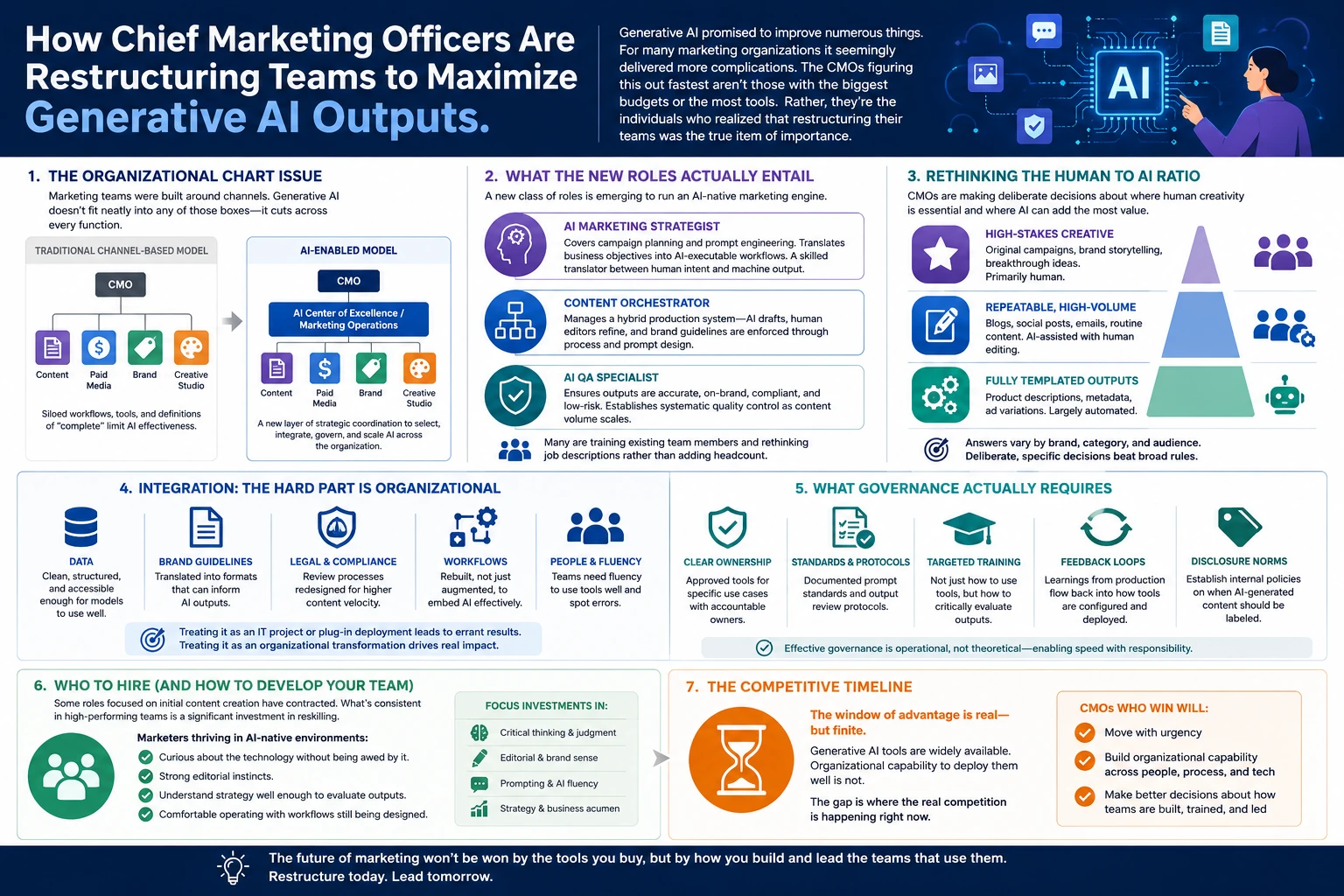
Generative artificial intelligence promised to improve numerous things. For many marketing organizations it seemingly delivered more complications
AI has proven to be a technology that works remarkably well when pointed in the right direction, and produces expensive and errant results when it is not. The CMOs figuring this out most rapidly aren’t those with the biggest budgets or the greatest number of tools. Rather, they’re the individuals who realized that restructuring their teams was the foremost item of importance.
Renascent Solutions Chief Marketing Officer Recruitment
The organizational chart issue
For decades, marketing teams were primarily built around channels. Content teams, paid media, brand, and perhaps a creative studio were the basic construct. Each function had its own workflow, toolset, and definition of complete. Generative AI definitely doesn’t fit neatly into any of those boxes.
A large language model that can draft copy, summarize research, and generate briefs in seconds doesn’t belong to a content box, while an image generation platform that turns a text prompt into a campaign visual isn’t purely a creative asset. These tools cut across every function, and organizations primarily built around fairly strict capacity spheres are struggling to deploy them effectively.
Forward-thinking CMOs are responding by introducing a new layer of strategic coordination. We’ve seen some call it a Center of Excellence while others are folding it into an expanded marketing operations function. The label matters less than the intent which is a dedicated group responsible for how AI tools are selected, tested, integrated, and governed across the entire marketing organization.
What the new roles actually entail
The emergence of the AI native marketing team has created demand for a new class of positions that didn’t meaningfully exist only a few years ago.
The AI Marketing Strategist
Covers campaign planning and prompt engineering. This person understands what the models can and can’t do, knows how to structure inputs to get reliable outputs, and can translate business objectives into AI-executable workflows. They’re less a technologist than a skilled translator between human intent and machine output.
The Content Orchestrator
Has replaced the traditional content manager at many organizations. Where the old role centered on assigning, editing, and publishing, this new version is focused on managing a hybrid production system in which AI drafts, human editors refine, and brand guidelines are enforced through a combination of process and prompt design.
The AI QA Specialist
Perhaps the least glamorous but most necessary addition. Generative AI outputs need systematic review, not just for factual accuracy, but for tone, brand alignment, regulatory compliance, and legal risk. As content volume scales, so does the need for structured quality control. Many are training existing team members and rethinking job descriptions rather than adding headcount.
Rethinking the human to AI ratio
One of the more consequential decisions CMOs are making right now is determining where human creativity is truly necessary and where it may be less productive. This is invariably more of a philosophical question than a practical one, and the answers vary considerably by brand, category, and audience.
For a B2B software company producing hundreds of technical blog posts a month, AI assisted drafting with minor human editing may be entirely appropriate. On the other hand, a luxury fashion brand whose identity depends on authentic storytelling and visual distinctiveness might require and entirely different approach. Most organizations sit somewhere in between, and the CMOs doing this well are making deliberate, specific decisions rather than all encompassing rules.
What’s emerging seems to be a tiered model. High stakes creative work remains primarily human. Repeatable, high volume content production is being shifted to AI with greater regularity. Fully templated outputs like product descriptions, metadata, and ad variations also are becoming largely automated.
Integration
Vendor pitch decks rarely mention that deploying generative AI at scale inside a marketing organization is genuinely hard, and most of the difficulty is organizational rather than technical.
Data has to be clean, structured, and accessible enough for models to use it well. Brand guidelines have to be translated into formats that can inform AI outputs. Legal and compliance review processes have to be redesigned for higher content velocity. Existing workflows have to be rebuilt, not just augmented. And people throughout the organization have to develop enough fluency with the tools to use them well and sufficient insight to catch errors when they don’t.
CMOs who treat this as an IT project or a plug in deployment tend to get errant results. Those getting traction are treating it as an organizational transformation with a technology component.
What governance actually requires
This conversation in AI marketing tends to fluctuate between two extremes ranging from a set of vague principles posted somewhere on the intranet, or a bureaucratic approval process that slows output to a crawl. Neither works.
What effective AI governance looks like in practice is more operational than either of these. It means clear ownership of which tools are approved for specific use cases, documented prompt standards and output review protocols, and training that’s specific enough to be useful, covering not just how to use the tools but how to evaluate their outputs critically. Most importantly, it promotes feedback loops that allow what’s learned in production to flow back into how the tools are configured and deployed.
Some CMOs are also getting ahead of disclosure norms by establishing internal policies about when AI generated content should be labeled as such, before external pressures or regulation force the conversation.
Who to hire
The restructuring conversation eventually revolves around what happens to the people whose jobs have changed most dramatically. Some roles that were primarily focused on initial content creation have contracted while others have expanded in scope as AI handles lower level tasks. What’s consistent across organizations that are managing this well is a significant investment in reskilling, not just in how to use specific tools, but in the judgment and critical thinking that make AI outputs actually useful.
The marketers thriving in AI native environments tend to share a few characteristics.
• They’re curious about the technology without being awed by it.
• They have strong editorial instincts.
• They understand strategy well enough to evaluate whether an output serves the objective.
• They’re comfortable operating with workflows that are still being designed.
The competitive timeline
Generative AI will not remain a differentiator forever. The window during which organizational capability with these tools translates into meaningful competitive advantage is certainly real, but it’s most definitely finite. The CMOs who recognize this are moving with urgency as the technology is largely available to everyone. The organizational capability to deploy it well is not. That gap is where the real competition is happening right now, and it’s being decided less in the tool selection area than in the decisions CMOs make about how their teams are built, trained, and led.
Renascent Solutions AI CXO/Sales/Sales Engineering Recruitment