
How to Structure a Fair Commission Plan for Multi-Year Cloud Contracts
How to Structure a Fair Commission Plan for Multi-Year Cloud Contracts
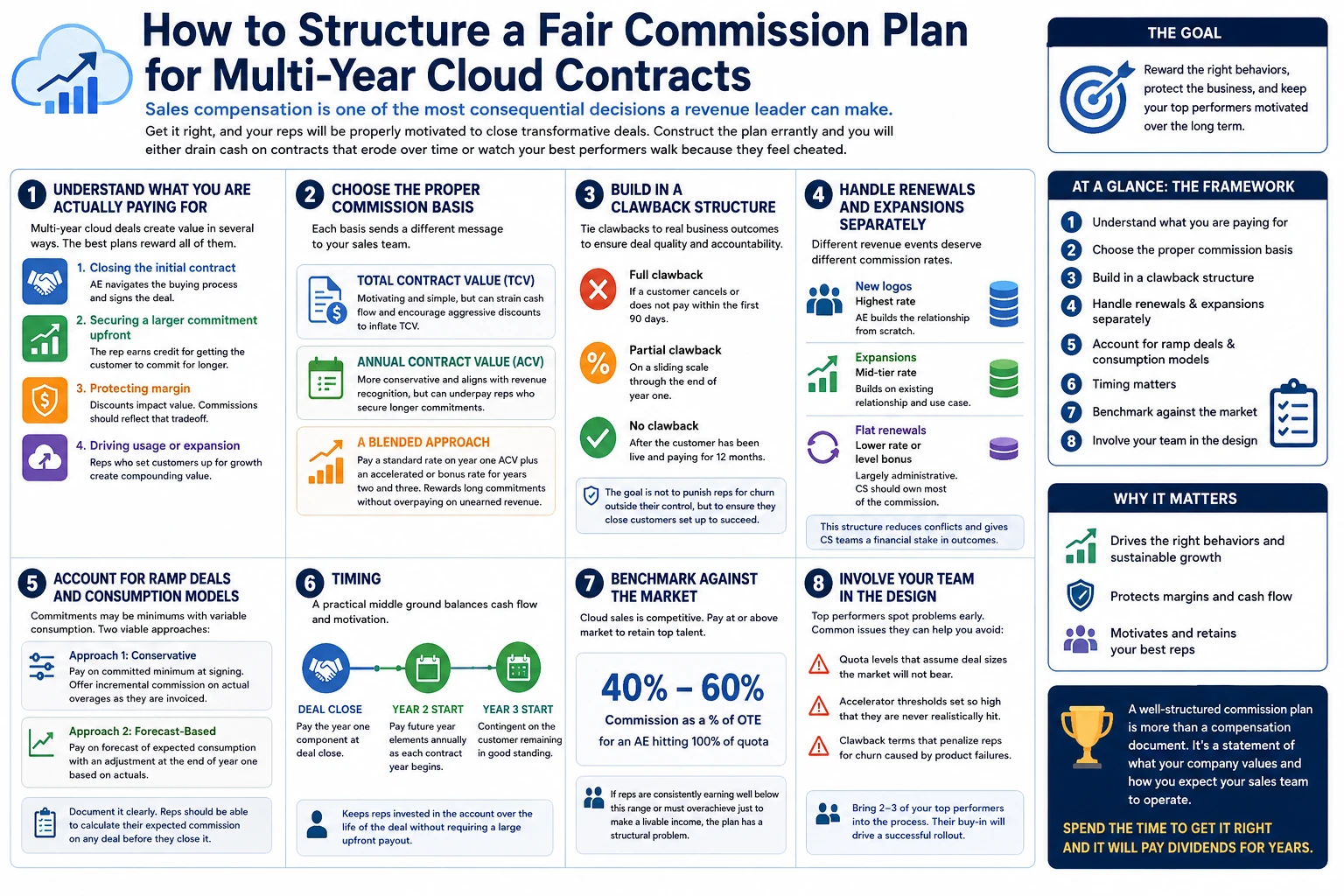
Sales compensation is one of the most consequential decisions a revenue leader can make
Get it right, and your reps will be properly motivated to close transformative deals. Construct the plan errantly and you will either drain cash on contracts that erode over time or watch your best performers walk depart because they feel cheated on the deals they worked hardest to win.
Multi-year cloud contracts add a particular layer of complexity. Unlike a one time software sale or a short renewal cycle, these agreements stretch across years, involve variable consumption, and often include price escalators, discounts, and ramp structures. A commission model designed for a transactional sale will break down fast in this environment. Here is how many we work with in this realm approach this.
Understand what you are actually paying for
Before you write a single number into a comp plan, it’s essential to properly define what behavior you want to reward. Multi-year cloud contracts typically involve several distinct stages of value creation:
Closing the initial contract
The AE identified the opportunity, navigated a complex buying process, and signed a customer to a long commitment.
Securing a larger commitment upfront
A multi-year deal is worth more to the business, and the rep who convinced the customer to extend deserves credit for that.
Protecting margin
If an AE discounted heavily to close, their commission should reflect that tradeoff.
Driving usage or expansion
In a cloud model, the contract floor is often just the starting point. Reps who set customers up for growth create compounding value.
Most plans only reward the first item on that list while the best structures reward all of them.
Choose the proper commission basis
This is where most compensation plans go wrong. There are three main options in this realm that may be used to base the commission on, and each sends a different message to your sales team.
Total Contract Value (TCV)
Paying on TCV means the rep gets credit for the full value of the signed agreement, including all years. This is motivating and straightforward to calculate, but it can create cash flow problems if you pay out the full commission at signing. It can also encourage individuals to offer aggressive multi-year discounts to inflate TCV while actually reducing the business value of the deal.
Annual Contract Value (ACV)
Paying on ACV ties the commission to the annualized value of the deal. This is more conservative and easier to reconcile with revenue recognition, but it can underpay reps who do the harder work of getting customers to commit to longer terms.
A Blended Approach
Many mature SaaS and cloud businesses utilize a blended model. The rep earns a standard rate on year one ACV plus an accelerated or bonus rate for years two and three of a committed term. This rewards the AE for securing a long commitment without overpaying on unearned future revenue.
Build in a clawback structure
A commission plan without clawbacks tends to invite unwanted behavior. If a rep can close a large multi-year agreement and collect their commission before the customer ever gets appreciative value, there is no accountability for deal quality.
Clawbacks should be tied to real business outcomes. A reasonable structure might include:
• Full clawback if a customer cancels or does not pay within the first 90 days.
• Partial clawback on a sliding scale through the end of year one.
• No clawback after the customer has been live and paying for 12 months.
The goal is not to punish reps for churn that happens for reasons outside their control. It’s simply to ensure that they are closing customers who are genuinely set up to succeed.
Handle renewals and expansions separately
One of the most common mistakes we see in cloud compensation plans is treating renewals like new business. Conflating the two creates tension between sales and customer success teams and often leads to overpaying for work that was already completed. A cleaner model separates three types of revenue events:
• New logos earn the highest commission rate. The AE built a relationship from scratch and converted a prospect into a customer.
• Expansions on existing contracts earn a mid-tier rate. There is an existing relationship and current use case to build on, but driving upsell still requires a good deal of work and skill.
• Flat renewals earn a lower rate or a level bonus. The customer was happy, the product delivered, and the renewal was largely an administrative exercise. If customer success owns the renewal motion, they should own most of the commission too.
This structure tends to keep new business reps from fighting over renewal credit and gives CS teams a financial stake in the outcomes they drive.
Account for ramp deals and consumption models
Many cloud contracts are structured with either of these components where the customer commits to a minimum spend but may exceed it based on usage. This creates a timing problem for commissions.
There are two viable approaches here.
• Pay commission only on the committed minimum at signing, then offer incremental commission on actual overages as they are invoiced. This is fairly conservative but administratively tidy.
• Pay commission on a forecast of expected consumption with an adjustment at the end of year one based on actual numbers. This is more generous to reps and better reflects the deal they actually sold, but it requires good forecasting discipline and a clear policy for handling adjustments.
The primary key is to document it clearly. Reps should be able to calculate their expected commission on any deal before they close it.
Timing
Cash flow matters on both sides. Paying out a full multi-year commission at signing strains your finances and creates misaligned incentives, but spreading it out too thin demotivates the AE and makes the plan hard to model. A practical middle ground is to pay the year one component at deal close and the future year elements annually as each contract year begins, contingent on the customer remaining in good standing of course. This keeps the representative financially invested in the account over the life of the deal without requiring the business to fund a large upfront payout.
Benchmark against the market
Even a well-designed plan will prompt team losses to other companies if it pays below market. Cloud sales is a competitive space, and the reps who can close complex agreements know their value.
On target earnings for enterprise cloud sales roles vary widely by segment and geography, but a general benchmark based on what we see is that commission should represent 40 to 60 percent of total OTE for an account executive hitting 100 percent of quota. If your reps are consistently earning well below that split, or if they have to overachieve dramatically just to hit a livable number, the plan has a structural problem.
Involve your team in the design
A number of sales leaders choose not to and often rue this later. Plans designed entirely in a finance or within a management vacuum tend to have blind spots that experienced AE’s can spot immediately. A few common errors:
• Quota levels that assume deal sizes the market will not bear.
• Accelerator thresholds set so high that they are never realistically hit.
• Clawback terms that penalize reps for churn caused by product failures.
Bring two or three of your top performers into the design process. They will generally outline many of the possible issues that may arise before the plan goes live, and their buy in will help tremendously with the broader rollout.
A well-structured commission plan is far more than a compensation document. It’s a statement of what your company values and how you expect your sales team to operate. Spend the time to get it right and it will pay dividends for years.