The Sales Hiring Mistake Companies Keep Making
The Sales Hiring Mistake Companies Keep Making
Many sales interviews seem designed to find the most compelling candidate
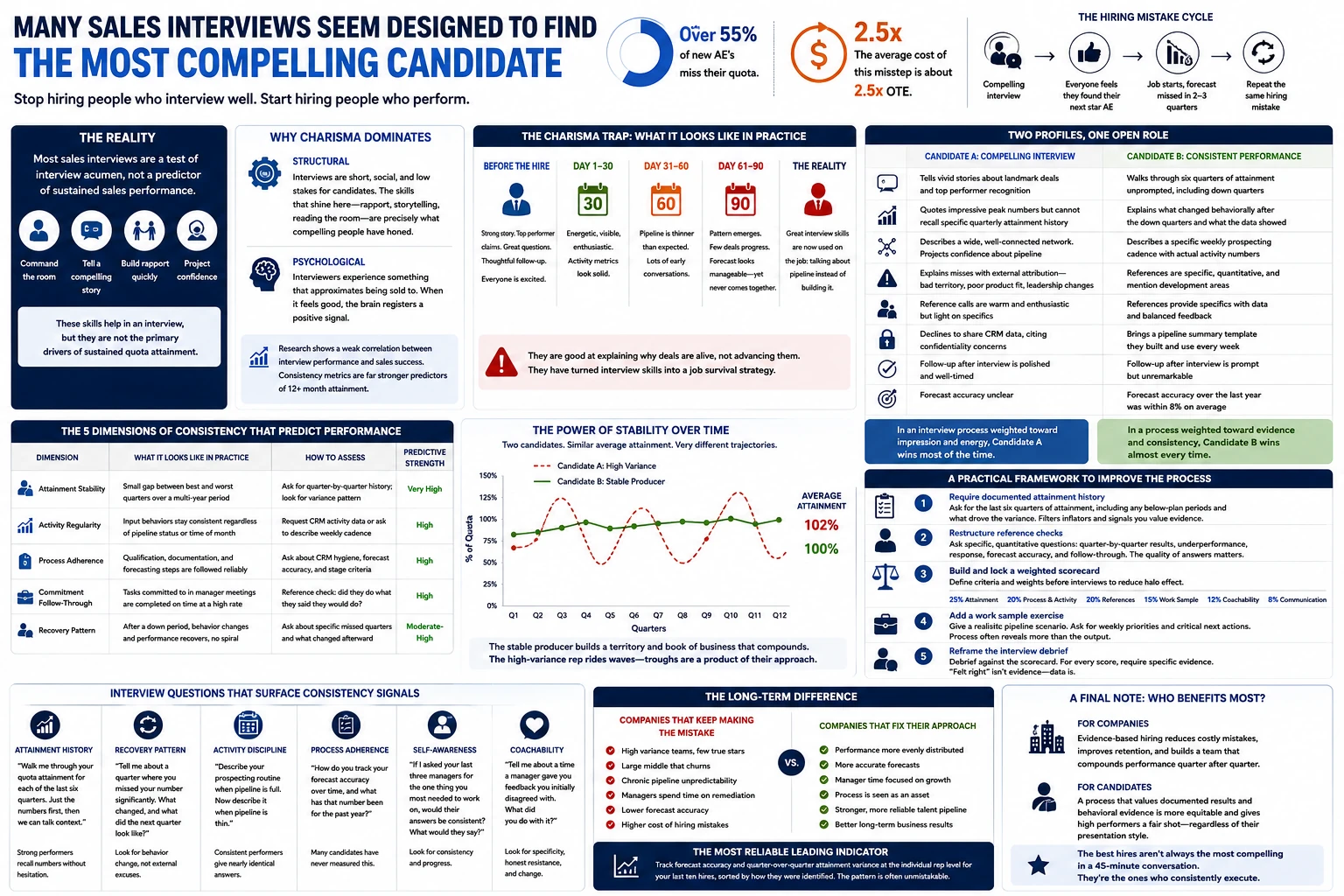
When a client comes to us seeking to fill a role that has been vacated due to errant performance (or they’re seeking to replace a current individual) we always make certain to have them describe the interview process that led to the hire. Quite often the story tends to follow a familiar path where the candidate was impressively confident, told great tales about their performance and abilities, and made everyone feel that they had potentially found their next star AE. Then the job started, and within two or three quarters it became clear that the numbers being forecast were not going to be realized.
In the majority of cases, this is a fairly predictable result of a process optimized for the wrong thing and not designed to measure what actually drives sustained sales performance. Sales interviews, as most companies currently run them, are fundamentally a test of interview acumen. They measure how well a person can command a room, tell a compelling story, build rapport quickly, and project confidence. These are certainly tangible and applicable skills, but the problem is that they are not the primary drivers of sustained quota attainment, and treating them as though they are frequently leads to an errant hire. This is particularly significant given that over 55% of new AE’s miss their quota and the average cost of this misstep is about 2.5 times the number relative to OTE.
Charisma
Charm, appeal, whatever moniker you would like to apply certainly is not a quality to be disregarded offhand. Indeed, sales rep who can’t build rapport, makes buyers feel uncomfortable, or who comes across as low energy/disengaged will most likely struggle in almost any selling environment. The argument here is not that personality should be ignored. Rather, it’s that this trait has been dramatically overweighted relative to behavioral indicators that are far more predictive of sustained performance.
The primary reason charisma dominates the interview is partly structural and partly psychological. Structurally, interviews are short, social, and relatively low stakes for the candidate. The skills that serve someone well in that context (quick rapport building, persuasive storytelling, reading the room and adjusting in real time) are exactly the proficiencies a compelling person has spent years refining. Psychologically, interviewers experience something that approximates being sold to, and if that experience feels good, the brain registers a positive signal. It is genuinely difficult for many managers to separate “I liked talking to this person” from “this person will perform well.”
Research that has attempted to correlate interview performance with eventual sales outcomes consistently finds a fairly weak relationship. Studies tracking cohorts of sales hires tend to show that structured measures of consistency including performance variance across quarters, activity regularity, forecast accuracy, and follow through on self-reported commitments, are substantially stronger predictors of 12+ month attainment than interview scores.
The charisma trap: what it looks like in practice
There is a recognizable pattern that plays out at companies that have fallen into this problem. A candidate arrives with a strong story: they were in the top tier at their last company, they have relationships in the space, they are ready to hit the ground running. They give sharp answers in the interview, ask the right questions, and they close the process well by following up thoughtfully and sending a thank-you note that references specific things discussed in the conversation.
Then the job starts. In the first 30 days, things look good. The new hire is energetic, visible, and enthusiastic in team meetings. They send a lot of outbound items and activity metrics look solid. But by day 60, the pipeline is thinner than expected, and by day 90, there is a pattern developing – lots of early stage conversations with very few progressing. When asked about it, the rep is articulate and optimistic. There is a good explanation for every deal that stalled. The forecast looks manageable yet somehow it never quite comes together.
What is often happening is that the skills that made this person great in the interview (talking compellingly about potential, projecting confidence, managing impressions) are now being applied to the job itself. They are good at talking about pipeline rather than building it. They are good at explaining why a deal is still alive rather than advancing it. They have turned their interview skills into a job survival strategy.
An example of two profiles with one open role
To make this a bit more concrete, consider two candidates for an account executive position at a mid-market software company. Both have roughly comparable experience on paper, come highly recommended, and give strong interviews. The differences only become more visible when you take a closer look at some specifics.
|
Candidate A: Compelling interview |
Candidate B: Consistent performance |
|---|---|
|
Tells vivid stories about landmark deals and top performer recognition |
Walks through six quarters of attainment unprompted, perhaps including some that were below plan |
|
Quotes impressive peak numbers but cannot recall specific quarterly attainment history |
Explains what changed behaviorally after the down quarters and what the data showed |
|
Describes a wide and well connected network. Projects confidence about pipeline |
Describes a specific weekly prospecting cadence with actual activity numbers |
|
Explains any missed periods with external attribution – bad territory, poor product fit, leadership changes |
References are specific, quantitative, and occasionally mention development areas alongside strengths |
|
Reference calls are warm and enthusiastic but light on specifics |
Brings a pipeline summary template they built and use every week |
|
Declines to share CRM data, citing confidentiality concerns |
Forecast accuracy over the last year was within 8 percent on average |
|
Follow-up after interview is polished and well-timed |
Follow-up after interview is prompt but unremarkable |
In a standard interview process weighted toward impression and energy, Candidate A wins most of the time. They are more enjoyable to talk to, their stories are more exciting, and they leave the room feeling like something significant just happened. Candidate B may come across as slightly flat by comparison and possibly be deemed too focused on process while not being quite as electric.
That said, in a process weighted toward verified evidence and behavioral consistency, Candidate B wins almost every time. And the downstream performance data supports that outcome emphatically.
What to look for instead
Redirecting a hiring process away from charisma and toward consistency requires getting specific about what uniform reliability actually means as a measurable attribute. It is not about hiring people who are low key or unambitious. Many consistent performers have significant energy and personal presence. The distinguishing feature is that their behavior does not change much based on external conditions. They prospect at the same rate when their pipeline is full as when it is empty, their CRM is clean at any given time, and they follow up when they say they will regardless of whether a manager is watching.
There are five dimensions of consistency that are worth assessing separately because they require different evidence and predict various aspects of performance.
|
Dimension |
What is looks like in practice |
How to assess |
Predictive strength |
|---|---|---|---|
|
Attainment stability |
Small gap between best and worst quarters over a multi-year period |
Ask for quarter-by-quarter history; look for variance pattern |
Very high |
|
Activity regularity |
Input behaviors stay consistent regardless of pipeline status or time of month |
Request CRM activity data or ask to describe weekly cadence in specific terms |
High |
|
Process adherence |
Qualification, documentation, and forecasting steps are followed reliably |
Ask about CRM hygiene, forecast accuracy, and stage advancement criteria |
High |
|
Commitment follow-through |
Tasks committed to in manager meetings are completed on time at a high rate |
Reference check question: did they do what they said they would do? |
High |
|
Recovery pattern |
After a down period, behavior changes and performance recovers; the rep does not spiral |
Ask about specific missed quarters and what changed afterward |
Moderate-high |
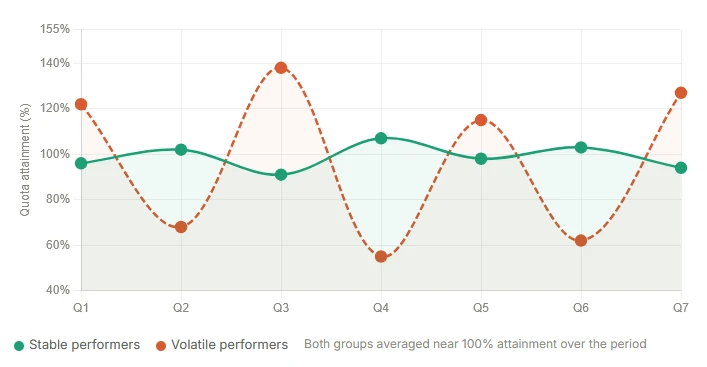
The chart above makes a point worth sitting noting. Both groups show similar average attainment over the period. A hiring manager looking only at aggregate numbers would see two candidates performing at roughly the same level. But the stable producer is building a territory and a book of business in a way that compounds over time. The more volatile individual is riding waves, and the troughs are as much a product of their approach as the peaks are.
A practical framework for making the process more productive
The following changes can be integrated without a major overhaul of the existing hiring infrastructure. They are ordered roughly by impact and ease of implementation, though most organizations benefit from applying all of them together.
1. Require documented attainment history before the first interview. Ask candidates to submit a written account of their attainment for each of the last six quarters, including any periods below plan and a brief explanation of what drove the variance. This single step filters out a significant portion of candidates who have been inflating their results in interviews, and it signals to strong performers that this organization takes evidence seriously.
2. Restructure reference checks around quantitative probing. The standard approach often only confirms employment and elicits vague praise. A useful reference check asks specific questions: What was their attainment in each of the quarters you worked together? Were there any periods of significant underperformance, and what was their response? How accurate were their forecasts? Did they consistently complete tasks they committed to? The quality of the answers, including pauses and deflections, is itself informative.
3. Build a weighted scorecard and lock it before the interview begins. Post-interview scoring is heavily susceptible to the halo effect that charismatic candidates produce. Establish the criteria and weights before any candidate enters the room. A reasonable starting distribution for most field sales roles – verified attainment history 25 percent, process adherence and activity discipline 20 percent, reference check depth score 20 percent, work sample or structured exercise 15 percent, coachability and self-awareness 12 percent, and communication presence 8 percent.
4. Add a work sample exercise for roles that justify it. Give the candidate a realistic pipeline scenario with six to eight deals at various stages and ask them to prioritize their week, identify their most critical next actions for each deal, and explain their reasoning. The process is often more revealing than the output. Consistent performers tend to work methodically, flag assumptions explicitly, and ask clarifying questions before proceeding. Impression-oriented candidates tend to gravitate toward the biggest deals and produce compelling but vague action plans for the rest.
5. Reframe the interview debrief. Most of these tend to quickly become a conversation about who the team liked and who felt right. Redirect the debrief to the scorecard. For each criterion ask: what specific evidence did we collect that supports this score? If the answer is “it felt like they had strong process,” that is not evidence. Require the team to identify the actual behavioral data point before assigning a number. This slows the debrief down in a useful way.
Interview questions that surface consistency signals
The following questions are designed to be difficult to answer compellingly without actually having the underlying data. A candidate who has been consistent will find them easy. A candidate who has been primarily relying on charisma will find ways to answer that sound good but often lack substance, and that gap is exactly what you are listening for.
Attainment history “Walk me through your quota attainment for each of the last six quarters. Just the numbers first, then we can talk about context.” The instruction to give numbers before context removes the ability to frame every period with a narrative before the data lands. Strong performers tend to recite these from memory without hesitation.
Recovery pattern “Tell me about a quarter where you missed your number significantly. What specifically did you change about your behavior afterward, and what did the next quarter look like?” Answers that focus on behavior change are credible. Answers that focus on external circumstances and a return to normal are a warning sign.
Activity discipline “Describe your prospecting routine on a typical week when your pipeline is in good shape. Now describe it on a week when your pipeline is thin.” Consistent performers give nearly identical answers to both halves of this question. That consistency is the point.
Process adherence “How do you track your forecast accuracy over time, and what has that number been for the past year?” Many candidates have never measured this. The ones who have are telling you something important about how they think about their own performance.
Self-awareness “If I asked each of your last three managers for the one thing you most needed to work on, would their answers be consistent? What would they say?” Consistent performers often describe the same development theme across multiple managers, along with the progress they made on it. This is a positive signal, not a negative one.
Coachability “Tell me about a time a manager gave you feedback that you initially disagreed with. What did you do with it?” Look for specificity and an honest account of the internal resistance before the behavioral change. Answers that are too smooth are often rehearsed rather than real.
The company that keeps making this mistake versus the one that amends their approach
There is a meaningful difference in the long-term trajectory of sales organizations that have solved this problem versus those that have not. Companies that hire for charisma tend to have high variance teams that include a few genuine stars, a large middle that churns, and a chronic sense that the talent pipeline is unreliable. They spend a disproportionate amount of management energy on the bottom of the performance distribution, and their forecasts are less reliable than they should be because the team’s individual accuracy is low.
Companies that have shifted their hiring toward consistency tend to build something that looks different from the outside. The team is perhaps less flashy and there are fewer dramatic stories about landmark quarters. But attainment is more broadly distributed across the team, forecasts are more generally more accurate, manager attention can go toward growth rather than remediation, and the culture tends to develop a different relationship with process where it it treated as an asset rather than a constraint.
The most reliable leading indicator: Track forecast accuracy and quarter-over-quarter attainment variance at the individual rep level for your last ten hires, sorted by whether they were identified primarily as strong interview performers or as documented consistent performers. Most sales leaders who run this exercise find a pattern they is quite useful.
None of this requires ignoring personality or hiring people who are genuinely difficult to work with. It instead prompts building a process that collects the right evidence, weights it honestly, and does not let a great 45-minute conversation substitute for a track record of actual execution. The candidates who have built that type of profile are out there, they just do not always win the interview.
A final note on who benefits most from this change
It is worth noting that a shift toward evidence-based sales hiring does not only benefit the companies doing the hiring. It also creates a more equitable process for candidates. A process that centers on documented behavioral evidence and verified performance history creates more room for candidates whose results speak clearly even when their presentation style does not immediately command a room.