
The C-Suite Is Being Rebuilt From Scratch
The C-Suite Is Being Rebuilt From Scratch
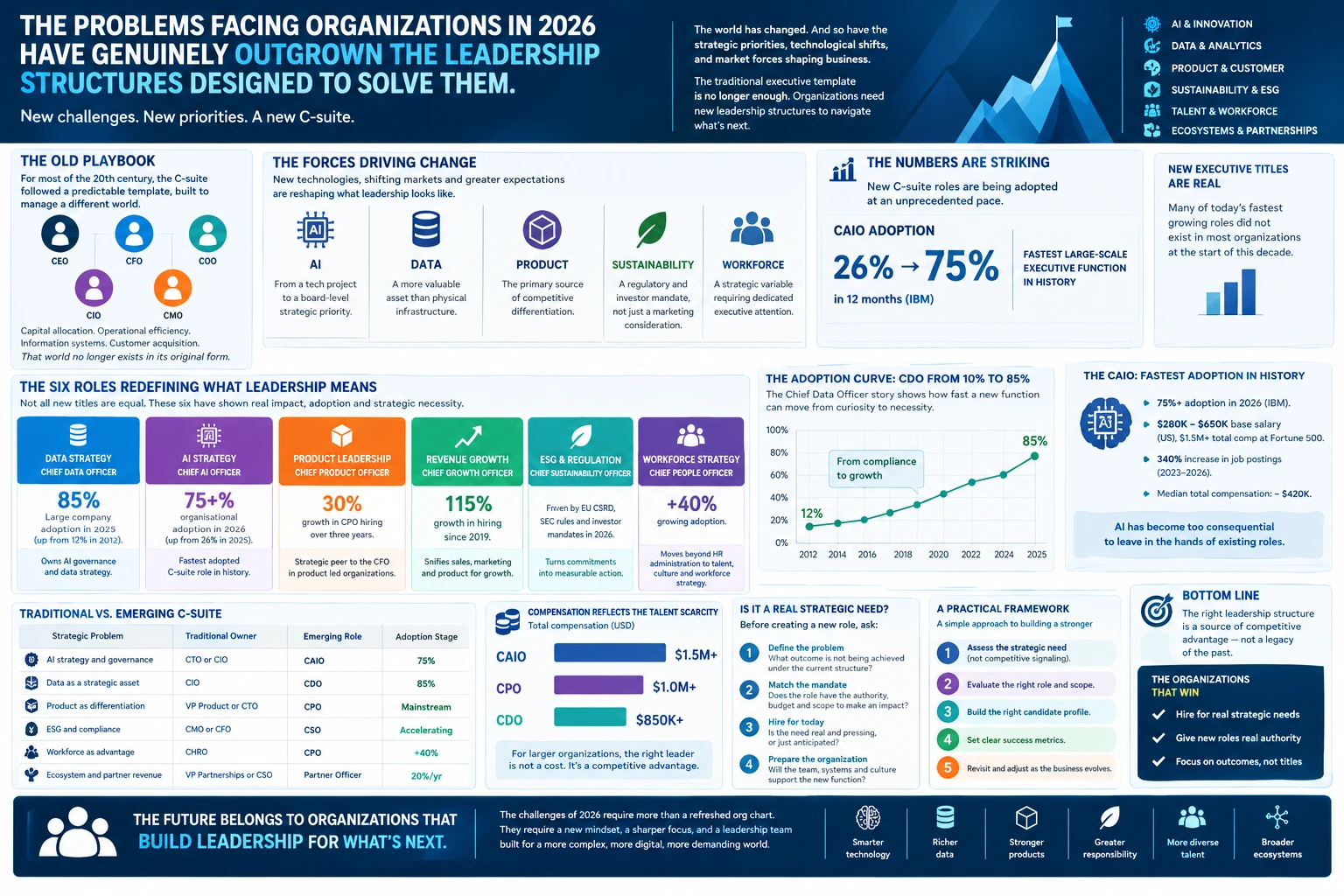
The problems facing organizations in 2026 have genuinely outgrown the leadership structures designed to solve them.
For most of the twentieth century, the executive suite followed a fairly predictable template that included a chief executive, a chief financial officer, a chief operating officer, and in later decades, a chief information officer along with a chief marketing officer. The structure reflected the dominant strategic priorities of the era that centered around capital allocation, operational efficiency, information systems, and customer acquisition. The world those titles were built to manage no longer exists in its original form, and the leadership architecture is catching up accordingly.
There are a number of forces reshaping the composition of the modern C-suite, and they certainly are not subtle. Artificial intelligence has moved from a technology project to a board-level strategic priority. Data has become, for many organizations, a more valuable asset than the physical infrastructure surrounding it. The product function has evolved from a development team into the primary source of competitive differentiation. Sustainability has moved from a marketing consideration to a regulatory and investor mandate. And the workforce itself has emerged as a strategic variable requiring dedicated executive attention in ways that traditional human resources frameworks were not designed to address.
There are a number of important factors for boards, CEOs, and executive teams to consider when determining whether a new C-suite role is a genuine strategic necessity, a response to external pressure, or simply a title inflation exercise with limited organizational benefit.
The numbers are striking
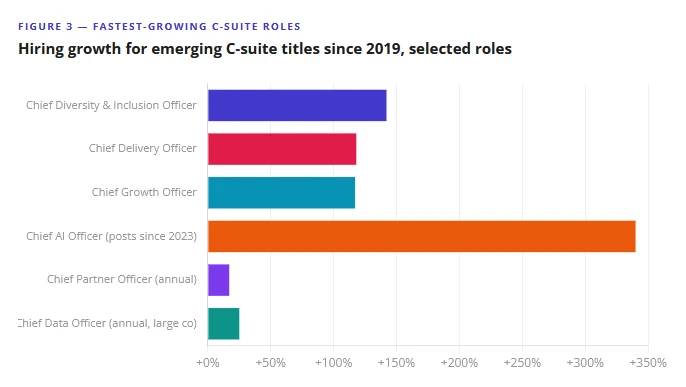
The pace at which new executive titles have been created and adopted across sectors is one of the more remarkable organizational phenomena of the past five years. Several of the fastest growing roles did not meaningfully exist in most companies at the start of this decade.
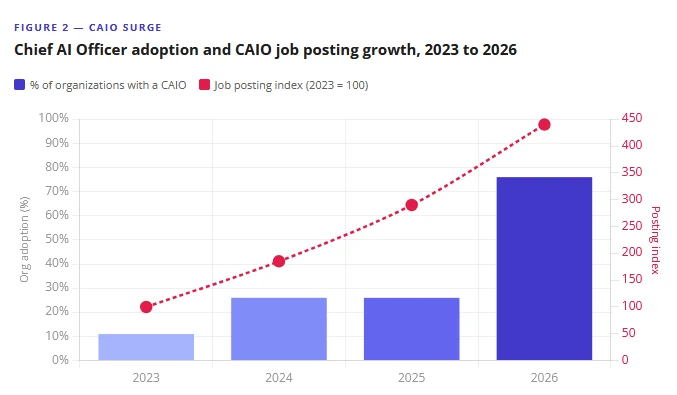
The Chief AI Officer figure deserves particular emphasis. IBM’s 2026 CEO Study, conducted with Oxford Economics across 2,000 senior leaders in 33 countries and 21 industries, found that over 75% of organizations now have a CAIO. Twelve months prior that figure was 26%. That is the fastest large-scale adoption of an executive function in the recorded history of corporate governance, and it happened almost entirely in response to a single technology shift reaching a strategic inflection point.
The six roles redefining what leadership means
Not all new C-suite titles carry equal weight or represent genuine strategic innovation. The six roles described below are the ones that have demonstrated substantive organizational impact, meaningful adoption curves, and a clear rationale rooted in real strategic necessity rather than competitive mimicry.
Data Strategy
Chief Data Officer
85% Large company adoption in 2025, up from 12% in 2012. Now owns AI governance alongside traditional data strategy.
AI Strategy
Chief AI Officer
75+% organizational adoption in 2026 per IBM, up from 26% in 2025. Fastest adopted C-suite role in corporate history.
Product Leadership
Chief Product Officer
30% Growth in CPO hiring over three years. Now a strategic peer to the CFO in product led organizations.
Revenue Growth
Chief Growth Officer
115% growth in hiring since 2019. Created to unify fragmented growth accountability across sales, marketing, and product.
ESG & Regulation
Chief Sustainability Officer
Driven by EU CSRD, SEC climate disclosure rules, and investor ESG mandates reaching enforcement phase in 2026.
Workforce Strategy
Chief People Officer
+40%. Growing adoption as the CHRO function evolves from HR administration to workforce strategy and culture design.
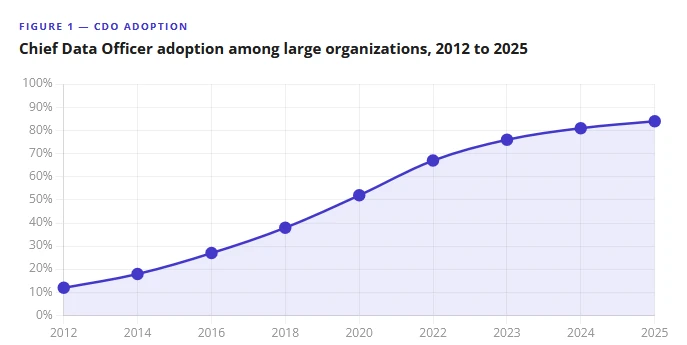
The adoption curve: from 10% to 85% in little over 10 years
The Chief Data Officer story is the clearest illustration of how a new executive function moves from curiosity to necessity. The role is believed to have originated at Capital One in the early 2000s, and for the better part of a decade it remained a novelty confined to the financial services and healthcare sectors. Organizations that appointed CDOs during that period were generally responding to regulatory pressure around data privacy and financial reporting, not to a broader conviction that data was a strategic asset requiring C-suite ownership.
The shift began in earnest around 2020, when the intersection of cloud data infrastructure, analytics at scale, and the first wave of machine learning applications made the case that data required dedicated executive leadership rather than being managed as a subset of the CIO’s purview. By 2025 almost 90% of large organizations had a CDO,
What is happening with the CDO function now is equally instructive. The early CDO was hired for compliance: someone to manage data governance, privacy policy, and regulatory reporting. Today’s CDO is hired to grow revenue, accelerate AI product development, and make the rest of the organization measurably smarter about how it uses information. The role has effectively expanded from custodian to strategist within the span of a decade, and the organizations that still position the CDO primarily as a compliance function are beginning to find themselves at a competitive disadvantage to peers who have made the transition.
The Chief AI Officer: the fastest adoption in C-suite history
No single development in the evolution of the executive suite over the past decade approaches the speed and scale of the CAIO’s emergence. The title barely registered as a distinct function just a few years ago. That changed with striking suddenness in 2025 and 2026.
The strategic rationale is not complicated. AI has become too consequential to leave in the hands of a CTO who is managing the entire technology stack, or a CDO whose primary mandate is data governance. The organizations that treated AI as a technology initiative and embedded it within existing functions discovered that the cross-functional coordination challenges, the governance requirements, the talent competition, and the pace of model development all demanded dedicated executive leadership with a clear mandate and board level accountability.
CAIO compensation reflects the acute scarcity of qualified candidates. Base salaries in the United States range from $280,000 to $650,000, with total compensation at Fortune 500 companies and frontier AI organizations reaching $1.5 million or more when equity, signing bonuses, and performance pay are included. CAIO job postings were up 340% from 2023 to 2026, with median total compensation currently sitting around $420,000.
The Chief Product Officer
The emergence of the Chief Product Officer as a genuine C-suite peer rather than a senior director with an inflated title reflects a profound structural shift in how competitive advantage is created and sustained in the modern economy. Many organizations, including software businesses, platform companies, and increasingly the digital arms of traditional enterprises, now view the product as the primary vehicle through which value is delivered to customers, differentiation is achieved relative to competitors, and revenue growth is generated over time.
The CPO role is distinct from a Vice President of Product in ways that are organizationally significant. A VP of Product typically owns the product development process and the roadmap for an existing set of offerings. A CPO covers the product vision, sits at the strategic table where decisions about market positioning, pricing, partnership, and build or buy are made, and is accountable for the product as a revenue generating and customer retaining asset rather than purely as an engineering deliverable. The CPO’s influence on business outcomes is direct and measurable in ways that are more immediately obvious than almost any other executive function.
The Chief Growth Officer
One of the more persistent structural problems in the executive suite of mid to large companies is the question of who is ultimately accountable for growth. In the typical organization, these outcomes are jointly influenced by sales, marketing, product, and sometimes customer success, with each function owning its own piece of the revenue equation and no single executive holding accountability for the whole portion. The Chief Growth Officer exists specifically to solve this ownership problem.
The CGO is more frequently filled through external search than through internal promotion, reflecting the reality that the competency set required, including the ability to orchestrate growth strategy across departments that have historically operated with significant autonomy, is genuinely difficult to develop within a single functional silo. Organizations that have hired CGOs and given them the authority to restructure how growth resources are allocated tend to report significant improvements in alignment, accountability, and ultimately revenue outcomes.
The Chief Sustainability Officer
For much of the previous decade, the Chief Sustainability Officer was a role that large companies created in response to external reputation pressure and was a signal to investors, customers, and media that the organization took environmental and social responsibility seriously. The strategic substance behind many of these appointments was, to be candid, fairly limited. The CSO often lacked budget authority, reporting lines to functions that actually drove emissions or supply chain decisions, and any real mechanism to translate sustainability commitments into operational change.
The regulatory environment has changed this dynamic decisively. The CSO who cannot produce auditable sustainability data, demonstrate progress against regulatory benchmarks, and integrate ESG considerations into material business decisions is now essentially a liability rather than a communications asset.
The practical implication for organizations is that the quality of who holds the CSO role matters enormously. A leader with deep regulatory expertise, strong relationships with the CFO and General Counsel, and the operational authority to influence supply chain and capital allocation decisions is a genuinely valuable executive. A CSO with a strong communications background and limited operational mandate is increasingly insufficient for the current regulatory environment.
The Chief People Officer
The transition from Chief Human Resources Officer to Chief People Officer is perhaps the most debated title evolution in the current C-suite conversation, precisely because it can represent either a genuine strategic reinvention of the function or a rebranding exercise with minimal underlying change. The distinction matters enormously, and it is one that candidates considering the role, boards evaluating their executive team composition, and organizations designing the function must examine carefully.
The case for the genuine reimagination is compelling and grounded in real organizational change. Workforce strategy, talent pipeline design, organizational culture, and employee experience have become primary drivers of competitive outcomes in ways that the traditional HR function was not built to address. The CHRO model optimized for policy administration, compensation benchmarking, compliance management, and reactive talent acquisition. These certainly remain necessary functions, but they are no longer sufficient to describe the strategic scope of what leading organizations need from their most senior people executive.
The CPO model, at its best, brings together workforce strategy, organizational design, culture development, and talent market intelligence as integrated tools of competitive advantage. The CPO who can speak credibly about the connection between talent strategy and product roadmap, or between organizational culture and customer outcomes, is operating in a genuinely different space from a traditional CHRO. That said, organizations that change the title without changing the mandate, the reporting structure, or the scope of authority are, to no surprise, unlikely to get substantively different outcomes from the rebranding alone.
How the traditional and emerging C-suite compare
It’s useful to lay out the contrast between the traditional executive structure and the emerging one side by side, because the strategic logic behind each new role becomes clearer when viewed in the context of what problem it is solving that the existing structure was not adequately addressing.
|
Strategic problem |
Traditional owner |
Emerging role |
Why the gap appeared |
Adoption stage |
|---|---|---|---|---|
|
AI strategy and governance |
CTO or CIO (partial ownership) |
Chief AI Officer (CAIO) |
AI crossed a threshold where no existing executive had a clean mandate for enterprise-wide governance and ROI accountability |
75% adoption |
|
Data as a strategic asset |
CIO (infrastructure focus) |
Chief Data Officer (CDO) |
Data value creation, governance, and regulatory compliance required dedicated executive ownership separate from IT infrastructure |
85% large companies |
|
Product as competitive differentiation |
VP Product or CTO (tactical) |
Chief Product Officer (CPO) |
Product became the primary revenue driver in software-led businesses, requiring C-suite accountability for vision, strategy, and market positioning |
Mainstream |
|
ESG and sustainability compliance |
CMO or CFO (partial, reactive) |
Chief Sustainability Officer (CSO) |
EU CSRD, SEC disclosure rules, and investor ESG mandates created audit grade compliance obligations that required dedicated executive ownership |
Accelerating |
|
Workforce as strategic advantage |
CHRO (policy and compliance focus) |
Chief People Officer (CPO) |
Talent strategy, culture design, and employee experience became primary drivers of competitive differentiation, requiring a broader mandate than traditional HR |
+40% growing |
|
Ecosystem and partner revenue |
VP Partnerships or CSO |
Chief Partner Officer |
BCG projects ecosystem models will account for 30% of global corporate revenue by 2027, requiring dedicated executive ownership of partner strategy |
20% yr growth |
Compensation reflects the talent scarcity
One of the clearest signals of how seriously organizations are taking these emerging roles is what they are willing to pay to fill them. Compensation for CDOs, CAIOs, and CPOs in particular has escalated significantly over the past two years, reflecting both the genuine lack of qualified candidates with the right combination of technical depth and executive leadership capability, and the competitive intensity of the search for those individuals.
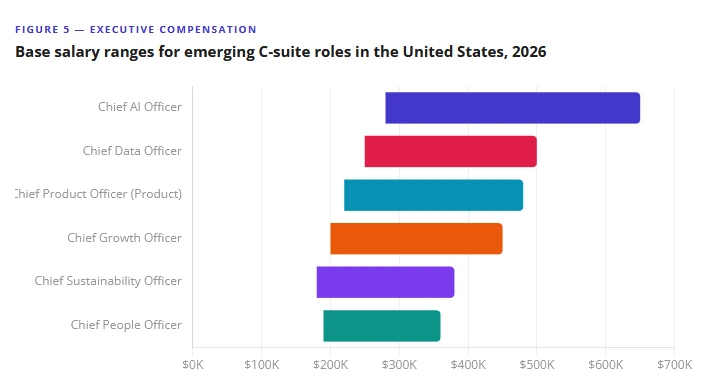
The CAIO compensation figures are particularly striking. A Fortune 500 CAIO answering to an audit committee about model risk every quarter is commanding base salaries at the top of the range, and total packages that can exceed $1.5 million once equity and performance pay are included. The $370,000 gap between a mid-market CAIO and a Fortune 500 CAIO reflects not just organizational scale but the complexity and regulatory exposure of the role at the enterprise level. For organizations that try to fill these positions at below market compensation on the assumption that the title alone is sufficient incentive, the search timelines and failure rates tend to be quite instructive.
When a new title is a genuine strategic investment versus an organizational fashion statement
There is a real risk in any environment where new C-suite titles are proliferating that organizations create roles in response to competitive signaling, investor expectations, or a desire to appear current rather than in response to an authentic strategic need. A CAIO hired before the organization has a coherent AI strategy to execute is unlikely to drive meaningful outcomes. A CSO appointed without operational authority to influence supply chain decisions is unlikely to satisfy the regulatory requirements that justified the hire. A CGO who does not have the organizational standing to realign how growth resources are allocated across functions will find the role frustrating and probably short.
Define the problem before defining the title
The question to ask before creating any new C-suite position is what specific strategic outcome is not being achieved under the current structure and why. If the honest answer is that the problem is execution quality within an existing function rather than a structural ownership gap, a new title will not solve it.
Ensure the mandate matches the title
A CAIO without budget authority over AI investments is not a Chief AI Officer in any meaningful sense. A CPO who reports to the CMO rather than to the CEO is not operating at C-suite level regardless of what the title says. The organizational authority granted to a new executive role must correspond to the strategic scope the role is intended to address.
Hire for current reality, not aspirational future state
Organizations that hire a CDO because they plan to become more data driven, rather than because they have reached the organizational maturity where a CDO can prompt immediate value, often find the role underutilized and the executive frustrated. New C-suite functions tend to succeed when the strategic need is present and pressing, not when it is anticipated as a future consideration.
Prepare the organization for the arrival
A CAIO arriving at an organization where AI governance processes do not exist, data quality is poor, and the technology team does not yet understand how to work alongside an AI function has a significant organizational development challenge to address before the strategic work can begin in earnest. Preparing the broader executive team for what a new function requires in terms of collaboration, data sharing, and budget prioritization is as important as the search itself.
A note on fractional and interim appointments
For organizations at revenue scales below approximately $50 million, or those in early stages of building capability in a new area, a fractional or interim appointment is frequently the more appropriate path than a full-time C-suite hire. A fractional CAIO, for example, provides genuine senior AI leadership at a cost of $60,000 to $180,000 annually rather than the $400,000 or more that a full-time appointment requires, while allowing the organization to develop the internal readiness that will eventually justify a permanent hire. Several of the emerging roles described in this article lend themselves particularly well to fractional arrangements at smaller organizational scale, and the executive search landscape has responded accordingly with a growing supply of experienced professionals available in this capacity.
What this means for organizations building their leadership teams
The practical implication of everything described above is that the composition of the C-suite is now a genuine strategic design question rather than an inherited template. Boards and CEOs who approach executive team composition with the same analytical rigor they bring to capital allocation decisions are finding that the right leadership structure is a meaningful source of competitive advantage in itself. The organizations that identified the need for a CAIO eighteen months before their competitors, or that built a genuine CDO function before data governance became a regulatory requirement, gained time and organizational capability that is very difficult to replicate under competitive pressure.
For executive search, this shift means that the candidate profile for many senior leadership roles has changed considerably. The CAIO who can speak to both AI governance frameworks and business unit P&L outcomes is a different candidate from the CTO who learned to talk about AI. The CPO who has built product organizations that drove measurable revenue growth is a different candidate from the VP Product who executed against a defined roadmap. Finding the right individual for roles where the competency set is still being defined by the market, and where qualified candidates are genuinely scarce, requires a search approach that looks beyond the obvious pools and evaluates adjacent experience with significant care. We have strong experience here: Retained Recruitment
We should have a more complete picture of how these roles perform over five-year tenures as the wave of recent appointments matures. What is already clear from the early data is that organizations with well defined, appropriately resourced, and strategically integrated versions of these positions are outperforming those that have not made the transition, and that the gap is widening rather than narrowing as the strategic priorities driving these roles continue to accelerate.