
The Rise of the Fractional Executive
The Rise of the Fractional Executive
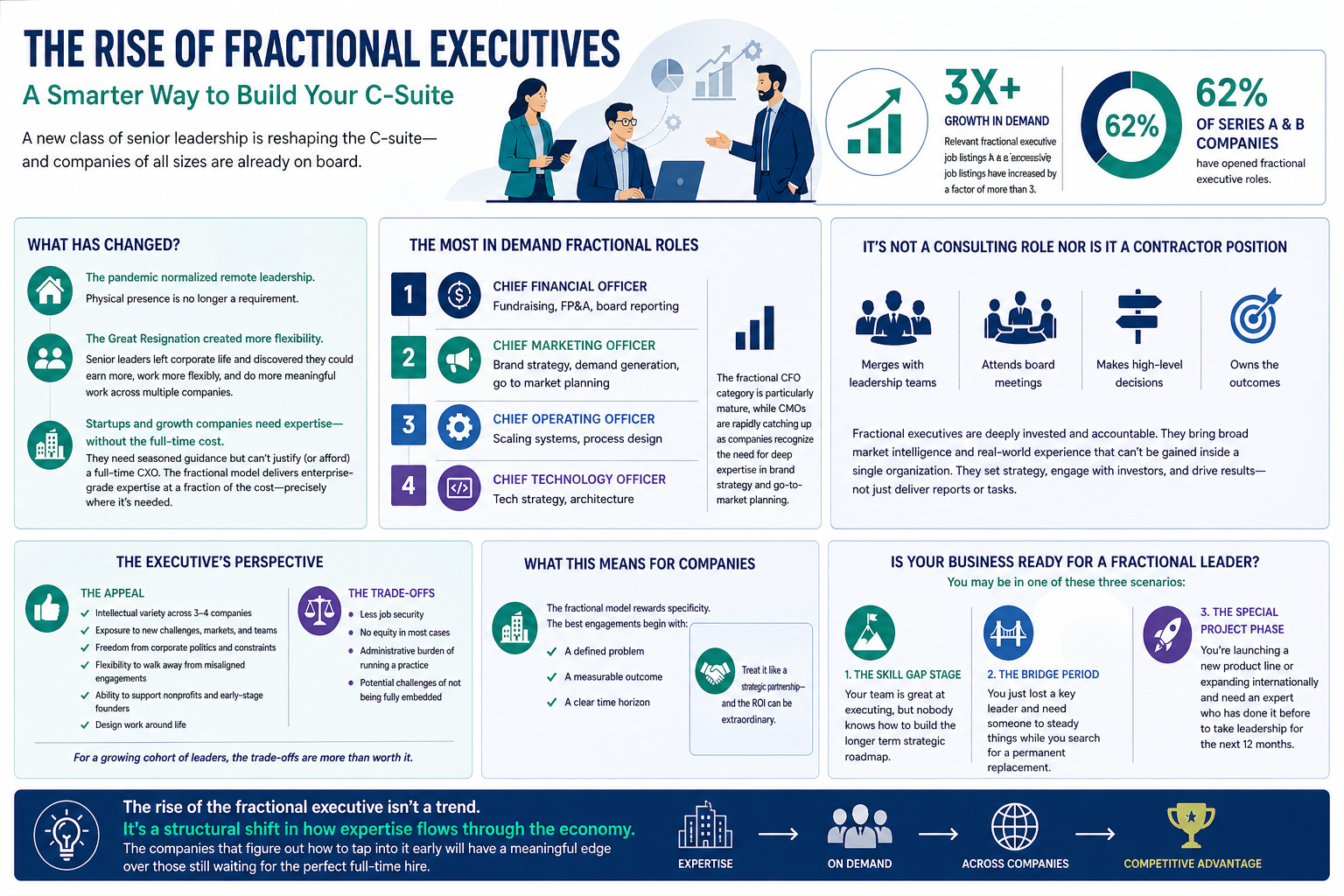
How a new class of senior leadership is reshaping the C-suite and why numerous companies are already on board.
Ten years ago, the idea of a part-time CFO would have been met with consternation at best in most boardrooms. Today it may raise valuations. Across industries and company sizes, a fairly quiet shift is underway in how organizations access and utilize senior talent, and it’s upending assumptions about what it means to be an executive.
The fractional executive model, where a seasoned C-suite leader works with multiple companies simultaneously on a part-time or project basis, has moved from a startup workaround to a relatively mainstream strategic tool. Indeed, the number of relevant job listing have increased by a factor of more than 3, while 62% of Series A and B companies have opened fractional roles.
What has changed?
The pandemic put a dent in the assumption that executive leadership required physical presence. Remote work effectively normalized dispersed leadership, and the slew of resignations that occurred pushed a wave of senior talent out of corporate structures, often for good. Many of these executives discovered they could earn more, conduct business with more flexibly, and very often do more interesting work by distributing their expertise across several companies rather than devoting it all to one entity.
At the same time, a generation of venture backed startups and growth stage companies came to the realization they needed seasoned guidance but couldn’t justify (or simply couldn’t afford) a full-time CXO at the going rate. The fractional model became the obvious solution as it provides enterprise grade expertise at a portion of the cost and it can be applied precisely where it’s needed.
The most in demand fractional roles
Chief Financial Officer
Fundraising, FP&A, board reporting
Chief Marketing Officer
Brand strategy, demand generation, go to market planning
Chief Operating Officer
Scaling systems, process design
Chief Technology Officer
Tech strategy, architecture
The fractional CFO category is one that is particularly mature as it has established platforms and rate benchmarks that are fairly well outlined for a given stage or company area of operation. CMOs are rapidly catching up, especially as companies recognize that brand strategy and go to market planning require deep expertise that a junior marketing hire simply can’t replicate regardless of how much budget or space you may provide.
It’s not a consulting role nor is it a contractor position
One of the most persistent misunderstandings about the function of fractional executives is misidentifying them as simple advisors. The distinctions matter tremendously as a consultant typically delivers a report and departs while a contractor executes specific tasks. A fractional executive does much more including merging with leadership teams, attending board meetings, making high-level decisions, and owning the outcomes of these activities. They are very much invested and carry a good deal of responsibility along with bringing a wide-ranging market intelligence that is impossible to achieve within the vacuum of a single organization.
This accountability is what separates fractional executives from a broader group with less responsibility. A CFO operating in this manner isn’t simply a bookkeeper who shows up randomly. They’re setting financial strategy, interacting with investors, and often serving as the primary on an array of decisions. The company gets a seasoned executive who also happens to be conduct similar activities for other organizations.
The executive’s perspective
For the leaders themselves, the appeal is multi-dimensional. Many of these individuals cite intellectual variety as the primary draw which allows them to work across three or four companies simultaneously and gain constant exposure to new challenges, markets, and teams. There’s also a freedom that comes from not being beholden to a single organization’s politics or culture. Fractional executives can walk away from engagements that aren’t working or simply take on pro-bono work for nonprofits or early stage founders they believe in. Most importantly, they can design their work around their life..
The trade offs include less job security, no equity in most cases, the administrative burden of running an independent practice, and the potential difficulties associated with not being fully embedded in a number of cases. Nonetheless, for a growing cohort of senior leaders, those trade offs are more than worth it.
What this means for companies
For organizations that are considering employing this model, the key insight is most likely is that a fractional executive will be most effective when the company is clear about what they actually need. The fractional model rewards specificity as the best engagements begin with a defined problem, a measurable outcome, and a clear time horizon. Treat it like a strategic partnership and the ROI can be extraordinary.
Is Your Business Ready for a Fractional Leader?
The rise of this model reflects a broader shift in the 2026 economy as leadership is becoming a service, not just a headcount. If you find yourself in one of these three scenarios, it may be time to look at the fractional market:
The Skill Gap Stage: Your team is great at executing, but nobody knows how to build the longer term strategic roadmap.
The Bridge Period: You just lost a key leader and need someone to steady things while you search for a permanent replacement.
The Special Project Phase: You’re launching a new product line or expanding internationally and need an expert who has done it before to take leadership for the next 12 months.
The rise of the fractional executive isn’t a trend. It’s a structural shift in how expertise flows through the economy, and the companies that figure out how to tap into it early will have a meaningful edge over those still waiting for the perfect full time hire.